


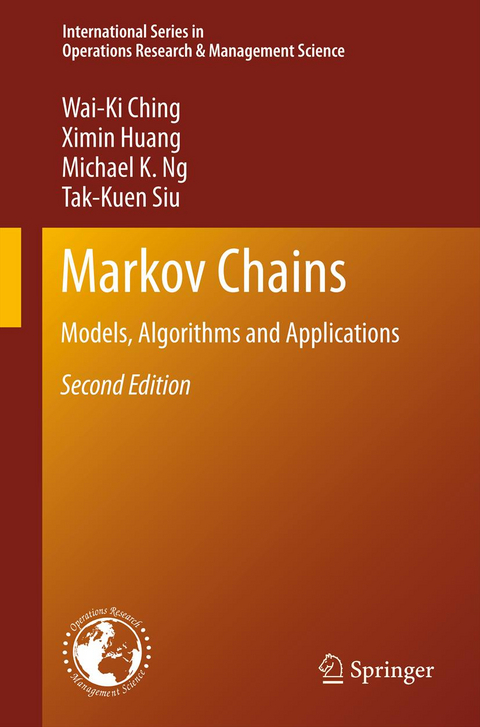
Markov Chains
Models, Algorithms and Applications
Seiten
2015
|
2nd ed. 2013
Springer-Verlag New York Inc.
978-1-4899-9752-4 (ISBN)
Springer-Verlag New York Inc.
978-1-4899-9752-4 (ISBN)
This new edition is expanded and updated, complete with end-of-chapter exercises. Outlines the recent development of Markov chain models for modeling queueing systems, manufacturing and re-manufacturing systems, inventory systems and financial risk management.
This new edition of Markov Chains: Models, Algorithms and Applications has been completely reformatted as a text, complete with end-of-chapter exercises, a new focus on management science, new applications of the models, and new examples with applications in financial risk management and modeling of financial data.
This book consists of eight chapters. Chapter 1 gives a brief introduction to the classical theory on both discrete and continuous time Markov chains. The relationship between Markov chains of finite states and matrix theory will also be highlighted. Some classical iterative methods for solving linear systems will be introduced for finding the stationary distribution of a Markov chain. The chapter then covers the basic theories and algorithms for hidden Markov models (HMMs) and Markov decision processes (MDPs).
Chapter 2 discusses the applications of continuous time Markov chains to model queueing systems and discrete time Markov chain for computing the PageRank, the ranking of websites on the Internet. Chapter 3 studies Markovian models for manufacturing and re-manufacturing systems and presents closed form solutions and fast numerical algorithms for solving the captured systems. In Chapter 4, the authors present a simple hidden Markov model (HMM) with fast numerical algorithms for estimating the model parameters. An application of the HMM for customer classification is also presented.
Chapter 5 discusses Markov decision processes for customer lifetime values. Customer Lifetime Values (CLV) is an important concept and quantity in marketing management. The authors present an approach based on Markov decision processes for the calculation of CLV using real data.
Chapter 6 considers higher-order Markov chain models, particularly a class of parsimonious higher-order Markov chain models. Efficient estimation methods for model parameters based on linear programming are presented. Contemporary research results on applications to demand predictions, inventory control and financial risk measurement are also presented. In Chapter 7, a class of parsimonious multivariate Markov models is introduced. Again, efficient estimation methods based on linear programming are presented. Applications to demand predictions, inventory control policy and modeling credit ratings data are discussed. Finally, Chapter 8 re-visits hidden Markov models, and the authors present a new class of hidden Markov models with efficient algorithms for estimating the model parameters. Applications to modeling interest rates, credit ratings and default data are discussed.
This book is aimed at senior undergraduate students, postgraduate students, professionals, practitioners, and researchers in applied mathematics, computational science, operational research, management science and finance, who are interested in the formulation and computation of queueing networks, Markov chain models and related topics. Readers are expected to have some basic knowledge of probability theory, Markov processes and matrix theory.
This new edition of Markov Chains: Models, Algorithms and Applications has been completely reformatted as a text, complete with end-of-chapter exercises, a new focus on management science, new applications of the models, and new examples with applications in financial risk management and modeling of financial data.
This book consists of eight chapters. Chapter 1 gives a brief introduction to the classical theory on both discrete and continuous time Markov chains. The relationship between Markov chains of finite states and matrix theory will also be highlighted. Some classical iterative methods for solving linear systems will be introduced for finding the stationary distribution of a Markov chain. The chapter then covers the basic theories and algorithms for hidden Markov models (HMMs) and Markov decision processes (MDPs).
Chapter 2 discusses the applications of continuous time Markov chains to model queueing systems and discrete time Markov chain for computing the PageRank, the ranking of websites on the Internet. Chapter 3 studies Markovian models for manufacturing and re-manufacturing systems and presents closed form solutions and fast numerical algorithms for solving the captured systems. In Chapter 4, the authors present a simple hidden Markov model (HMM) with fast numerical algorithms for estimating the model parameters. An application of the HMM for customer classification is also presented.
Chapter 5 discusses Markov decision processes for customer lifetime values. Customer Lifetime Values (CLV) is an important concept and quantity in marketing management. The authors present an approach based on Markov decision processes for the calculation of CLV using real data.
Chapter 6 considers higher-order Markov chain models, particularly a class of parsimonious higher-order Markov chain models. Efficient estimation methods for model parameters based on linear programming are presented. Contemporary research results on applications to demand predictions, inventory control and financial risk measurement are also presented. In Chapter 7, a class of parsimonious multivariate Markov models is introduced. Again, efficient estimation methods based on linear programming are presented. Applications to demand predictions, inventory control policy and modeling credit ratings data are discussed. Finally, Chapter 8 re-visits hidden Markov models, and the authors present a new class of hidden Markov models with efficient algorithms for estimating the model parameters. Applications to modeling interest rates, credit ratings and default data are discussed.
This book is aimed at senior undergraduate students, postgraduate students, professionals, practitioners, and researchers in applied mathematics, computational science, operational research, management science and finance, who are interested in the formulation and computation of queueing networks, Markov chain models and related topics. Readers are expected to have some basic knowledge of probability theory, Markov processes and matrix theory.
Introduction.- Manufacturing and Re-manufacturing Systems.- A Hidden Markov Model for Customer Classification.- Markov Decision Processes for Customer Lifetime Value.- Higher-order Markov Chains.- Multivariate Markov Chains.- Hidden Markov Chains.
| Reihe/Serie | International Series in Operations Research Management Science ; 189 |
|---|---|
| Zusatzinfo | XVI, 243 p. |
| Verlagsort | New York |
| Sprache | englisch |
| Maße | 155 x 235 mm |
| Themenwelt | Mathematik / Informatik ► Mathematik |
| Wirtschaft ► Allgemeines / Lexika | |
| Wirtschaft ► Betriebswirtschaft / Management ► Unternehmensführung / Management | |
| Schlagworte | decision science • markov chains • Markov Processes • mathematical finance • Operations Research • Optimization • Queueing Networks • randomness • Risk • stochastic • Uncertainty |
| ISBN-10 | 1-4899-9752-0 / 1489997520 |
| ISBN-13 | 978-1-4899-9752-4 / 9781489997524 |
| Zustand | Neuware |
| Informationen gemäß Produktsicherheitsverordnung (GPSR) | |
| Haben Sie eine Frage zum Produkt? |
Mehr entdecken
aus dem Bereich



aus dem Bereich
warum etablierte Unternehmen den Wettbewerb um bahnbrechende …
Buch | Softcover (2025)
Vahlen (Verlag)
CHF 48,85
wie Teams funktionieren und wann sie effektiv arbeiten
Buch | Softcover (2024)
Vahlen (Verlag)
CHF 45,95
wie man Menschen wirklich weiterbringt
Buch | Softcover (2024)
Vahlen (Verlag)
CHF 37,65


