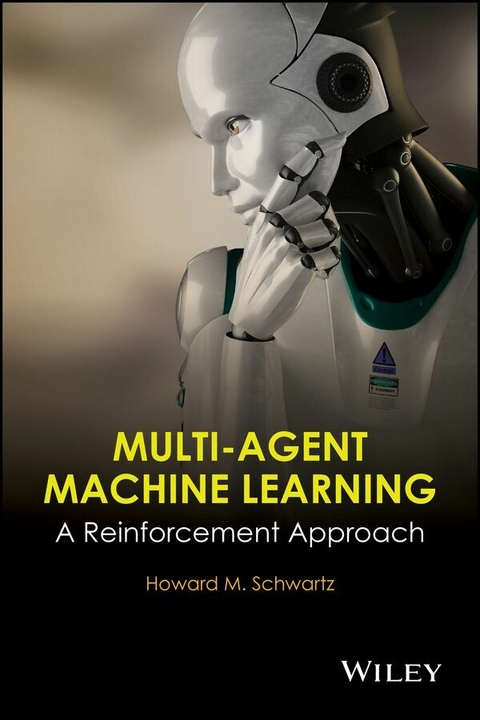
Multi-Agent Machine Learning (eBook)
John Wiley & Sons (Verlag)
978-1-118-88447-8 (ISBN)
The book begins with a chapter on traditional methods of supervised learning, covering recursive least squares learning, mean square error methods, and stochastic approximation. Chapter 2 covers single agent reinforcement learning. Topics include learning value functions, Markov games, and TD learning with eligibility traces. Chapter 3 discusses two player games including two player matrix games with both pure and mixed strategies. Numerous algorithms and examples are presented. Chapter 4 covers learning in multi-player games, stochastic games, and Markov games, focusing on learning multi-player grid games-two player grid games, Q-learning, and Nash Q-learning. Chapter 5 discusses differential games, including multi player differential games, actor critique structure, adaptive fuzzy control and fuzzy interference systems, the evader pursuit game, and the defending a territory games. Chapter 6 discusses new ideas on learning within robotic swarms and the innovative idea of the evolution of personality traits.
• Framework for understanding a variety of methods and approaches in multi-agent machine learning.
• Discusses methods of reinforcement learning such as a number of forms of multi-agent Q-learning
• Applicable to research professors and graduate students studying electrical and computer engineering, computer science, and mechanical and aerospace engineering
Howard M. Schwartz, PhD, received his B.Eng. Degree from McGill University, Montreal, Canada in une 1981 and his MS Degree and PhD Degree from MIT, Cambridge, USA in 1982 and 1987 respectively. He is currently a professor in systems and computer engineering at Carleton University, Canada. His research interests include adaptive and intelligent control systems, robotic, artificial intelligence, system modelling, system identification, and state estimation.
The book begins with a chapter on traditional methods of supervised learning, covering recursive least squares learning, mean square error methods, and stochastic approximation. Chapter 2 covers single agent reinforcement learning. Topics include learning value functions, Markov games, and TD learning with eligibility traces. Chapter 3 discusses two player games including two player matrix games with both pure and mixed strategies. Numerous algorithms and examples are presented. Chapter 4 covers learning in multi-player games, stochastic games, and Markov games, focusing on learning multi-player grid games two player grid games, Q-learning, and Nash Q-learning. Chapter 5 discusses differential games, including multi player differential games, actor critique structure, adaptive fuzzy control and fuzzy interference systems, the evader pursuit game, and the defending a territory games. Chapter 6 discusses new ideas on learning within robotic swarms and the innovative idea of the evolution of personality traits. Framework for understanding a variety of methods and approaches in multi-agent machine learning. Discusses methods of reinforcement learning such as a number of forms of multi-agent Q-learning Applicable to research professors and graduate students studying electrical and computer engineering, computer science, and mechanical and aerospace engineering
Howard M. Schwartz, PhD, received his B.Eng. Degree from McGill University, Montreal, Canada in une 1981 and his MS Degree and PhD Degree from MIT, Cambridge, USA in 1982 and 1987 respectively. He is currently a professor in systems and computer engineering at Carleton University, Canada. His research interests include adaptive and intelligent control systems, robotic, artificial intelligence, system modelling, system identification, and state estimation.
"This is an interesting book both as research reference as well as teaching material for Master and PhD students." (Zentralblatt MATH, 1 April 2015)
| Erscheint lt. Verlag | 25.8.2014 |
|---|---|
| Sprache | englisch |
| Themenwelt | Informatik ► Theorie / Studium ► Künstliche Intelligenz / Robotik |
| Technik ► Elektrotechnik / Energietechnik | |
| Schlagworte | Computational & Graphical Statistics • Drahtlose Kommunikation • Electrical & Electronics Engineering • Elektrotechnik u. Elektronik • Intelligente Systeme u. Agenten • Intelligent Systems & Agents • Maschinelles Lernen • Mobile & Wireless Communications • Multi-Agent Machine Learnings, Mobile Robotics, Multi-Agent Systems, Game Theoretics, Single-Agent Reinforcement Learning, Multi-Agent Q-Learning, Learning Differential Games, Learning in Robotic Swarms • Rechnergestützte u. graphische Statistik • Rechnergestützte u. graphische Statistik • Statistics • Statistik |
| ISBN-10 | 1-118-88447-7 / 1118884477 |
| ISBN-13 | 978-1-118-88447-8 / 9781118884478 |
| Informationen gemäß Produktsicherheitsverordnung (GPSR) | |
| Haben Sie eine Frage zum Produkt? |
 PDF (Adobe DRM)
Kopierschutz: Adobe-DRM
Adobe-DRM ist ein Kopierschutz, der das eBook vor Mißbrauch schützen soll. Dabei wird das eBook bereits beim Download auf Ihre persönliche Adobe-ID autorisiert. Lesen können Sie das eBook dann nur auf den Geräten, welche ebenfalls auf Ihre Adobe-ID registriert sind.
Details zum Adobe-DRM
Dateiformat: PDF (Portable Document Format)
Mit einem festen Seitenlayout eignet sich die PDF besonders für Fachbücher mit Spalten, Tabellen und Abbildungen. Eine PDF kann auf fast allen Geräten angezeigt werden, ist aber für kleine Displays (Smartphone, eReader) nur eingeschränkt geeignet.
Systemvoraussetzungen:
PC/Mac: Mit einem PC oder Mac können Sie dieses eBook lesen. Sie benötigen eine
eReader: Dieses eBook kann mit (fast) allen eBook-Readern gelesen werden. Mit dem amazon-Kindle ist es aber nicht kompatibel.
Smartphone/Tablet: Egal ob Apple oder Android, dieses eBook können Sie lesen. Sie benötigen eine
Geräteliste und zusätzliche Hinweise
Buying eBooks from abroad
For tax law reasons we can sell eBooks just within Germany and Switzerland. Regrettably we cannot fulfill eBook-orders from other countries.
aus dem Bereich