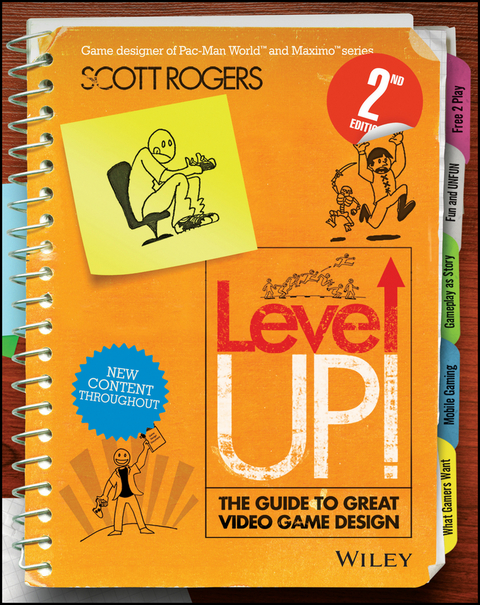
Level Up! The Guide to Great Video Game Design (eBook)
John Wiley & Sons (Verlag)
978-1-118-87719-7 (ISBN)
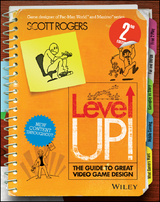
Want to design your own video games? Let expert Scott Rogers show you how!
If you want to design and build cutting-edge video games but aren’t sure where to start, then the SECOND EDITION of the acclaimed Level Up! is for you! Written by leading video game expert Scott Rogers, who has designed the hits Pac Man World, Maximo and SpongeBob Squarepants, this updated edition provides clear and well-thought out examples that forgo theoretical gobbledygook with charmingly illustrated concepts and solutions based on years of professional experience.
Level Up! 2nd Edition has been NEWLY EXPANDED to teach you how to develop marketable ideas, learn what perils and pitfalls await during a game’s pre-production, production and post-production stages, and provide even more creative ideas to serve as fuel for your own projects including:
- Developing your game design from the spark of inspiration all the way to production
- Learning how to design the most exciting levels, the most precise controls, and the fiercest foes that will keep your players challenged
- Creating games for mobile and console systems – including detailed rules for touch and motion controls
- Monetizing your game from the design up
- Writing effective and professional design documents with the help of brand new examples
Level Up! 2nd Edition is includes all-new content, an introduction by David “God of War” Jaffe and even a brand-new chili recipe –making it an even more indispensable guide for video game designers both “in the field” and the classroom.
Grab your copy of Level Up! 2nd Edition and let’s make a game!
Want to design your own video games? Let expert Scott Rogers show you how! If you want to design and build cutting-edge video games but aren t sure where to start, then the SECOND EDITION of the acclaimed Level Up! is for you! Written by leading video game expert Scott Rogers, who has designed the hits Pac Man World, Maximo and SpongeBob Squarepants, this updated edition provides clear and well-thought out examples that forgo theoretical gobbledygook with charmingly illustrated concepts and solutions based on years of professional experience. Level Up! 2nd Edition has been NEWLY EXPANDED to teach you how to develop marketable ideas, learn what perils and pitfalls await during a game s pre-production, production and post-production stages, and provide even more creative ideas to serve as fuel for your own projects including: Developing your game design from the spark of inspiration all the way to production Learning how to design the most exciting levels, the most precise controls, and the fiercest foes that will keep your players challenged Creating games for mobile and console systems including detailed rules for touch and motion controls Monetizing your game from the design up Writing effective and professional design documents with the help of brand new examples Level Up! 2nd Edition is includes all-new content, an introduction by David God of War Jaffe and even a brand-new chili recipe making it an even more indispensable guide for video game designers both in the field and the classroom. Grab your copy of Level Up! 2nd Edition and let s make a game!
Scott Rogers (Thousand Oaks, CA) is a Principal Imagineer at Walt Disney. After deciding that game designers have more fun, Scott embarked on a career creating game designs for a number of successful titles including Sony's GOD OF WAR, Capcom's MAXIMO: GHOSTS TO GLORY and its sequel MAXIMO VS. ARMY OF ZIN, Namco's PAC-MAN WORLD and THQ's DRAWN TO LIFE series. He lives in Thousand Oaks with his family and a large collection of video games.
Press Start!
If You Are Anything Like Me …
… YOU READ THE first page of a book before you buy it. I find that if I like the first page, I’ll probably like the whole thing. I have noticed that many books have an exciting excerpt on the first page in order to grab the reader’s interest, such as:
The skeleton dragon grabbed the helicopter with bony talons and shook it so hard that Jack’s teeth rattled. Evelyn fought at the controls, attempting any maneuver that would free the copter from beast’s unyielding clutches. “Hang on!” she screamed over the engine’s tortured whine. “We’re going down!” The world whirled around and around as the copter and dragon performed a death waltz. Jack didn’t remember the copter slamming hard into the skyscraper or the crash or the dragon’s bones raining down or being thrown from the wreckage—until Evelyn shook him into consciousness. “Jack! Jack!” she said. “We need to move. Now!” “What’s the hurry, Sis? That dragon’s toast.” Then his eyes finally focused. On the cemetery gate. On the crooked gravestones. On the zombies pulling themselves from the dirt. Jack thought, “Nuts. I should have never opened that book.”
Not that I would ever resort to such cheap tactics in this book. I have also noticed that some books try to gain respectability by publishing a positive quote from an industry professional or famous person on their first page:
I learned more from reading the first page of the second edition of Level Up! The Book of Great Video Game Design than I learned from working for 25 years in the video game industry!
–A very famous game designer1
You obviously don’t need someone else to tell you how to make up your mind. Just by picking up this book, I can tell you are a discriminating reader. I can also tell you are seeking the straight truth on the creation of video games. This book will teach you the who, what, where and, most importantly, how to design video games. If you have an interest in arcade games, boss fights, chili, deadly traps, ergonomics, fun, giant hydras, haunted mansions, islands and alleys, jumps, killer bunnies, leitmotifs, Mexican pizza, non-player characters, one-sheet designs, pitch sessions, quests, robotic chickens, smart bombs, the triangle of weirdness, un-fun, violence, whack-a-mole, XXX, Y-axis and zombies, then this is the book for you.
Before we start, keep in mind that there are many ways to approach game design. All of them are valid, as long as they can communicate the designer’s ideas. The tricks and techniques found in this second edition of Level Up! are MY WAYS of creating game design.
Another quick reminder: when I say “I designed a game,” this is an oversimplification. Video games are created by many, many, many talented people (you’ll be introduced to them shortly) and to give the impression that I did all the work myself is not only incorrect but egotistical.2 There is no “I” in team.3
The majority of the games I’ve helped design were single player action games, so many of the examples found in this edition of Level Up! are skewed towards that perspective. It’s just the way I think. But I have also found that most of the gameplay concepts are transferable to many different genres of games. It won’t be too hard for you to translate my advice to your own game, no matter what the genre.
Another thing before we get started. If you are looking for a single chapter about gameplay, don’t bother. Because EVERY chapter in this book is about gameplay. You should be thinking about gameplay all the time and how things affect the player, even when designing passive elements like cutscenes, monetization models, and pause screens.
Since you have made it this far, I may as well start by actually telling you the bad news first. Making video games is very hard work.4 I have worked in video games for over 20 years and on games that have sold millions of copies.
But in that time, I have learned that making video games is also the best job in the world. It can be thrilling, frustrating, rewarding, nerve-wracking, hectic, boring, vomit-inducing, and just plain fun.
No, You Can’t Have My Job
Over the course of my career, I came up with some Clever Ideas and learned some Universal Truths. For your convenience, I have added these at the end of each “level.”
I also learned a couple of very important things. You can tell they are very important because they are written in all uppercase letters. The first very important thing I learned was:
GAME DESIGNERS HAVE MORE FUN
I know this, because my first job in the video game industry was as an artist.5 Back in those 16-bit days, video game artists drew images with pixels. There are several great 16-bit artists, like Paul Robertson and the teams that made the Metal Slug and classic Capcom fighting games; but for me, drawing pictures out of pixels is like drawing with bathroom tiles. Here is what a drawing I made out of pixels looks like:
Anyway, as I was “pushing pixels” I heard the sound of raucous laughter coming from the group of cubicles next to mine. I peered over the wall to see a bunch of video game designers yukking it up and have a good ol’ time. For the record, I was not having a good ol’ time pushing pixels. I realized, “Those game designers are having more fun than I am! Making video games should be fun! I want to have fun! I want to become a game designer too!” And so I did. I eventually worked my way up the ladder to become a game designer. After I became a real game designer, I learned the second very important thing:
NO ONE ON YOUR TEAM WANTS TO READ YOUR DESIGN DOCUMENT
This is a horrible thing to discover, but it is something every game designer needs to hear. Here I was, a brand new game designer with brand new game designs ready to go, and no one wanted to read any of them! What was I to do? In order to solve this problem and get my colleagues to read my design documents, I started drawing them as cartoons. And guess what? It worked. They conveyed the ideas I wanted to get across to my teammates. And I’ve been designing games this way ever since, many of which have gone on to become top-selling titles. That is why you will find many cartoons, so you will continue reading and understand the ideas presented. If you do, then you can apply them to your own design and become a great designer, too.
Who Is This Book For?
Why you, of course. Provided you are one of the following people.
A working video games professional. There are lots of books about video game design, but most of them are full of THEORY, which I have never found very helpful while making a game. Don’t get me wrong, theory is great when you are at a game developers conference or one of those wine and cheese affairs we game designers always find ourselves at. But when I am working on a game, with my sleeves rolled up and blood splattered all over the walls,6 I need practical nuts n’ bolts advice on how to solve any problems I may encounter. I mention this because I assume that some of you reading this second edition of Level Up! will be experienced video game professionals. I hope you find the techniques and tips in this book useful in your day-to-day work. Not that this book doesn’t have uses for beginners.
I’m talking about you, future video game designers. Remember, one page ago when I told you I was a pixel pusher? There was a point to that story, which is I was just like you. Maybe you’re also an artist who is tired of hearing the game designers laughing it up over in the other office. Or a programmer who knows he can design a better enemy encounter than the knucklehead currently doing it on your game. Or maybe you are a tester who wants to move up in the world, but you don’t know how to do it. When I wanted to become a video game designer, there weren’t any books on the subject. We had to learn everything from other game designers. I was lucky to have a mentor and an opportunity to work as a game designer. If you don’t have either of these things, don’t fret. Read this book; I will be your mentor. All you need to do is follow my advice, be prepared, and take advantage of the opportunity when it finally arrives.
This book is also great for students of video game design. Back when I started making games, I didn’t take any classes on video game design—because they didn’t exist! I just made stuff up as I went along! And I made a lot of mistakes. This is why I wrote this book: so you can learn from all my mistakes before they become your mistakes too.
Finally, this book is for anyone who loves video games. I love video games. I love to play them. I love to make them and I love to read about making them. If you want to make video games, then you must love them too. Ironically, I know several people who work in video games that freely admit they do not like to play video games. That does not make any sense to me. Why would you work in video games if you do not love video games? They are fools. They should just step aside and let someone who loves video games make video games. Someone like...
| Erscheint lt. Verlag | 16.4.2014 |
|---|---|
| Sprache | englisch |
| Themenwelt | Mathematik / Informatik ► Informatik ► Programmiersprachen / -werkzeuge |
| Informatik ► Software Entwicklung ► Spieleprogrammierung | |
| Schlagworte | 1st person • Arcade • Attack • Bandai • Character • characters • Computer Science • context-sensitive prompts • Design • Enemy • Game • Informatik • Ion • Level • massively multiplayer online • memorial mapping • MMO • Mortal Kombat • music • Namco • players • Playstation • Programmierung u. Software-Entwicklung • Programming & Software Development • Spieleprogrammierung • Story • video games • World |
| ISBN-10 | 1-118-87719-5 / 1118877195 |
| ISBN-13 | 978-1-118-87719-7 / 9781118877197 |
| Informationen gemäß Produktsicherheitsverordnung (GPSR) | |
| Haben Sie eine Frage zum Produkt? |
 EPUB (Adobe DRM)
Kopierschutz: Adobe-DRM
Adobe-DRM ist ein Kopierschutz, der das eBook vor Mißbrauch schützen soll. Dabei wird das eBook bereits beim Download auf Ihre persönliche Adobe-ID autorisiert. Lesen können Sie das eBook dann nur auf den Geräten, welche ebenfalls auf Ihre Adobe-ID registriert sind.
Details zum Adobe-DRM
Dateiformat: EPUB (Electronic Publication)
EPUB ist ein offener Standard für eBooks und eignet sich besonders zur Darstellung von Belletristik und Sachbüchern. Der Fließtext wird dynamisch an die Display- und Schriftgröße angepasst. Auch für mobile Lesegeräte ist EPUB daher gut geeignet.
Systemvoraussetzungen:
PC/Mac: Mit einem PC oder Mac können Sie dieses eBook lesen. Sie benötigen eine
eReader: Dieses eBook kann mit (fast) allen eBook-Readern gelesen werden. Mit dem amazon-Kindle ist es aber nicht kompatibel.
Smartphone/Tablet: Egal ob Apple oder Android, dieses eBook können Sie lesen. Sie benötigen eine
Geräteliste und zusätzliche Hinweise
Buying eBooks from abroad
For tax law reasons we can sell eBooks just within Germany and Switzerland. Regrettably we cannot fulfill eBook-orders from other countries.
aus dem Bereich