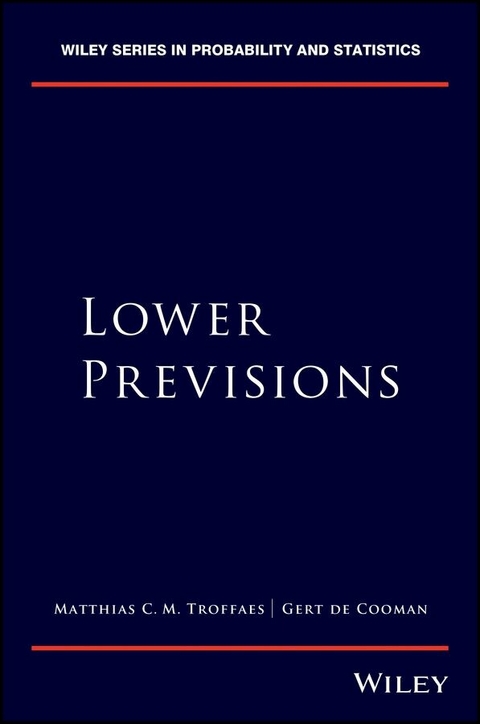
Lower Previsions (eBook)
John Wiley & Sons (Verlag)
978-1-118-76113-7 (ISBN)
This book has two main purposes. On the one hand, it provides a
concise and systematic development of the theory of lower previsions,
based on the concept of acceptability, in spirit of the work of
Williams and Walley. On the other hand, it also extends this theory to
deal with unbounded quantities, which abound in practical
applications.
Following Williams, we start out with sets of acceptable gambles. From
those, we derive rationality criteria---avoiding sure loss and
coherence---and inference methods---natural extension---for
(unconditional) lower previsions. We then proceed to study various
aspects of the resulting theory, including the concept of expectation
(linear previsions), limits, vacuous models, classical propositional
logic, lower oscillations, and monotone convergence. We discuss
n-monotonicity for lower previsions, and relate lower previsions with
Choquet integration, belief functions, random sets, possibility
measures, various integrals, symmetry, and representation theorems
based on the Bishop-De Leeuw theorem.
Next, we extend the framework of sets of acceptable gambles to consider
also unbounded quantities. As before, we again derive rationality
criteria and inference methods for lower previsions, this time also
allowing for conditioning. We apply this theory to construct
extensions of lower previsions from bounded random quantities to a
larger set of random quantities, based on ideas borrowed from the
theory of Dunford integration.
A first step is to extend a lower prevision to random quantities that
are bounded on the complement of a null set (essentially bounded
random quantities). This extension is achieved by a natural extension
procedure that can be motivated by a rationality axiom stating that
adding null random quantities does not affect acceptability.
In a further step, we approximate unbounded random quantities by a
sequences of bounded ones, and, in essence, we identify those for
which the induced lower prevision limit does not depend on the details
of the approximation. We call those random quantities 'previsible'. We
study previsibility by cut sequences, and arrive at a simple
sufficient condition. For the 2-monotone case, we establish a Choquet
integral representation for the extension. For the general case, we
prove that the extension can always be written as an envelope of
Dunford integrals. We end with some examples of the theory.
This book has two main purposes. On the one hand, it provides aconcise and systematic development of the theory of lower previsions,based on the concept of acceptability, in spirit of the work ofWilliams and Walley. On the other hand, it also extends this theory todeal with unbounded quantities, which abound in practicalapplications. Following Williams, we start out with sets of acceptable gambles. Fromthose, we derive rationality criteria---avoiding sure loss andcoherence---and inference methods---natural extension---for(unconditional) lower previsions. We then proceed to study variousaspects of the resulting theory, including the concept of expectation(linear previsions), limits, vacuous models, classical propositionallogic, lower oscillations, and monotone convergence. We discussn-monotonicity for lower previsions, and relate lower previsions withChoquet integration, belief functions, random sets, possibilitymeasures, various integrals, symmetry, and representation theoremsbased on the Bishop-De Leeuw theorem. Next, we extend the framework of sets of acceptable gambles to consideralso unbounded quantities. As before, we again derive rationalitycriteria and inference methods for lower previsions, this time alsoallowing for conditioning. We apply this theory to constructextensions of lower previsions from bounded random quantities to alarger set of random quantities, based on ideas borrowed from thetheory of Dunford integration. A first step is to extend a lower prevision to random quantities thatare bounded on the complement of a null set (essentially boundedrandom quantities). This extension is achieved by a natural extensionprocedure that can be motivated by a rationality axiom stating thatadding null random quantities does not affect acceptability. In a further step, we approximate unbounded random quantities by asequences of bounded ones, and, in essence, we identify those forwhich the induced lower prevision limit does not depend on the detailsof the approximation. We call those random quantities 'previsible'. Westudy previsibility by cut sequences, and arrive at a simplesufficient condition. For the 2-monotone case, we establish a Choquetintegral representation for the extension. For the general case, weprove that the extension can always be written as an envelope ofDunford integrals. We end with some examples of the theory.
Matthias Troffaes, Department of Mathematical Sciences, Durham University, UK Since gaining his PhD, Dr Troffaes has conducted research in Belgium and the US in imprecise probabilities, before becoming a lecturer in statistics at Durham. He has published papers in a variety of journals, and written two book chapters. Gert de Cooman, SYSTeMS Research Group, Ghent University, Belgium With many years' research and teaching experience, Professor de Cooman serves/has served on the Editorial Boards of many statistical journals. He has published over 40 journal articles, and is an editor of the Imprecise Probabilities Project. He has also written chapters for six books, and has co-edited four.
| Erscheint lt. Verlag | 9.4.2014 |
|---|---|
| Reihe/Serie | Wiley Series in Probability and Statistics |
| Wiley Series in Probability and Statistics | Wiley Series in Probability and Statistics |
| Sprache | englisch |
| Themenwelt | Mathematik / Informatik ► Mathematik ► Statistik |
| Mathematik / Informatik ► Mathematik ► Wahrscheinlichkeit / Kombinatorik | |
| Technik | |
| Schlagworte | Angew. Wahrscheinlichkeitsrechn. u. Statistik / Modelle • Applied Probability & Statistics - Models • Electrical & Electronics Engineering • Elektrotechnik u. Elektronik • Gert de Cooman • Lower Previsions • lower, upper and linear previsions • Matthias C. M. Troffaes • Probability & Mathematical Statistics • Qualität u. Zuverlässigkeit • Qualität u. Zuverlässigkeit • Quality & Reliability • Statistics • Statistik • Wahrscheinlichkeitsrechnung • Wahrscheinlichkeitsrechnung u. mathematische Statistik |
| ISBN-10 | 1-118-76113-8 / 1118761138 |
| ISBN-13 | 978-1-118-76113-7 / 9781118761137 |
| Informationen gemäß Produktsicherheitsverordnung (GPSR) | |
| Haben Sie eine Frage zum Produkt? |
 EPUB (Adobe DRM)
Kopierschutz: Adobe-DRM
Adobe-DRM ist ein Kopierschutz, der das eBook vor Mißbrauch schützen soll. Dabei wird das eBook bereits beim Download auf Ihre persönliche Adobe-ID autorisiert. Lesen können Sie das eBook dann nur auf den Geräten, welche ebenfalls auf Ihre Adobe-ID registriert sind.
Details zum Adobe-DRM
Dateiformat: EPUB (Electronic Publication)
EPUB ist ein offener Standard für eBooks und eignet sich besonders zur Darstellung von Belletristik und Sachbüchern. Der Fließtext wird dynamisch an die Display- und Schriftgröße angepasst. Auch für mobile Lesegeräte ist EPUB daher gut geeignet.
Systemvoraussetzungen:
PC/Mac: Mit einem PC oder Mac können Sie dieses eBook lesen. Sie benötigen eine
eReader: Dieses eBook kann mit (fast) allen eBook-Readern gelesen werden. Mit dem amazon-Kindle ist es aber nicht kompatibel.
Smartphone/Tablet: Egal ob Apple oder Android, dieses eBook können Sie lesen. Sie benötigen eine
Geräteliste und zusätzliche Hinweise
Buying eBooks from abroad
For tax law reasons we can sell eBooks just within Germany and Switzerland. Regrettably we cannot fulfill eBook-orders from other countries.
aus dem Bereich