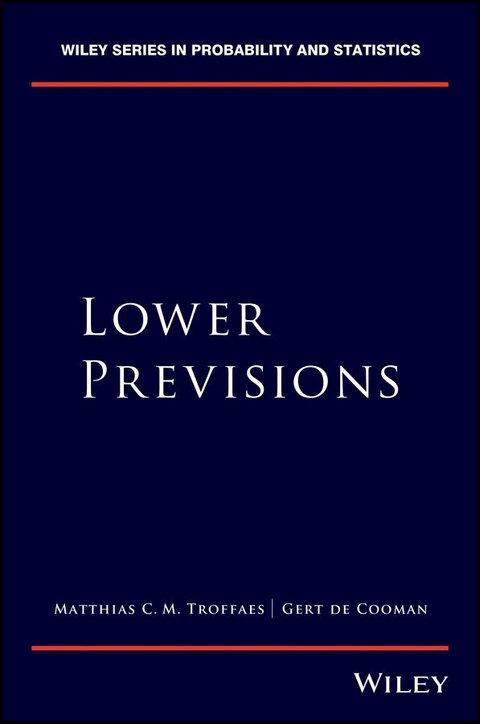
Lower Previsions (eBook)
John Wiley & Sons (Verlag)
978-1-118-76264-6 (ISBN)
This book has two main purposes. On the one hand, it provides a
concise and systematic development of the theory of lower previsions,
based on the concept of acceptability, in spirit of the work of
Williams and Walley. On the other hand, it also extends this theory to
deal with unbounded quantities, which abound in practical
applications.
Following Williams, we start out with sets of acceptable gambles. From
those, we derive rationality criteria---avoiding sure loss and
coherence---and inference methods---natural extension---for
(unconditional) lower previsions. We then proceed to study various
aspects of the resulting theory, including the concept of expectation
(linear previsions), limits, vacuous models, classical propositional
logic, lower oscillations, and monotone convergence. We discuss
n-monotonicity for lower previsions, and relate lower previsions with
Choquet integration, belief functions, random sets, possibility
measures, various integrals, symmetry, and representation theorems
based on the Bishop-De Leeuw theorem.
Next, we extend the framework of sets of acceptable gambles to consider
also unbounded quantities. As before, we again derive rationality
criteria and inference methods for lower previsions, this time also
allowing for conditioning. We apply this theory to construct
extensions of lower previsions from bounded random quantities to a
larger set of random quantities, based on ideas borrowed from the
theory of Dunford integration.
A first step is to extend a lower prevision to random quantities that
are bounded on the complement of a null set (essentially bounded
random quantities). This extension is achieved by a natural extension
procedure that can be motivated by a rationality axiom stating that
adding null random quantities does not affect acceptability.
In a further step, we approximate unbounded random quantities by a
sequences of bounded ones, and, in essence, we identify those for
which the induced lower prevision limit does not depend on the details
of the approximation. We call those random quantities 'previsible'. We
study previsibility by cut sequences, and arrive at a simple
sufficient condition. For the 2-monotone case, we establish a Choquet
integral representation for the extension. For the general case, we
prove that the extension can always be written as an envelope of
Dunford integrals. We end with some examples of the theory.
Matthias Troffaes, Department of Mathematical Sciences, Durham University, UK
Since gaining his PhD, Dr Troffaes has conducted research in Belgium and the US in imprecise probabilities, before becoming a lecturer in statistics at Durham. He has published papers in a variety of journals, and written two book chapters.
Gert de Cooman, SYSTeMS Research Group, Ghent University, Belgium
With many years' research and teaching experience, Professor de Cooman serves/has served on the Editorial Boards of many statistical journals. He has published over 40 journal articles, and is an editor of the Imprecise Probabilities Project. He has also written chapters for six books, and has co-edited four.
This book has two main purposes. On the one hand, it provides aconcise and systematic development of the theory of lower previsions,based on the concept of acceptability, in spirit of the work ofWilliams and Walley. On the other hand, it also extends this theory todeal with unbounded quantities, which abound in practicalapplications. Following Williams, we start out with sets of acceptable gambles. Fromthose, we derive rationality criteria---avoiding sure loss andcoherence---and inference methods---natural extension---for(unconditional) lower previsions. We then proceed to study variousaspects of the resulting theory, including the concept of expectation(linear previsions), limits, vacuous models, classical propositionallogic, lower oscillations, and monotone convergence. We discussn-monotonicity for lower previsions, and relate lower previsions withChoquet integration, belief functions, random sets, possibilitymeasures, various integrals, symmetry, and representation theoremsbased on the Bishop-De Leeuw theorem. Next, we extend the framework of sets of acceptable gambles to consideralso unbounded quantities. As before, we again derive rationalitycriteria and inference methods for lower previsions, this time alsoallowing for conditioning. We apply this theory to constructextensions of lower previsions from bounded random quantities to alarger set of random quantities, based on ideas borrowed from thetheory of Dunford integration. A first step is to extend a lower prevision to random quantities thatare bounded on the complement of a null set (essentially boundedrandom quantities). This extension is achieved by a natural extensionprocedure that can be motivated by a rationality axiom stating thatadding null random quantities does not affect acceptability. In a further step, we approximate unbounded random quantities by asequences of bounded ones, and, in essence, we identify those forwhich the induced lower prevision limit does not depend on the detailsof the approximation. We call those random quantities 'previsible'. Westudy previsibility by cut sequences, and arrive at a simplesufficient condition. For the 2-monotone case, we establish a Choquetintegral representation for the extension. For the general case, weprove that the extension can always be written as an envelope ofDunford integrals. We end with some examples of the theory.
Matthias Troffaes, Department of Mathematical Sciences, Durham University, UK Since gaining his PhD, Dr Troffaes has conducted research in Belgium and the US in imprecise probabilities, before becoming a lecturer in statistics at Durham. He has published papers in a variety of journals, and written two book chapters. Gert de Cooman, SYSTeMS Research Group, Ghent University, Belgium With many years' research and teaching experience, Professor de Cooman serves/has served on the Editorial Boards of many statistical journals. He has published over 40 journal articles, and is an editor of the Imprecise Probabilities Project. He has also written chapters for six books, and has co-edited four.
Cover 1
Title Page 5
Copyright 6
Contents 9
Preface 17
Acknowledgements 19
Chapter 1 Preliminary notions and definitions 21
1.1 Sets of numbers 21
1.2 Gambles 22
1.3 Subsets and their indicators 25
1.4 Collections of events 25
1.5 Directed sets and Moore-Smith limits 27
1.6 Uniform convergence of bounded gambles 29
1.7 Set functions, charges and measures 30
1.8 Measurability and simple gambles 32
1.9 Real functionals 37
1.10 A useful lemma 39
Part I Lower Previsions On Bounded Gambles 41
Chapter 2 Introduction 43
Chapter 3 Sets of acceptable bounded gambles 45
3.1 Random variables 46
3.2 Belief and behaviour 47
3.3 Bounded gambles 48
3.4 Sets of acceptable bounded gambles 49
3.4.1 Rationality criteria 49
3.4.2 Inference 52
Chapter 4 Lower previsions 57
4.1 Lower and upper previsions 58
4.1.1 From sets of acceptable bounded gambles to lower previsions 58
4.1.2 Lower and upper previsions directly 60
4.2 Consistency for lower previsions 61
4.2.1 Definition and justification 61
4.2.2 A more direct justification for the avoiding sure loss condition 64
4.2.3 Avoiding sure loss and avoiding partial loss 65
4.2.4 Illustrating the avoiding sure loss condition 65
4.2.5 Consequences of avoiding sure loss 66
4.3 Coherence for lower previsions 66
4.3.1 Definition and justification 66
4.3.2 A more direct justification for the coherence condition 70
4.3.3 Illustrating the coherence condition 71
4.3.4 Linear previsions 71
4.4 Properties of coherent lower previsions 73
4.4.1 Interesting consequences of coherence 73
4.4.2 Coherence and conjugacy 76
4.4.3 Easier ways to prove coherence 76
4.4.4 Coherence and monotone convergence 83
4.4.5 Coherence and a seminorm 84
4.5 The natural extension of a lower prevision 85
4.5.1 Natural extension as least-committal extension 85
4.5.2 Natural extension and equivalence 86
4.5.3 Natural extension to a specific domain 86
4.5.4 Transitivity of natural extension 87
4.5.5 Natural extension and avoiding sure loss 87
4.5.6 Simpler ways of calculating the natural extension 89
4.6 Alternative characterisations for avoiding sure loss, coherence, and natural extension 90
4.7 Topological considerations 94
Chapter 5 Special coherent lower previsions 96
5.1 Linear previsions on finite spaces 97
5.2 Coherent lower previsions on finite spaces 98
5.3 Limits as linear previsions 100
5.4 Vacuous lower previsions 101
5.5 {0,1}-valued lower probabilities 102
5.5.1 Coherence and natural extension 102
5.5.2 The link with classical propositional logic 108
5.5.3 The link with limits inferior 110
5.5.4 Monotone convergence 111
5.5.5 Lower oscillations and neighbourhood filters 113
5.5.6 Extending a lower prevision defined on all continuous bounded gambles 118
Chapter 6 n-Monotone lower previsions 121
6.1 n-Monotonicity 122
6.2 n-Monotonicity and coherence 127
6.2.1 A few observations 127
6.2.2 Results for lower probabilities 129
6.3 Representation results 133
Chapter 7 Special n-monotone coherent lower previsions 142
7.1 Lower and upper mass functions 143
7.2 Minimum preserving lower previsions 147
7.2.1 Definition and properties 147
7.2.2 Vacuous lower previsions 148
7.3 Belief functions 148
7.4 Lower previsions associated with proper filters 149
7.5 Induced lower previsions 151
7.5.1 Motivation 151
7.5.2 Induced lower previsions 153
7.5.3 Properties of induced lower previsions 154
7.6 Special cases of induced lower previsions 158
7.6.1 Belief functions 159
7.6.2 Refining the set of possible values for a random variable 159
7.7 Assessments on chains of sets 162
7.8 Possibility and necessity measures 163
7.9 Distribution functions and probability boxes 167
7.9.1 Distribution functions 167
7.9.2 Probability boxes 169
Chapter 8 Linear previsions, integration and duality 171
8.1 Linear extension and integration 173
8.2 Integration of probability charges 179
8.3 Inner and outer set function, completion and other extensions 183
8.4 Linear previsions and probability charges 186
8.5 The S-integral 188
8.6 The Lebesgue integral 191
8.7 The Dunford integral 192
8.8 Consequences of duality 197
Chapter 9 Examples of linear extension 201
9.1 Distribution functions 201
9.2 Limits inferior 202
9.3 Lower and upper oscillations 203
9.4 Linear extension of a probability measure 203
9.5 Extending a linear prevision from continuous bounded gambles 207
9.6 Induced lower previsions and random sets 208
Chapter 10 Lower previsions and symmetry 211
10.1 Invariance for lower previsions 212
10.1.1 Definition 212
10.1.2 Existence of invariant lower previsions 214
10.1.3 Existence of strongly invariant lower previsions 215
10.2 An important special case 220
10.3 Interesting examples 225
10.3.1 Permutation invariance on finite spaces 225
10.3.2 Shift invariance and Banach limits 228
10.3.3 Stationary random processes 230
Chapter 11 Extreme lower previsions 234
11.1 Preliminary results concerning real functionals 235
11.2 Inequality preserving functionals 237
11.2.1 Definition 237
11.2.2 Linear functionals 237
11.2.3 Monotone functionals 238
11.2.4 n-Monotone functionals 238
11.2.5 Coherent lower previsions 239
11.2.6 Combinations 240
11.3 Properties of inequality preserving functionals 240
11.4 Infinite non-negative linear combinations of inequality preserving functionals 241
11.4.1 Definition 241
11.4.2 Examples 242
11.4.3 Main result 243
11.5 Representation results 244
11.6 Lower previsions associated with proper filters 245
11.6.1 Belief functions 245
11.6.2 Possibility measures 246
11.6.3 Extending a linear prevision defined on all continuous bounded gambles 246
11.6.4 The connection with induced lower previsions 247
11.7 Strongly invariant coherent lower previsions 248
Part II Extending the Theory to Unbounded Gambles 251
Chapter 12 Introduction 253
Chapter 13 Conditional lower previsions 255
13.1 Gambles 256
13.2 Sets of acceptable gambles 256
13.2.1 Rationality criteria 256
13.2.2 Inference 258
13.3 Conditional lower previsions 260
13.3.1 Going from sets of acceptable gambles to conditional lower previsions 260
13.3.2 Conditional lower previsions directly 272
13.4 Consistency for conditional lower previsions 274
13.4.1 Definition and justification 274
13.4.2 Avoiding sure loss and avoiding partial loss 277
13.4.3 Compatibility with the definition for lower previsions on bounded gambles 278
13.4.4 Comparison with avoiding sure loss for lower previsions on bounded gambles 278
13.5 Coherence for conditional lower previsions 279
13.5.1 Definition and justification 279
13.5.2 Compatibility with the definition for lower previsions on bounded gambles 284
13.5.3 Comparison with coherence for lower previsions on bounded gambles 284
13.5.4 Linear previsions 284
13.6 Properties of coherent conditional lower previsions 286
13.6.1 Interesting consequences of coherence 286
13.6.2 Trivial extension 289
13.6.3 Easier ways to prove coherence 290
13.6.4 Separate coherence 298
13.7 The natural extension of a conditional lower prevision 299
13.7.1 Natural extension as least-committal extension 300
13.7.2 Natural extension and equivalence 301
13.7.3 Natural extension to a specific domain and the transitivity of natural extension 302
13.7.4 Natural extension and avoiding sure loss 303
13.7.5 Simpler ways of calculating the natural extension 305
13.7.6 Compatibility with the definition for lower previsions on bounded gambles 306
13.8 Alternative characterisations for avoiding sure loss, coherence and natural extension 307
13.9 Marginal extension 308
13.10 Extending a lower prevision from bounded gambles to conditional gambles 315
13.10.1 General case 315
13.10.2 Linear previsions and probability charges 317
13.10.3 Vacuous lower previsions 318
13.10.4 Lower previsions associated with proper filters 320
13.10.5 Limits inferior 320
13.11 The need for infinity? 321
Chapter 14 Lower previsions for essentially bounded gambles 324
14.1 Null sets and null gambles 325
14.2 Null bounded gambles 330
14.3 Essentially bounded gambles 331
14.4 Extension of lower and upper previsions to essentially bounded gambles 336
14.5 Examples 342
14.5.1 Linear previsions and probability charges 342
14.5.2 Vacuous lower previsions 343
14.5.3 Lower previsions associated with proper filters 343
14.5.4 Limits inferior 344
14.5.5 Belief functions 345
14.5.6 Possibility measures 345
Chapter 15 Lower previsions for previsible gambles 347
15.1 Convergence in probability 348
15.2 Previsibility 351
15.3 Measurability 360
15.4 Lebesgue's dominated convergence theorem 363
15.5 Previsibility by cuts 368
15.6 A sufficient condition for previsibility 370
15.7 Previsibility for 2-monotone lower previsions 372
15.8 Convex combinations 375
15.9 Lower envelope theorem 375
15.10 Examples 378
15.10.1 Linear previsions and probability charges 378
15.10.2 Probability density functions: The normal density 379
15.10.3 Vacuous lower previsions 380
15.10.4 Lower previsions associated with proper filters 381
15.10.5 Limits inferior 381
15.10.6 Belief functions 382
15.10.7 Possibility measures 382
15.10.8 Estimation 385
Appendix A Linear spaces, linear lattices and convexity 388
Appendix B Notions and results from topology 391
B.1 Basic definitions 391
B.2 Metric spaces 392
B.3 Continuity 393
B.4 Topological linear spaces 394
B.5 Extreme points 394
Appendix C The Choquet integral 396
C.1 Preliminaries 396
C.1.1 The improper Riemann integral of a non-increasing function 396
C.1.2 Comonotonicity 398
C.2 Definition of the Choquet integral 398
C.3 Basic properties of the Choquet integral 399
C.4 A simple but useful equality 407
C.5 A simplified version of Greco's representation theorem 409
Appendix D The extended real calculus 411
D.1 Definitions 411
D.2 Properties 412
References 418
Index 427
Wiley Series in Probability and Statistics 436
| Erscheint lt. Verlag | 21.3.2014 |
|---|---|
| Reihe/Serie | Wiley Series in Probability and Statistics | Wiley Series in Probability and Statistics |
| Sprache | englisch |
| Themenwelt | Mathematik / Informatik ► Mathematik ► Statistik |
| Mathematik / Informatik ► Mathematik ► Wahrscheinlichkeit / Kombinatorik | |
| Technik | |
| Schlagworte | Angew. Wahrscheinlichkeitsrechn. u. Statistik / Modelle • Applied Probability & Statistics - Models • Electrical & Electronics Engineering • Elektrotechnik u. Elektronik • Gert de Cooman • Lower Previsions • lower, upper and linear previsions • Matthias C. M. Troffaes • Probability & Mathematical Statistics • Qualität u. Zuverlässigkeit • Qualität u. Zuverlässigkeit • Quality & Reliability • Statistics • Statistik • Wahrscheinlichkeitsrechnung • Wahrscheinlichkeitsrechnung u. mathematische Statistik |
| ISBN-10 | 1-118-76264-9 / 1118762649 |
| ISBN-13 | 978-1-118-76264-6 / 9781118762646 |
| Informationen gemäß Produktsicherheitsverordnung (GPSR) | |
| Haben Sie eine Frage zum Produkt? |
 PDF (Adobe DRM)
Kopierschutz: Adobe-DRM
Adobe-DRM ist ein Kopierschutz, der das eBook vor Mißbrauch schützen soll. Dabei wird das eBook bereits beim Download auf Ihre persönliche Adobe-ID autorisiert. Lesen können Sie das eBook dann nur auf den Geräten, welche ebenfalls auf Ihre Adobe-ID registriert sind.
Details zum Adobe-DRM
Dateiformat: PDF (Portable Document Format)
Mit einem festen Seitenlayout eignet sich die PDF besonders für Fachbücher mit Spalten, Tabellen und Abbildungen. Eine PDF kann auf fast allen Geräten angezeigt werden, ist aber für kleine Displays (Smartphone, eReader) nur eingeschränkt geeignet.
Systemvoraussetzungen:
PC/Mac: Mit einem PC oder Mac können Sie dieses eBook lesen. Sie benötigen eine
eReader: Dieses eBook kann mit (fast) allen eBook-Readern gelesen werden. Mit dem amazon-Kindle ist es aber nicht kompatibel.
Smartphone/Tablet: Egal ob Apple oder Android, dieses eBook können Sie lesen. Sie benötigen eine
Geräteliste und zusätzliche Hinweise
Buying eBooks from abroad
For tax law reasons we can sell eBooks just within Germany and Switzerland. Regrettably we cannot fulfill eBook-orders from other countries.
aus dem Bereich