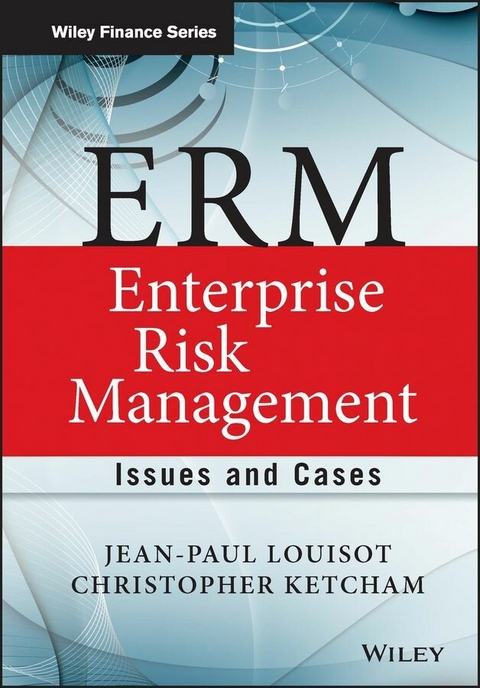
Despite enterprise risk management's relative newness as a recognized business discipline, the marketplace is replete with guides and references for ERM practitioners. Yet, until now, few case studies illustrating ERM in action have appeared in the literature. One reason for this is that, until recently, there were many disparate, even conflicting definitions of what, exactly ERM is and, more importantly, how organizations can use it to utmost advantage. With efforts underway, internationally, to mandate ERM and to standardize ERM standards and practices, the need has never been greater for an authoritative resource offering risk management professionals authoritative coverage of the full array of contemporary ERM issues and challenges. Written by two recognized international thought leaders in the field, ERM-Enterprise Risk Management provides that and much more.
- Packed with international cases studies illustrating ERM best practices applicable across all industry sectors and business models
- Explores contemporary issues, including quantitative and qualitative measures, as well as potential pitfalls and challenges facing today's enterprise risk managers
- Includes interviews with leading risk management theorists and practitioners, as well as risk managers from a variety of industries
- An indispensable working resource for risk management practitioners everywhere and a valuable reference for researchers, providing the latest empirical evidence and an exhaustive bibliography
Professor Jean-Paul Louisot, ARM, FIRM, holds a mining engineer degree, a Master in Economics and an MBA from the Kellogg School of Management and is a member of Beta Gamma Sigma. He has worked in risk management for nearly forty years, as a broker, an underwriter and a risk-manager. Since 1993, his activity focuses on teaching and coaching post graduate students and risk management professionals, while still acting as a part-time risk manager for several clients developing ERM programs. As curriculum director for CARM_Institute, Ltd, he supervises the ARM and EFARM (European Fellow in Applied Risk Management) programmes. After nine years at Paris 1 Panthéon Sorbonne University, he now teaches postgraduate courses in Risk Management at the Institut Catholique de Lille and in various universities, including the IACA in Vienna. He is a frequent speaker in professional conferences in Europe, in Australia, and in the USA. He has published a number of articles and studies on risk management and developed the first edition of the ERM course at The Institutes (ARM 57). He is currently working on his Doctorat en sciences de Gestion at University Paris 1 Panthéon Sorbonne and plans to complete the process in 2014.
Christopher Ketcham, Ph.D., CPCU, CFP®, CIC, CRM, CISR, recently retired as Visiting Assistant Professor at the University of Houston Downtown College of Business Insurance and Risk Management department. While at UHD, Chris developed and taught seven courses for the new online curriculum for insurance and risk management undergraduate majors in this AACSB accredited school. Chris consults with industry and the independent insurance agent community on areas of practical risk management, ethics, and strategic planning. With Jean-Paul Louisot he was co-editor of the first edition of the textbook Enterprise-Wide Risk Management: Developing and Implementing published by The Institutes for their ARM-E designation. Chris’s work in ethics extends to issues associated with emerging technologies such as private space exploration.
A wealth of international case studies illustrating current issues and emerging best practices in enterprise risk management Despite enterprise risk management's relative newness as a recognized business discipline, the marketplace is replete with guides and references for ERM practitioners. Yet, until now, few case studies illustrating ERM in action have appeared in the literature. One reason for this is that, until recently, there were many disparate, even conflicting definitions of what, exactly ERM is and, more importantly, how organizations can use it to utmost advantage. With efforts underway, internationally, to mandate ERM and to standardize ERM standards and practices, the need has never been greater for an authoritative resource offering risk management professionals authoritative coverage of the full array of contemporary ERM issues and challenges. Written by two recognized international thought leaders in the field, ERM-Enterprise Risk Management provides that and much more. Packed with international cases studies illustrating ERM best practices applicable across all industry sectors and business models Explores contemporary issues, including quantitative and qualitative measures, as well as potential pitfalls and challenges facing today's enterprise risk managers Includes interviews with leading risk management theorists and practitioners, as well as risk managers from a variety of industries An indispensable working resource for risk management practitioners everywhere and a valuable reference for researchers, providing the latest empirical evidence and an exhaustive bibliography
PROFESSOR JEAN-PAUL LOUISOT, ARM, FIRM, holds a Mining Engineering Degree, a Master in Economics and an MBA from the Kellogg School of Management and is a member of Beta Gamma Sigma. He has worked in risk management for nearly forty years, as a broker, an underwriter and a risk-manager. Since 1993, his activity focuses on teaching and coaching postgraduate students and risk management professionals, while still acting as a part-time risk manager for several clients developing ERM programmes. As curriculum director for CARM Institute, Ltd, he supervises the ARM and EFARM (European Fellow in Applied Risk Management) programmes. After nine years at Paris 1 Panthéon Sorbonne University, he now teaches postgraduate courses in Risk Management at the Institut Catholique de Lille and in various universities, including the IACA in Vienna. He is a frequent speaker at professional conferences in Europe, in Australia, and in the USA. He has published a number of articles and studies on risk management and developed the first edition of the ERM course at The Institutes. He is currently working on his Doctorat en sciences de Gestion at University Paris 1 Panthéon Sorbonne and plans to complete this in 2014. CHRISTOPHER KETCHAM, Ph.D., CPCU, CFP¯®, CIC, CRM, CISR, recently retired as Visiting Assistant Professor at the University of Houston Downtown's College of Business Insurance and Risk Management department. While at UHD, Chris developed and taught seven courses for the new online curriculum for insurance and risk management undergraduate majors in this AACSB accredited school. Chris consults with industry and independent insurance agent communities on areas of practical risk management, ethics, and strategic planning. With Jean-Paul Louisot he was co-editor of the first edition of the textbook Enterprise-Wide Risk Management: Developing and Implementing published by The Institutes for their ARM-E designation. Chris's work in ethics extends to issues associated with emerging technologies such as private space exploration.
Contributor List vii
About the Editors ix
Acknowledgements x
Introduction xi
ISO 31000 and Guide 73: 2009 Select Terms and Their Definitions xvii
Part I Erm Articles 1
1 Establishing the Internal and External Contexts 3
1.1 Managing Risks to Enable Strategy 3
Jean-Paul Louisot and Christopher Mandel
1.2 Strategy, Constraint, Risk Management and the Value Chain 12
Christopher Ketcham and Kevin W. Knight
1.3 The Risk of Group Decision Making within Organizations: A Synthesis 19
Daniel A. Gaus
2 Risk Assessment 41
2.1 Risk Quantification: Cornerstone for Rational Risk Management 41
Jean-Paul Louisot, Laurent Condamin and Patrick Naim
2.2 Brief Overview of Cindynics 48
Georges-Yves Kervern and Jean-Paul Louisot
2.3 Risk Assessment or Exposure Diagnostic 56
Jean-Paul Louisot
2.4 Managing the Collection of Relevant Data for an ERM Program: The Importance of Efficient and Neutral Questionnaires 84
Sophie Gaultier-Gaillard
2.5 Enterprise Risk Analytics Systems 96
Richard Connelly and Jean-Paul Louisot
2.6 Emerging Enterprise Risks Facing the US Healthcare Industry 103
Robert L. Snyder
3 Select and Implement the Appropriate Risk Management Technique 109
3.1 Risk to Reputation 109
Sophie Gaultier-Gaillard, Jean-Paul Louisot and Jenny Rayner
3.2 Disturbance Management 123
Jean-Paul Louisot
4 Monitor Results and Revise 135
4.1 Business Ethics and Risk Management 135
Marc Ronez
4.2 Governance, Risk, Compliance: The New Paradigm of Risk Management 146
Jean-Paul Louisot
5 Communicate and Consult 155
5.1 Communication as a Risk Mitigation Tool 155
Jean-Paul Louisot
Part II Case Studies 163
6 Case Study Protocol 165
7 Case Study: Risk Management Implementation in China 167
Duojia (Doug) Lu
8 Case Study: Agreeing Upon the Scope of the Project and the Job of the ERM Risk Manager 187
Christopher Ketcham
9 Case Study: Wellcome Trust 191
Fiona Davidge Interviewed by Jean-Paul Louisot
10 Case Study: Large Health Insurer in the US 199
Anonymous Interviewed by Christopher Ketcham
11 Case Study: Three Steps for Bringing Risk Management Back in House 217
Renee Reimer Interviewed by Christopher Ketcham
12 Case Study: University of California 229
Grace Crickette Interviewed by Christopher Ketcham
13 Case Study: Managing Risk at the OPAC du Rhône 241
Samiha Viand Interviewed by Jean-Paul Louisot
ERM References for Practitioners 249
Further Reading 253
Index 255
Introduction
“So, how are we doing?” is the question many in the board and C-suites are probably asking of their enterprise risk management team. The answers will likely vary from, “We are just getting started and it is too soon for results”; “While it isn't perfect, we are getting results”; or even, “I believe we have exceeded expectations.” All three answers may also be appropriate for any given ERM implementation, for like any other strategic initiative operated by people, the take-up rate will vary from department to department. There is, of course, an answer in the other extreme: “It's gone off the rails …”.
As of yet there is no agreed upon definition for Enterprise Risk Management (ERM). The ISO 31000 and Guide 73 define risk management as “coordinated activities to direct and control an organization with regard to risk”. Enterprise or enterprise-wide risk management has grown out of the need for financial and non-financial organizations to direct and control risks outside of the traditional operational hazards and events. Financial institutions (and some other enterprises) have, on the other hand, long been using risk management techniques of another sort to direct and control financial, credit, and market related risks. Enterprise-wide risk management has been expressed as a way to bring the direction and control of all categories of risks under one umbrella so that all critical risks to the organization are identified and directed and controlled. Towards this end, more and more organizations are locating their risk management (ERM) efforts at the senior levels of the organization and are linking risk management efforts towards critical risks that can impact the strategies and strategic goals of the organization. “Grafting risk management onto strategy” is a phrase that has been used to identify this change in focus. Unlike hazard risk where there is only the opportunity for loss, ERM also considers the possibilities of the positive effects of risks of outperforming strategies that may arise from unanticipated events, conditions, or opportunities. While traditional operational and financial risk management techniques are often retained in an ERM installation because they are effective, organizations are finding that other types of risks (some of these not anticipated) require unique risk management strategies that do not have traditional methods of treatment or control. Some of the cases in this book reflect the broadening horizon of risks that ERM has begun to identify and control.
This book has three purposes. The first purpose in the articles section is to address certain key issues of ERM implementations that may need greater explanation. The second is to provide a number of case studies of organizations in the midst of their strategic ERM implementations. Cases include mature implementations as well as organizations that are in the early stages of inculcating ERM into their organizations. No attempt was made to connect the articles section with the case studies section. Many of the topics addressed in the articles section are from issues raised in the broader risk management community or from discussions with individual risk managers who were not part of the case studies presented in this text. The third purpose of the text is to provide a more recent bibliography of resources for risk management professionals who are in the midst of, or are contemplating, ERM implementations.
The book was designed for the practicing risk professional and those who aspire to become risk professionals, including university students. The case studies in this book are appropriate for these readers as well as senior leadership in organizations in the midst of, or considering, adopting ERM. This said, there are other texts, white papers, and journal articles that will provide more extensive development and examination of sophisticated financial and other quantitative risk identification and analysis tools. Many of the sophisticated tools appropriate for quantitative risk identification and analysis have been used by risk management teams showcased in the case studies and are appropriate for certain of the processes and activities outlined in the articles. Risk managers have used these tools to identify the likelihood and probability of risk as well as its impact. However this text was written in response to one of the identified issues in ERM, and that is the need to provide accessible methods that all stakeholders in the organization can use to identify and assess the impact of critical risks. Risk managers have found that they can use sophisticated tools to quantify probability and impact, but it is crucial that all risk owners understand the “critical risks” and that they and the organization are engaged in the dialog necessary to begin the process of managing these risks. For this purpose, many are using “expert” methods to identify and assess the impact of critical risks. These “expert” methods require a combination of the analysis of quantitative data prepared by and from different sources as well as an ongoing dialog towards understanding the specific enterprise in context with its local and global ecology.
The other issue that risk managers are discovering is that they must prepare the organization to collect good and relevant data in sufficient quantities for these sophisticated tools to have any credibility. If critical risks are identified, this narrows the scope of data required to understand these risks. However, all are in agreement that ERM risk identification and quantification is a continual process, so over time, required data and the tools to analyse data will evolve. This is one of the distinct advantages of ERM because it continually develops the understanding of critical risks the organization is and will be facing.
Case Studies
There was no attempt to try to find a case study for every industry or in every part of the world. Case studies in the US include a hospital system, a health insurer, and a university system. There is a biomedical trust case from the UK, a public housing office agency in France, and an analysis of ERM implementations in various public sectors in China. Finally, there are observations from a veteran risk manager about negotiating the CRO job and establishing the scope both of the job and the ERM project in an organization. These case studies by no means represent a complete spectrum of the ERM environment today. However, we hope to show in this text the importance of collecting more case study data on more ERM installations simply because there are so many different approaches to the process. In addition it is likely that each organization that engages an ERM installation will have its own issues with change management and the actual environment of managing risks. The fact that no two ERM installations are likely to be the same is a reason why more case studies are required to broaden the available data on the issues that organizations can face in the ERM process.
Frankly, some organizations we approached declined to speak on the record because they have found that their ERM initiative has uncovered areas of improvement that at this point they would not want to make public. Others have been unwilling to explain how their ERM initiative went off the rails. While the cases in this text are limited in industry breadth and depth, and there is not more than one case for any one industry, there are some common threads in these cases that should be explored further.
One of the cornerstone requirements of ERM is strong management support. Case study participants agreed that this is important. However, many participants observed that management support will vary over time. There will be changes in leadership or priorities and like any initiative sometimes support can become stale. ERM is not like a project to develop a new product. Unlike most projects with end-stage goals, ERM does not have an end product – it is a process that never concludes. What risk managers must do is to find ways to keep the initiative on track even when the organization strays or priorities change.
The second observation gleaned from these case studies is that quite often the simpler the better. There is a time and place for sophisticated risk analysis using Monte Carlo and other tools but, by and large, the risk needs to be understood by managers, employees, and stakeholders. The case study participants provide a number of examples of how they have simplified processes, calculations, and explanations in a way that those who are not risk management professionals can understand and adopt specific practices in their departments and throughout the organization. What risk managers are finding is that if they have solid ERM practices in place that managers feel comfortable with, and it benefits them and their departments directly, they will continue to utilize these tools and techniques with little prodding. The goal, as risk managers explain it, is to have these practices become part of the everyday activity of the organization. This said, all of the quantitative and qualitative tools risk managers have traditionally used (and others are beginning to use) are available to the organization engaged in ERM. In fact, many of the successful ongoing operational risk management practices that mitigate workers' compensation, liability claims and the like are often retained in an ERM installation because they are already effective. However, ERM identifies broader areas of risk beyond the operational and with such categories as financial, strategic, and competitive risk. As a result,...
| Erscheint lt. Verlag | 25.3.2014 |
|---|---|
| Reihe/Serie | The Wiley Finance Series |
| Wiley Finance Series | Wiley Finance Series |
| Sprache | englisch |
| Themenwelt | Mathematik / Informatik ► Mathematik ► Finanz- / Wirtschaftsmathematik |
| Recht / Steuern ► Wirtschaftsrecht | |
| Wirtschaft ► Betriebswirtschaft / Management ► Finanzierung | |
| Wirtschaft ► Betriebswirtschaft / Management ► Unternehmensführung / Management | |
| Schlagworte | business risk management • business risk management case studies • business risk management strategies • business risk management techniques • business risk management tools • enterprise management tools • Enterprise Risk Management • enterprise risk management best practices • enterprise risk management case studies • enterprise risk management framework • Enterprise risk management models • enterprise risk management policy • Enterprise Risk Management Process • enterprise risk management solutions • enterprise risk management system • enterprise risk management techniques • ERM • ERM best practices • ERM case studies • ERM techniques • ERM tools • Finance & Investments • Finanz- u. Anlagewesen • manage enterprise risk • Operational Risk Management • operation risk management case studies • risk enterprise management • Risk Management • what is ERM |
| ISBN-13 | 9781118539514 / 9781118539514 |
| Informationen gemäß Produktsicherheitsverordnung (GPSR) | |
| Haben Sie eine Frage zum Produkt? |
 EPUB (Adobe DRM)
Kopierschutz: Adobe-DRM
Adobe-DRM ist ein Kopierschutz, der das eBook vor Mißbrauch schützen soll. Dabei wird das eBook bereits beim Download auf Ihre persönliche Adobe-ID autorisiert. Lesen können Sie das eBook dann nur auf den Geräten, welche ebenfalls auf Ihre Adobe-ID registriert sind.
Details zum Adobe-DRM
Dateiformat: EPUB (Electronic Publication)
EPUB ist ein offener Standard für eBooks und eignet sich besonders zur Darstellung von Belletristik und Sachbüchern. Der Fließtext wird dynamisch an die Display- und Schriftgröße angepasst. Auch für mobile Lesegeräte ist EPUB daher gut geeignet.
Systemvoraussetzungen:
PC/Mac: Mit einem PC oder Mac können Sie dieses eBook lesen. Sie benötigen eine
eReader: Dieses eBook kann mit (fast) allen eBook-Readern gelesen werden. Mit dem amazon-Kindle ist es aber nicht kompatibel.
Smartphone/Tablet: Egal ob Apple oder Android, dieses eBook können Sie lesen. Sie benötigen eine
Geräteliste und zusätzliche Hinweise
Buying eBooks from abroad
For tax law reasons we can sell eBooks just within Germany and Switzerland. Regrettably we cannot fulfill eBook-orders from other countries.
aus dem Bereich