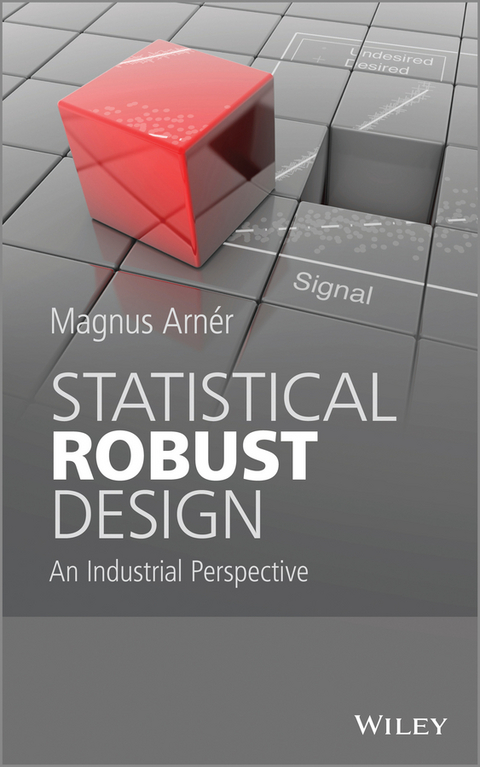
A UNIQUELY PRACTICAL APPROACH TO ROBUST DESIGN FROM A STATISTICAL AND ENGINEERING PERSPECTIVE Variation in environment, usage conditions, and the manufacturing process has long presented a challenge in product engineering, and reducing variation is universally recognized as a key to improving reliability and productivity. One key and cost-effective way to achieve this is by robust design making the product as insensitive as possible to variation. With Design for Six Sigma training programs primarily in mind, the author of this book offers practical examples that will help to guide product engineers through every stage of experimental design: formulating problems, planning experiments, and analysing data. He discusses both physical and virtual techniques, and includes numerous exercises and solutions that make the book an ideal resource for teaching or self-study. Presents a practical approach to robust design through design of experiments. Offers a balance between statistical and industrial aspects of robust design. Includes practical exercises, making the book useful for teaching. Covers both physical and virtual approaches to robust design. Supported by an accompanying website www.wiley/com/go/robust featuring MATLAB scripts and solutions to exercises. Written by an experienced industrial design practitioner. This book's state of the art perspective will be of benefit to practitioners of robust design in industry, consultants providing training in Design for Six Sigma, and quality engineers. It will also be a valuable resource for specialized university courses in statistics or quality engineering.
Magnus Arnér, Tetra Pak Packaging Solutions, Sweden
Preface
1 What is Robust Design?
1.1 The Importance of Small Variation
1.2 Variance Reduction
1.3 Variation Propagation
1.4 Discussion
1.4.1 Limitations
1.4.2 The outline of this book
Exercises
2 DOE for Robust Design, Part 1
2.1 Combined Arrays: An Example
2.2 Dispersion Effects
Exercises
References
3 Noise and Control Factors
3.1 Introduction to Noise Factors
3.2 Finding the Important Noise Factors
3.2.1 Reducing the number of noise factors
3.3 How to Include Noise in a Designed Experiment
3.3.1 How to include noise in experimentation
3.4 Control Factors
Exercises
References
4 Response, Signal, and P diagrams
4.1 The Idea of Signal and Response
4.2 Ideal Functions and P Diagrams
4.3 The Signal
Exercises
5 DOE for Robust Design, Part 2
5.1 Combined and Crossed Arrays
5.2 Including a Signal in a Designed Experiment
5.2.1 Combined arrays with a signal
5.2.2 Inner and outer arrays with a signal
5.3 Crossed Arrays versus Combined Arrays
5.3.1 Differences in factor aliasing
5.4 Crossed Arrays and Split-Plot Designs
5.4.1 Limits of randomization
5.4.2 Split-plot designs
Exercises
References
6 Smaller-the-Better and Larger-the-Better
6.1 Different Types of Responses
6.2 Failure Modes and Smaller-the-Better
6.3 Larger-the-Better
6.4 OperatingWindow
Exercises
References
7 Regression for Robust Design
7.1 Graphical Techniques
7.2 Analytical Minimization of (g0(z))2
7.3 Regression and Crossed Arrays
Exercises
8 Mathematics of Robust Design
8.1 Notational System
8.2 The Objective Function
8.2.1 Multidimensional problems
8.2.2 Pareto optimality
8.3 ANOVA for Robust Design
8.3.1 Traditional ANOVA
8.3.2 Functional ANOVA
Exercises
References
9 Design and Analysis of Computer Experiments
9.1 Overview of Computer Experiments
9.2 Experimental Arrays for Computer Experiments
9.2.1 Screening designs
9.2.2 Space filling designs
9.3 Response Surfaces
9.4 Optimization
Exercises
References
10 Monte Carlo Methods for Robust Design
10.1 Geometry Variation
10.2 Geometry Variation in Two Dimensions
10.3 Crossed Arrays
11 Taguchi and His Ideas on Robust Design
11.1 The Experimental Arrays
11.1.1 The nature of inner arrays
11.1.2 Crossing the arrays
11.2 Signal to Noise Ratios
11.3 Some Other Ideas
Exercises
References
Appendix A Loss Functions
Exercises
References
Appendix B Data to chapter 2
Appendix C Data to chapter 5
Appendix D Data to chapter 6
Index
1
What is robust design?
1.1 The importance of small variation
When mass production started in the dawn of the industrial revolution, variation came in the focal point of interest. An early example that illustrates this concerns mass production of guns. The French gunsmith Honoré le Blanc realized the importance for guns to have interchangeable parts. His solution was the invention of a system for making gun parts in a standardized way. The problem that challenged le Blanc is the same as in any modern day manufacturing, as, for example, in the production of bolts and nuts. It shall be possible to pick a bolt and a nut at random that fit together. This requires that the variation in diameter, in roundness, and in thread pitch is small from bolt to bolt and from nut to nut. Unless this is the case, there will be a substantial amount of scrapping, or even worse bolts that crack or fall off while they are in use.
Before the industrial revolution, this problem was handled by good craftsmen. In the industrial era, this was not an option anymore. The importance of managing the variation became obvious. Several approaches emerged. Specifying the tolerance limits was one of them and even if the gunsmith le Blanc did not get many immediate followers in France, some Americans saw the potential of his ideas and implemented them at the armoury in Springfield. This is sometimes considered as the birth of tolerance limits (which is not quite true as tolerance limits are much older than this).
To quote Edward Deming, a forefront figure in quality engineering, ‘Variation is the enemy of quality.’ The bolt and the nut is one example. Another one is thickness variation of the plastic film on the inside of a milk package–a plastic film preventing the beverage from coming in contact with the aluminium foil that is present in most milk (and juice) packages. If this thickness varies too much, it may occasionally happen that there is a point with direct contact between the beverage and the aluminium foil. However, it is not the fact that there is a contact point that should be the centre of interest. The focus should rather be the size of the film thickness variation. The contact point is just a symptom of this problem.
Investigations show that a substantial part of all failures observed on products in general are caused by variation. With this in mind it is obvious that variation needs to be addressed and reduced. The issue is just how.
This book is about random variation, or more specifically how to reduce random variation in a response variable y, but not just any way to reduce this variation. It will not be about tightening tolerances, not about feedback control systems, and not sorting units outside the tolerance limits. The focus is solely on preventing variation to propagate. It is this approach to variation that is called robust design.
1.2 Variance reduction
Example 1.1 Consider a bar that is attached to a wall. There is a support to the bar and a random variation in the insertion point in the wall, as sketched in Figure 1.1. We are interested in the position (x, y) of the end point of the bar and that its variation is small.
Figure 1.1 A bar is attached to a wall. There is a support to keep it in place. If there is a variation in the insertion point, there will be a variation in the end point.
The variation of the end point position can be reduced in two fundamentally different ways. One is to reduce the variation of the insertion point in the wall. It may be costly. Typically it can involve investment in new and better equipment. However, it might be another way to reduce the variation of the end point position, namely to move the support. In that way the design becomes less sensitive to the variation in the insertion point (Figure 1.2). This is what we mean by robust design: to make the variation of the output insensitive (robust) against incoming variation.
Figure 1.2 A bar is attached to a wall. The variation in the end point can be reduced in two fundamentally different ways, namely by reducing the incoming variation or by making the design robust against this variation.
Example 1.2 Two metal sheets are attached to each other. There are two holes in each one and they are attached to each other using two bolts (Figure 1.3). Assume that the maximum stress σmax in the metal sheets is of interest to us. A small variation in the position of the holes, or rather distance between them, affects this stress.
Suppose that this stress should be minimized. This can be achieved by increasing the precision of the positions of the holes. It can also be achieved by changing the design so that one hole is exchanged for a slot (Figure 1.4). In that way, the variation in the response, the maximum stress, is decreased without reducing the variation in the sources of variation, the hole positions. The stress is robust to the hole position.
Figure 1.3 Two metal sheets are mounted together. Since there is a variation in the attachment position, there will be a variation in the maximum stress.
Figure 1.4 Exchanging one hole for a slot will make the stress robust against the variation in the hole position.
We have seen two examples of robust design, the end point of the bar and the stress of the metal sheets. For both of them, ways to reduce the variation of the output without reducing or removing the original source of variation were pointed out.
In robust design, the original source of variation is called noise. This noise is typically sources of variation that the engineer cannot remove or even reduce, or something that can be reduced but at a considerable cost.
1.3 Variation propagation
The essence of robust design is to make use of nonlinearities in the transfer function y = g(x, z) in such a way that variation in the noise z is prevented from propagating. The key is in the derivative of the transfer function. We will study how this can be expressed mathematically.
Assume that Z is a random variable with mean μz and standard deviation σz and that x is a nonrandom variable. Further, assume that Y is a function of Z and x,
For example, Z can be the distance from the nominal attachment point and x the distance from the wall of the support in Example 1.1. Since Y is a function of the random variable Z, it is also a random variable. Taylor’s formula gives
where all the derivatives are taken with respect to z. This will be applied to study how the mean and variance of Z propagate to Y. For the mean of Y we obtain
and for the variance
These are called Gauss’ approximation formulas.
Let us apply this to Example 1.1. Define
and
Note that x has a different meaning here than in Example 1.1. We obtain
and
In robust design, Z is called a noise factor or variable that the engineer cannot fully control and x a control factor since it can be controlled.
The main difference between classical ways to approach variation and robust design is which factor in Gauss’ approximation formula (Equation 1.1) to focus on.
It is how the second one of these, ≈ (g′ (μz))2 (see Figure 1.5), is used that makes robust design different from traditional ways to reduce variation. In traditional engineering, the variance of the variation source, , is reduced in order to reduce the variation of the response, . In robust design the objective is still to reduce , but it is done by reducing g′(μz).
Figure 1.5 Robust design is one way to reduce variation.
1.4 Discussion
There have always been engineers that have made their designs insensitive to factors that are outside their own control. However, the modern development started in the 1950s, when Genichi Taguchi divided the factors in designed experiments into two different categories, noise and control factors. For some decades, it was primarily in Japan that these ideas attracted any attention.
Around 1980 the ideas of Taguchi reached North America and Europe. The basic principles, like dividing the factors into two different categories, were highly appreciated but some other ideas of Taguchi were more controversial. These controversies will be touched upon at several occasions in this book.
Even if robust design has been around for quite a long time, it is only since around the year 2000 that the application of it in industry has started to grow. One reason is that many companies have started programmes for Design for Six Sigma, DFSS, where robust design plays a central role. Another reason for the growth is the availability of software for CAE (computer aided engineering) based robust design.
1.4.1 Limitations
Since robust design is a broad field, we need to limit ourselves in this book. Two of these limitations are worth...
| Erscheint lt. Verlag | 4.2.2014 |
|---|---|
| Sprache | englisch |
| Themenwelt | Mathematik / Informatik ► Mathematik ► Angewandte Mathematik |
| Mathematik / Informatik ► Mathematik ► Statistik | |
| Mathematik / Informatik ► Mathematik ► Wahrscheinlichkeit / Kombinatorik | |
| Technik ► Maschinenbau | |
| Schlagworte | Approach • challenge • costeffective • Electrical & Electronics Engineering • Elektrotechnik u. Elektronik • Engineering • Engineering statistics • Environment • Key • Long • Manufacturing • Multivariate Analyse • multivariate analysis • Perspective • possible • Process • Product • Qualität u. Zuverlässigkeit • Qualität u. Zuverlässigkeit • Quality & Reliability • recognized • Reliability • Robust • Robust Design • Statistical • Statistics • Statistik • Statistik in den Ingenieurwissenschaften • uniquely practical • universally • Variation |
| ISBN-13 | 9781118841952 / 9781118841952 |
| Informationen gemäß Produktsicherheitsverordnung (GPSR) | |
| Haben Sie eine Frage zum Produkt? |
 EPUB (Adobe DRM)
Kopierschutz: Adobe-DRM
Adobe-DRM ist ein Kopierschutz, der das eBook vor Mißbrauch schützen soll. Dabei wird das eBook bereits beim Download auf Ihre persönliche Adobe-ID autorisiert. Lesen können Sie das eBook dann nur auf den Geräten, welche ebenfalls auf Ihre Adobe-ID registriert sind.
Details zum Adobe-DRM
Dateiformat: EPUB (Electronic Publication)
EPUB ist ein offener Standard für eBooks und eignet sich besonders zur Darstellung von Belletristik und Sachbüchern. Der Fließtext wird dynamisch an die Display- und Schriftgröße angepasst. Auch für mobile Lesegeräte ist EPUB daher gut geeignet.
Systemvoraussetzungen:
PC/Mac: Mit einem PC oder Mac können Sie dieses eBook lesen. Sie benötigen eine
eReader: Dieses eBook kann mit (fast) allen eBook-Readern gelesen werden. Mit dem amazon-Kindle ist es aber nicht kompatibel.
Smartphone/Tablet: Egal ob Apple oder Android, dieses eBook können Sie lesen. Sie benötigen eine
Geräteliste und zusätzliche Hinweise
Buying eBooks from abroad
For tax law reasons we can sell eBooks just within Germany and Switzerland. Regrettably we cannot fulfill eBook-orders from other countries.
aus dem Bereich