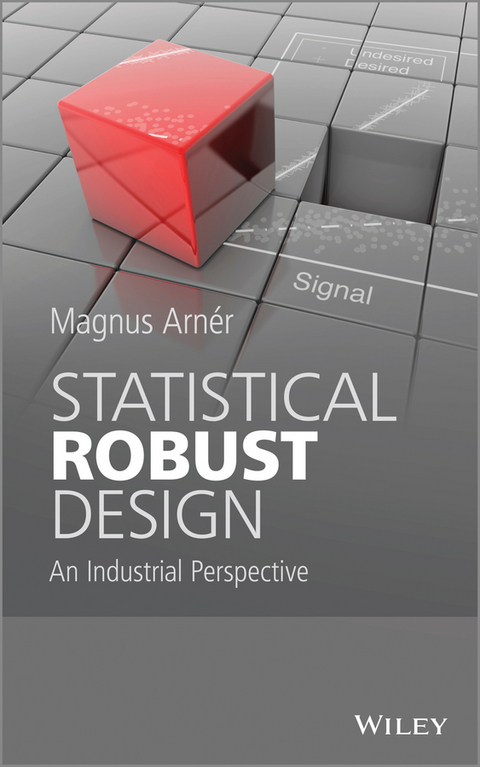
A UNIQUELY PRACTICAL APPROACH TO ROBUST DESIGN FROM A STATISTICAL AND ENGINEERING PERSPECTIVE
Variation in environment, usage conditions, and the manufacturing process has long presented a challenge in product engineering, and reducing variation is universally recognized as a key to improving reliability and productivity. One key and cost-effective way to achieve this is by robust design - making the product as insensitive as possible to variation.
With Design for Six Sigma training programs primarily in mind, the author of this book offers practical examples that will help to guide product engineers through every stage of experimental design: formulating problems, planning experiments, and analysing data. He discusses both physical and virtual techniques, and includes numerous exercises and solutions that make the book an ideal resource for teaching or self-study.
• Presents a practical approach to robust design through design of experiments.
• Offers a balance between statistical and industrial aspects of robust design.
• Includes practical exercises, making the book useful for teaching.
• Covers both physical and virtual approaches to robust design.
• Supported by an accompanying website (www.wiley/com/go/robust) featuring MATLAB® scripts and solutions to exercises.
• Written by an experienced industrial design practitioner.
This book's state of the art perspective will be of benefit to practitioners of robust design in industry, consultants providing training in Design for Six Sigma, and quality engineers. It will also be a valuable resource for specialized university courses in statistics or quality engineering.
Magnus Arnér, Tetra Pak Packaging Solutions, Sweden
A UNIQUELY PRACTICAL APPROACH TO ROBUST DESIGN FROM A STATISTICAL AND ENGINEERING PERSPECTIVE Variation in environment, usage conditions, and the manufacturing process has long presented a challenge in product engineering, and reducing variation is universally recognized as a key to improving reliability and productivity. One key and cost-effective way to achieve this is by robust design making the product as insensitive as possible to variation. With Design for Six Sigma training programs primarily in mind, the author of this book offers practical examples that will help to guide product engineers through every stage of experimental design: formulating problems, planning experiments, and analysing data. He discusses both physical and virtual techniques, and includes numerous exercises and solutions that make the book an ideal resource for teaching or self-study. Presents a practical approach to robust design through design of experiments. Offers a balance between statistical and industrial aspects of robust design. Includes practical exercises, making the book useful for teaching. Covers both physical and virtual approaches to robust design. Supported by an accompanying website www.wiley/com/go/robust featuring MATLAB scripts and solutions to exercises. Written by an experienced industrial design practitioner. This book's state of the art perspective will be of benefit to practitioners of robust design in industry, consultants providing training in Design for Six Sigma, and quality engineers. It will also be a valuable resource for specialized university courses in statistics or quality engineering.
Magnus Arnér, Tetra Pak Packaging Solutions, Sweden
Preface
1 What is Robust Design?
1.1 The Importance of Small Variation
1.2 Variance Reduction
1.3 Variation Propagation
1.4 Discussion
1.4.1 Limitations
1.4.2 The outline of this book
Exercises
2 DOE for Robust Design, Part 1
2.1 Combined Arrays: An Example
2.2 Dispersion Effects
Exercises
References
3 Noise and Control Factors
3.1 Introduction to Noise Factors
3.2 Finding the Important Noise Factors
3.2.1 Reducing the number of noise factors
3.3 How to Include Noise in a Designed Experiment
3.3.1 How to include noise in experimentation
3.4 Control Factors
Exercises
References
4 Response, Signal, and P diagrams
4.1 The Idea of Signal and Response
4.2 Ideal Functions and P Diagrams
4.3 The Signal
Exercises
5 DOE for Robust Design, Part 2
5.1 Combined and Crossed Arrays
5.2 Including a Signal in a Designed Experiment
5.2.1 Combined arrays with a signal
5.2.2 Inner and outer arrays with a signal
5.3 Crossed Arrays versus Combined Arrays
5.3.1 Differences in factor aliasing
5.4 Crossed Arrays and Split-Plot Designs
5.4.1 Limits of randomization
5.4.2 Split-plot designs
Exercises
References
6 Smaller-the-Better and Larger-the-Better
6.1 Different Types of Responses
6.2 Failure Modes and Smaller-the-Better
6.3 Larger-the-Better
6.4 OperatingWindow
Exercises
References
7 Regression for Robust Design
7.1 Graphical Techniques
7.2 Analytical Minimization of (g0(z))2
7.3 Regression and Crossed Arrays
Exercises
8 Mathematics of Robust Design
8.1 Notational System
8.2 The Objective Function
8.2.1 Multidimensional problems
8.2.2 Pareto optimality
8.3 ANOVA for Robust Design
8.3.1 Traditional ANOVA
8.3.2 Functional ANOVA
Exercises
References
9 Design and Analysis of Computer Experiments
9.1 Overview of Computer Experiments
9.2 Experimental Arrays for Computer Experiments
9.2.1 Screening designs
9.2.2 Space filling designs
9.3 Response Surfaces
9.4 Optimization
Exercises
References
10 Monte Carlo Methods for Robust Design
10.1 Geometry Variation
10.2 Geometry Variation in Two Dimensions
10.3 Crossed Arrays
11 Taguchi and His Ideas on Robust Design
11.1 The Experimental Arrays
11.1.1 The nature of inner arrays
11.1.2 Crossing the arrays
11.2 Signal to Noise Ratios
11.3 Some Other Ideas
Exercises
References
Appendix A Loss Functions
Exercises
References
Appendix B Data to chapter 2
Appendix C Data to chapter 5
Appendix D Data to chapter 6
Index
| Erscheint lt. Verlag | 23.1.2014 |
|---|---|
| Sprache | englisch |
| Themenwelt | Mathematik / Informatik ► Mathematik ► Angewandte Mathematik |
| Mathematik / Informatik ► Mathematik ► Statistik | |
| Mathematik / Informatik ► Mathematik ► Wahrscheinlichkeit / Kombinatorik | |
| Technik ► Maschinenbau | |
| Schlagworte | Approach • challenge • costeffective • Electrical & Electronics Engineering • Elektrotechnik u. Elektronik • Engineering • Engineering statistics • Environment • Key • Long • Manufacturing • Multivariate Analyse • multivariate analysis • Perspective • possible • Process • Product • Qualität u. Zuverlässigkeit • Qualität u. Zuverlässigkeit • Quality & Reliability • recognized • Reliability • Robust • Robust Design • Statistical • Statistics • Statistik • Statistik in den Ingenieurwissenschaften • uniquely practical • universally • Variation |
| ISBN-13 | 9781118841945 / 9781118841945 |
| Informationen gemäß Produktsicherheitsverordnung (GPSR) | |
| Haben Sie eine Frage zum Produkt? |
 PDF (Adobe DRM)
Kopierschutz: Adobe-DRM
Adobe-DRM ist ein Kopierschutz, der das eBook vor Mißbrauch schützen soll. Dabei wird das eBook bereits beim Download auf Ihre persönliche Adobe-ID autorisiert. Lesen können Sie das eBook dann nur auf den Geräten, welche ebenfalls auf Ihre Adobe-ID registriert sind.
Details zum Adobe-DRM
Dateiformat: PDF (Portable Document Format)
Mit einem festen Seitenlayout eignet sich die PDF besonders für Fachbücher mit Spalten, Tabellen und Abbildungen. Eine PDF kann auf fast allen Geräten angezeigt werden, ist aber für kleine Displays (Smartphone, eReader) nur eingeschränkt geeignet.
Systemvoraussetzungen:
PC/Mac: Mit einem PC oder Mac können Sie dieses eBook lesen. Sie benötigen eine
eReader: Dieses eBook kann mit (fast) allen eBook-Readern gelesen werden. Mit dem amazon-Kindle ist es aber nicht kompatibel.
Smartphone/Tablet: Egal ob Apple oder Android, dieses eBook können Sie lesen. Sie benötigen eine
Geräteliste und zusätzliche Hinweise
Buying eBooks from abroad
For tax law reasons we can sell eBooks just within Germany and Switzerland. Regrettably we cannot fulfill eBook-orders from other countries.
aus dem Bereich