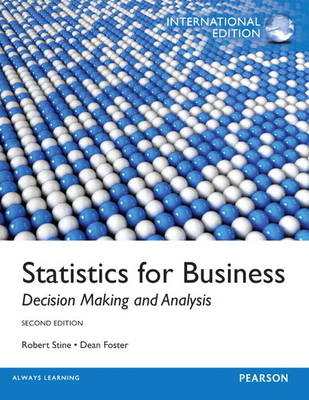
Statistics for Business, plus MyStatLab with Pearson eText
Pearson Education Limited
978-1-4479-5315-9 (ISBN)
- Titel erscheint in neuer Auflage
- Artikel merken

Your Instructor will need to provide you with a course ID in order for you to access the eText and MyStatLab
In Statistics for Business: Decision Making and Analysis, authors Robert Stine and Dean Foster of the University of Pennsylvania's Wharton School, take a sophisticated approach to teaching statistics in the context of making good business decisions. The authors show students how to recognize and understand each business question, use statistical tools to do the analysis, and how to communicate their results clearly and concisely.
MyLab and Mastering from Pearson improve results for students and educators. Used by over ten million students, they effectively engage learners at every stage.
MyStatLab is being used in universities all over the world to improve student performance. MyStatLab has immersive content and engaging tools, along with time-saving automatic grading.
"What students especially like about the system is that they get immediate feedback from MyStatLab on whether the exercise was right or wrong. I would recommend MyStatLab to another lecturer because I think I became a better lecturer in statistics, [as now] I'm able to provide individual students with better feedback." - Dr Patrick Stroobandt, Plantijn Hogeschool, Belgium
With MyStatLab, students gain knowledge that they will use throughout their lives, and universities gain a partner deeply committed to helping students and educators achieve their goals.
For students
Pearson eText gives you access to an eBook that can be used on the go, and allows you to highlight, search and take notes as you read online. Access to the eBook depends on the package you have bought.
Help Me Solve This breaks the problem down into manageable chunks so you can work through the methodology a stage at a time, applying what you've learnt as you go along.
MyStatLab questions often require you to draw or interpret graphs or statistical data. The integrated StatCrunch software allows your students to analyse the data set in the question and draw conclusions with a simple click.
For educators
Online assignments, tests, quizzes can be easily created and assigned to students.
Gradebook: Assignments are automatically graded and visible at a glance.
Register now to benefit from these resources.
A student access code card is included with your textbook at a reduced cost. To register with your code, visit www.mystatlab.co.uk.
For educator access, contact your Pearson account manager. To find out who your account manager is, visit www.pearsoned.co.uk/replocator
For more instructor resources available with this title, visit www.pearsoned.co.uk
Preface
Index of Application
PART ONE: VARIATION
1. Introduction
1.1 What Is Statistics?
1.2 Previews
2. Data
2.1 Data Tables
2.2 Categorical and Numerical Data
2.3 Recoding and Aggregation
2.4 Time Series
2.5 Further Attributes of Data
Chapter Summary
3. Describing Categorical Data
3.1 Looking at Data
3.2 Charts of Categorical Data
3.3 The Area Principle
3.4 Mode and Median
Chapter Summary
4. Describing Numerical Data
4.1 Summaries of Numerical Variables
4.2 Histograms
4.3 Boxplot
4.4 Shape of a Distribution
4.5 Epilog
Chapter Summary
5. Association between Categorical Variables
5.1 Contingency Tables
5.2 Lurking Variables and Simpson's Paradox
5.3 Strength of Association
Chapter Summary
6. Association between Quantitative Variables
6.1 Scatterplots
6.2 Association in Scatterplots
6.3 Measuring Association
6.4 Summarizing Association with a Line
6.5 Spurious Correlation
Chapter Summary
Statistics in Action: Financial Time Series
Statistics in Action: Executive Compensation
PART TWO: PROBABILITY
7. Probability
7.1 From Data to Probability
7.2 Rules for Probability
7.3 Independent Events
Chapter Summary
8. Conditional Probability
8.1 From Tables to Probabilities
8.2 Dependent Events
8.3 O rganizing Probabilities
8.4 O rder in Conditional Probabilities
Chapter Summary
9. Random Variables
9.1 Random Variables
9.2 Properties of Random Variables
9.3 Properties of Expected Values
9.4 Comparing Random Variables
Chapter Summary
10. Association between Random Variables
10.1 Portfolios and Random Variables
10.2 Joint Probability Distribution
10.3 Sums of Random Variables
10.4 Dependence between Random Variables
10.5 IID Random Variables
10.6 Weighted Sums
Chapter Summary
11. Probability Models for Counts
11.1 Random Variables for Counts
11.2 Binomial Model
11.3 Properties of Binomial Random Variables
11.4 Poisson Model
Chapter Summary
12. The Normal Probability Model
12.1 Normal Random Variable
12.2 The Normal Model
12.3 Percentiles
12.4 Departures from Normality
Chapter Summary
Statistics in Action: Managing Financial Risk
Statistics in Action: Modeling Sampling Variation
PART THREE: INFERENCE
13. Samples and Surveys
13.1 Two Surprising Properties of Samples
13.2 Variation
13.3 Alternative Sampling Methods
13.4 Questions to Ask
Chapter Summary
14. Sampling Variation and Quality
14.1 Sampling Distribution of the Mean
14.2 Control Limits
14.3 Using a Control Chart
14.4 Control Charts for Variation
Chapter Summary
15. Confidence Intervals
15.1 Ranges for Parameters
15.2 Confidence Interval for the Mean
15.3 Interpreting Confidence Intervals
15.4 Manipulating Confidence Intervals
15.5 Margin of Error
Chapter Summary
16. Statistical Tests
16.1 Concepts of Statistical Tests
16.2 Testing the Proportion
16.3 Testing the Mean
16.4 Significance versus Importance
16.5 Confidence Interval or Test?
Chapter Summary
17. Comparison
17.1 Data for Comparisons
17.2 Two-Sample z-test for Proportions
17.3 Two-Sample Confidence Interval for Proportions
17.4 Two-Sample T-test
17.5 Confidence Interval for the Difference between Means
17.6 Paired Comparisons
Chapter Summary
18. Inference for Counts
18.1 Chi-Squared Tests
18.2 Test of Independence
18.3 General versus Specific Hypotheses
18.4 Tests of Goodness of Fit
Chapter Summary
Statistics in Action: Rare Events
Statistics in Action: Data Mining Using Chi-Squared
PART FOUR: REGRESSION MODELS
19. Linear Patterns
19.1 Fitting a Line to Data
19.2 Interpreting the Fitted Line
19.3 Properties of Residuals
19.4 Explaining Variation
19.5 Conditions for Simple Regression
Chapter Summary
20. Curved Patterns
20.1 Detecting Nonlinear Patterns
20.2 Transformations
20.3 Reciprocal Transformation
20.4 Logarithm Transformation
Chapter Summary
21. The Simple Regression Model
21.1 The Simple Regression Model
21.2 Conditions for the SRM
21.3 Inference in Regression
21.4 Prediction Intervals
Chapter Summary
22. Regression Diagnostics
22.1 Changing Variation
22.2 Outliers
22.3 Dependent Errors and Time Series
Chapter Summary
23. Multiple Regression
23.1 The Multiple Regression Model
23.2 Interpreting Multiple Regression
23.3 Checking Conditions
23.4 Inference in Multiple Regression
23.5 Steps in Fitting a Multiple Regression
Chapter Summary
24. Building Regression Models
24.1 Identifying Explanatory Variables
24.2 Collinearity
24.3 Removing Explanatory Variables
Chapter Summary
25. Categorical Explanatory Variables
25.1 Two-Sample Comparisons
25.2 Analysis of Covariance
25.3 Checking Conditions
25.4 Interactions and Inference
25.5 Regression with Several Groups
Chapter Summary
26. Analysis of Variance
26.1 Comparing Several Groups
26.2 Inference in ANOVA Regression Models
26.3 Multiple Comparisons
26.4 Groups of Different Size
Chapter Summary
27. Time Series
27.1 Decomposing a Time Series
27.2 Regression Models
27.3 Checking the Model
Chapter Summary
Statistics in Action: Analyzing Experiments
Statistics in Action: Automated Modeling
| Erscheint lt. Verlag | 3.6.2013 |
|---|---|
| Verlagsort | Harlow |
| Sprache | englisch |
| Themenwelt | Mathematik / Informatik ► Mathematik ► Finanz- / Wirtschaftsmathematik |
| ISBN-10 | 1-4479-5315-0 / 1447953150 |
| ISBN-13 | 978-1-4479-5315-9 / 9781447953159 |
| Zustand | Neuware |
| Informationen gemäß Produktsicherheitsverordnung (GPSR) | |
| Haben Sie eine Frage zum Produkt? |
aus dem Bereich