


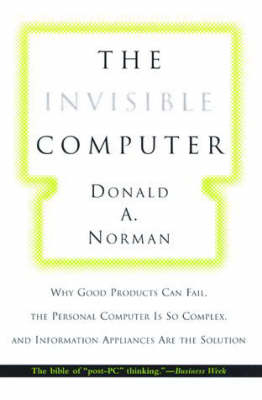
The Invisible Computer
Why Good Products Can Fail, the Personal Computer Is So Complex, and Information Appliances Are the Solution
Seiten
1999
MIT Press (Verlag)
9780262640411 (ISBN)
MIT Press (Verlag)
9780262640411 (ISBN)
- Titel ist leider vergriffen;
keine Neuauflage - Artikel merken
From "Science Finds, Industry Applies, Man Conforms" (motto of the 1933 Chicago USA World's Fair)-to "People Propose, Science Studies, Technology Conforms" (Donald Norman's person-centered motto for the twenty-first centuray).
Technologies have a life cycle, says Donald Norman, and companies and their products must change as they pass from youth to maturity. Alas, the computer industry thinks it is still in its rebellious teenage years, exulting in technical complexity. Customers want change. They are ready for products that offer convenience, ease of use, and pleasure. The technology should be invisible, hidden from sight.
In this book, Norman shows why the computer is so difficult to use and why this complexity is fundamental to its nature. The only answer, says Norman, is to start over again, to develop information appliances that fit people's needs and lives. To do this companies must change the way they develop products. They need to start with an understanding of people: user needs first, technology last-the opposite of how things are done now.
Technologies have a life cycle, says Donald Norman, and companies and their products must change as they pass from youth to maturity. Alas, the computer industry thinks it is still in its rebellious teenage years, exulting in technical complexity. Customers want change. They are ready for products that offer convenience, ease of use, and pleasure. The technology should be invisible, hidden from sight.
In this book, Norman shows why the computer is so difficult to use and why this complexity is fundamental to its nature. The only answer, says Norman, is to start over again, to develop information appliances that fit people's needs and lives. To do this companies must change the way they develop products. They need to start with an understanding of people: user needs first, technology last-the opposite of how things are done now.
Business Week has named Don Norman one of the world's most influential designers. He has been both a professor and an executive: he was Vice President of Advanced Technology at Apple; his company, the Nielsen Norman Group, helps companies produce human-centered products and services; and he has been on the faculty at Harvard, the University of California, San Diego, Northwestern University, and KAIST, in South Korea. He is the author of many books, including The Design of Everyday Things, The Invisible Computer (MIT Press), Emotional Design, and The Design of Future Things.
| Reihe/Serie | The Invisible Computer |
|---|---|
| Verlagsort | Cambridge, Mass. |
| Sprache | englisch |
| Maße | 152 x 229 mm |
| Gewicht | 431 g |
| Themenwelt | Informatik ► Weitere Themen ► Hardware |
| Mathematik / Informatik ► Mathematik ► Finanz- / Wirtschaftsmathematik | |
| ISBN-13 | 9780262640411 / 9780262640411 |
| Zustand | Neuware |
| Informationen gemäß Produktsicherheitsverordnung (GPSR) | |
| Haben Sie eine Frage zum Produkt? |
Mehr entdecken
aus dem Bereich



aus dem Bereich
ein Streifzug durch das Innenleben eines Computers
Buch | Softcover (2023)
Springer (Verlag)
CHF 39,15
Computer und Notebooks selbst reparieren, geeignete Komponenten …
Buch | Softcover (2025)
Eifert, Klaus (Verlag)
CHF 44,75


