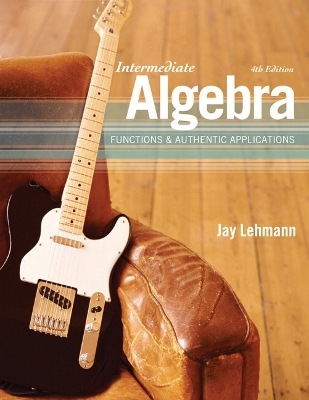
Intermediate Algebra
Pearson (Verlag)
978-0-321-62095-8 (ISBN)
- Titel erscheint in neuer Auflage
- Artikel merken

In the words of the author: Before writing my algebra series, it was painfully apparent that my students couldn't relate to the applications in the course. I was plagued with the question, "What is this good for?" To try to bridge that gap, I wrote some labs, which facilitated my students in collecting data, finding models via curve fitting, and using the models to make estimates and predictions. My students really loved working with the current, compelling, and authentic data and experiencing how mathematics truly is useful. My students' response was so strong that I decided to write an algebra series. Little did I know that to realize this goal, I would need to embark on a 15-year challenging journey, but the rewards of hearing such excitement from students and faculty across the country has made it all worthwhile! I'm proud to have played even a small role in raising peoples' respect and enthusiasm for mathematics. I have tried to honor my inspiration: by working with authentic data, students can experience the power of mathematics. A random-sample study at my college suggests that I am achieving this goal. The study concludes that students who used my series were more likely to feel that mathematics would be useful in their lives (P-value 0.0061) as well as their careers (P-value 0.024). In addition to curve fitting, my approach includes other types of meaningful modeling, directed-discovery explorations, conceptual questions, and of course, a large bank of skill problems. The curve-fitting applications serve as a portal for students to see the usefulness of mathematics so that they become fully engaged in the class. Once involved, they are more receptive to all aspects of the course.
1. Linear Equations and Linear Functions
1.1 Using Qualitative Graphs to Describe Situations
1.2 Graphing Linear Equations
1.3 Slope of a Line
1.4 Meaning of Slope for Equations, Graphs, and Tables
1.5 Finding Linear Equations
1.6 Functions
Chapter Summary
Key Points of Chapter 1
Chapter 1 Review Exercises
Chapter 1 Test
2. Modeling with Linear Functions
2.1 Using Lines to Model Data
2.2 Finding Equations of Linear Models
2.3 Function Notation and Making Predictions
2.4 Slope Is a Rate of Change
Chapter Summary
Key Points of Chapter 2
Chapter 2 Review Exercises
Chapter 2 Test
3. Systems of Linear Equations
3.1 Using Graphs and Tables to Solve Systems
3.2 Using Substitution and Elimination to Solve Systems
3.3 Using Systems to Model Data
3.4 Value, Interest, and Mixture Problems
3.5 Using Linear Inequalities in One Variable to Make Predictions
Chapter Summary
Key Points of Chapter 3
Chapter 3 Review Exercises
Chapter 3 Test
Cumulative Review of Chapters 1—3
4. Exponential Functions
4.1 Properties of Exponents
4.2 Rational Exponents
4.3 Graphing Exponential Functions
4.4 Finding Equations of Exponential Functions
4.5 Using Exponential Functions to Model Data
Chapter Summary
Key Points of Chapter 4
Chapter 4 Review Exercises
Chapter 4 Test
5. Logarithmic Functions
5.1 Inverse Functions
5.2 Logarithmic Functions
5.3 Properties of Logarithms
5.4 Using the Power Property with Exponential Models to Make Predictions
5.5 More Properties of Logarithms
5.6 Natural Logarithms
Chapter Summary
Key Points of Chapter 5
Chapter 5 Review Exercises
Chapter 5 Test
Cumulative Review of Chapters 1—5
6. Polynomial Functions
6.1 Adding and Subtracting Polynomial Expressions and Functions
6.2 Multiplying Polynomial Expressions and Functions
6.3 Factoring Trinomials of the Form x2 + bx + c; Factoring out the GCF
6.4 Factoring Polynomials
6.5 Factoring Special Binomials; A Factoring Strategy
6.6 Using Factoring to Solve Polynomial Equations
Chapter Summary
Key Points of Chapter 6
Chapter 6 Review Exercises
Chapter 6 Test
7. Quadratic Functions
7.1 Graphing Quadratic Functions in Vertex Form
7.2 Graphing Quadratic Functions in Standard Form
7.3 Using the Square Root Property to Solve Quadratic Equations
7.4 Solving Quadratic Equations by Completing the Square
7.5 Using the Quadratic Formula to Solve Quadratic Equations
7.6 Solving Systems of Linear Equations in Three Variables; Finding Quadratic Functions
7.7 Finding Quadratic Models
7.8 Modeling with Quadratic Functions
Chapter Summary
Key Points of Chapter 7
Chapter 7 Review Exercises
Chapter 7 Test
Cumulative Review of Chapters 1—7
8. Rational Functions
8.1 Finding the Domains of Rational Functions and Simplifying
Rational Expressions
8.2 Multiplying and Dividing Rational Expressions
8.3 Adding and Subtracting Rational Expressions
8.4 Simplifying Complex Rational Expressions
8.5 Solving Rational Equations
8.6 Modeling with Rational Functions
8.7 Variation
Chapter Summary
Key Points of Chapter 8
Chapter 8 Review Exercises
Chapter 8 Test
9. Radical Functions
9.1 Simplifying Radical Expressions
9.2 Adding, Subtracting, and Multiplying Radical Expressions
9.3 Rationalizing Denominators and Simplifying Quotients of Radical Expressions
9.4 Graphing and Combining Square Root Functions
9.5 Solving Radical Equations
9.6 Modeling with Square Root Functions
Chapter Summary
Key Points of Chapter 9
Chapter 9 Review Exercises
Chapter 9 Test
10. Sequences and Series
10.1 Arithmetic Sequences
10.2 Geometric Sequences
10.3 Arithmetic Series
10.4 Geometric Series
Chapter Summary
Key Points of Chapter 10
Chapter 10 Review Exercises
Chapter 10 Test
Cumulative Review of Chapters 1—10
11. Additional Topics
11.1 Absolute Value: Equations and Inequalities
Key Points of Section 11.1
11.2 Linear Inequalities in Two Variables; Systems of Linear Inequalities
Key Points of Section 11.2
11.3 Performing Operations with Complex Numbers
Key Points of Section 11.3
11.4 Pythagorean Theorem, Distance Formula, and Circles
Key Points of Section 11.4
11.5 Ellipses and Hyperbolas
Key Points of Section 11.5
11.6 Solving Nonlinear Systems of Equations
Key Points of Section 11.6
A. Reviewing Prerequisite Material
A.1 Plotting Points
A.2 Identifying Types of Numbers
A.3 Absolute Value
A.4 Performing Operations with Real Numbers
A.5 Exponents
A.6 Order of Operations
A.7 Constants, Variables, Expressions, and Equations
A.8 Distributive Law
A.9 Combining Like Terms
A.10 Solving Linear Equations in One Variable
A.11 Solving Equations in Two or More Variables
A.12 Equivalent Expressions and Equivalent Equations
B Using a TI-83 or TI-84 Graphing Calculator
B.1 Turning a Graphing Calculator On or Off
B.2 Making the Screen Lighter or Darker
B.3 Entering an Equation
B.4 Graphing an Equation
B.5 Tracing a Curve without a Scattergram
B.6 Zooming
B.7 Setting the Window Format
B.8 Plotting Points in a Scattergram
B.9 Tracing a Scattergram
B.10 Graphing Equations with a Scattergram
B.11 Tracing a Curve with a Scattergram
B.12 Turning a Plotter On or Off
B.13 Creating a Table
B.14 Creating a Table for Two Equations
B.15 Using “Ask” in a Table
B.16 Finding the Regression Curve for Some Data
B.17 Plotting Points in Two Scattergrams
B.18 Finding the Intersection Point(s) of Two Curves
B.19 Finding the Minimum Point(s) or Maximum Point(s) of a Curve
B.20 Storing a Value
B.21 Finding Any x-Intercepts of a Curve
B.22 Turning an Equation On or Off
B.23 Finding Coordinates of Points
B.24 Graphing Equations with Axes “Turned Off”
B.25 Entering an Equation by Using Yn References
B.26 Responding to Error Messages
| Sprache | englisch |
|---|---|
| Maße | 216 x 276 mm |
| Gewicht | 1670 g |
| Themenwelt | Mathematik / Informatik ► Mathematik ► Algebra |
| ISBN-10 | 0-321-62095-X / 032162095X |
| ISBN-13 | 978-0-321-62095-8 / 9780321620958 |
| Zustand | Neuware |
| Informationen gemäß Produktsicherheitsverordnung (GPSR) | |
| Haben Sie eine Frage zum Produkt? |
aus dem Bereich