Zum Hauptinhalt springen
Nicht aus der Schweiz? Besuchen Sie lehmanns.de
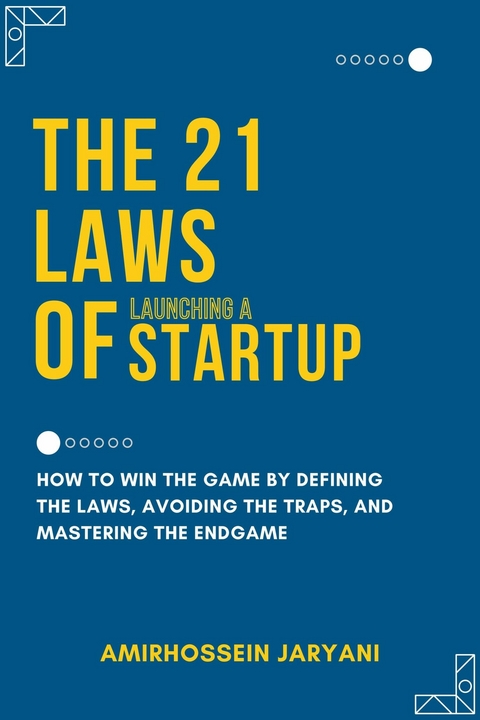
The 21 Laws of Launching a Startup -  Amirhossein Jaryani

The 21 Laws of Launching a Startup (eBook)

eBook Download: EPUB
2025 | 1. Auflage
240 Seiten
Publishdrive (Verlag)
978-0-00-111901-7 (ISBN)
Systemvoraussetzungen
0,00 inkl. MwSt
(CHF 0,00)
Der eBook-Verkauf erfolgt durch die Lehmanns Media GmbH (Berlin) zum Preis in Euro inkl. MwSt.
  • Download sofort lieferbar
  • Zahlungsarten anzeigen

Why do 90% of startups fail?


It's not because of bad ideas. It's not because of a lack of passion. It's because their founders are playing a high-stakes game without knowing the rules.


While other business books sell you feel-good fluff and survivorship bias, The 21 Laws of Launching a Startup delivers the unvarnished truth. This isn't a collection of suggestions; it's a strategic playbook of immutable laws, grounded in the catastrophic failures (Juicero, WeWork, Quibi) and legendary successes (Apple, Netflix, Nintendo) of modern business.


This book is a masterclass in strategic discipline. It destroys the myths of 'work-life balance' and 'brilliant ideas' and replaces them with a battle-hardened framework for reality.


Inside these 21 Laws, you will discover:


Law #7: Why your brilliant idea is worthless, and how to find the real market.


Law #10: The 'No Asshole Rule' and how one 'Brilliant Jerk' can kill your company (the Uber story).


Law #12: The critical difference between 'Smart Money' (Google) and 'Dumb Money' (WeWork).


Law #13: The 50/50 co-founder trap and why your equity is a weapon, not a reward.


Law #15: Why 'work-life balance' is a joke in the first 1,000 days (and what to do about it).


Law #17: How to design your 'Culture OS'-the invisible engine that dictates success or failure (the Enron vs. Netflix lesson).


Law #20: How to stop competing and change the game entirely (the Nintendo Wii strategy).


Law #21: The very first question you must answer-your Exit Strategy-and why not knowing it guarantees failure (the WhatsApp tragedy).


The 21 Laws is not just a guide to launching. It's a guide to winning. It's for founders, innovators, and leaders who are tired of the myths and ready for the rules.

law number 1
DON’T TAKE IT SO SERIOUSLY
Perfectionism is the Opportunity Killer.
In 2002, in the heart of Silicon Valley, a group of talented engineers was building what they believed would redefine the future of human interaction. They founded "Friendster." At the time, the idea was revolutionary: a platform that allowed you to connect not just with your friends, but with your "friends of friends," creating a social network of second and third-degree connections. The idea was so powerful that in the initial months of its launch, it attracted millions of users. Friendster became a phenomenon. Silicon Valley investors, including giants like Kleiner Perkins and Benchmark Capital, poured tens of millions of dollars into the company. They were the undisputed kings of the social networking hill.
But within the company's walls, an invisible enemy was growing: perfectionism.
Friendster's engineers, many of whom came from large, established software companies, were obsessed with writing "clean," "optimized," and "scalable" code. They wanted to build an architecture that could handle hundreds of millions of users without any issues. This was a commendable goal in a mature company, but for a fledgling startup, it was a deadly poison. As users flooded in, the website became increasingly slow. Pages took long minutes to load. Users grew frustrated.
The pressure to fix this problem was immense. But instead of choosing "quick and dirty" solutions—solutions that might not have been technically ideal but would have immediately improved the user experience—the engineering team insisted on a complete and "flawless" rewrite of parts of the code. They didn't want to create technical debt. They wanted to do the job "right." Every new feature, every small change, had to go through long cycles of quality review and optimization. They were building a cathedral, while their users just needed shelter from the rain.
Meanwhile, a few hundred miles away in Cambridge, Massachusetts, a college student named Mark Zuckerberg was building something called TheFacebook.com. His code was "dirty." Its architecture was chaotic. The product was full of bugs. But it had one key feature: it worked. And more importantly, it was fast. Zuckerberg and his initial team had the opposite philosophy: "Move Fast and Break Things."
While Friendster spent months debating the best way to scale its database, Facebook was releasing new features weekly. If something broke, they fixed it quickly. They understood that in an emerging market, the speed of learning is superior to technical perfection. Users didn't care about Friendster's beautiful code architecture; they just wanted to see their friends' photos. By the time Friendster woke up from its analysis paralysis, it was too late. Users had migrated to faster, more dynamic platforms like MySpace and, ultimately, Facebook. Friendster, the pioneer that was supposed to conquer the world, became a footnote in internet history. They didn't fail due to a lack of ideas, a lack of talent, or a lack of capital; they were victims of their own obsession with being perfect.
Deep Analysis: The Disease of Perfectionism in Startups
The Friendster story is a common tragedy in the world of entrepreneurship. Founders, often highly intelligent and capable individuals, are accustomed to being rewarded in academic or corporate environments for delivering flawless work. They have learned that getting a "B" is a failure and "A+" is the only acceptable outcome. They bring this mindset with them to their startup, not realizing that the rules of the game have completely changed.
In the startup world, there is no "A+," because the problem statement is constantly changing. Perfectionism in this environment is no longer a virtue; it is "Analysis Paralysis." It is the fear of being judged, the fear of failure, or worse, the fear of releasing something "imperfect."
Let's dissect this disease. Entrepreneurial perfectionism manifests itself in three main forms:
  1. Product Perfectionism: This is the most common form. The founder believes the product must have every possible feature before launch. They say, "If we just add this one more feature, users will love it." Or, "We can't launch with this design; it's not polished enough." These founders spend months or even years in "Stealth Mode," working on their masterpiece. The problem is that they are making decisions in a vacuum. They are building based on their assumptions, not market data. They forget that until a real user uses the product, all their ideas are just guesses.
  2. Strategic Perfectionism: These founders wait for the "perfect business plan" or the "perfect go-to-market strategy." They spend weeks fine-tuning their presentation slides, conducting endless market research, and trying to predict every possible variable. They forget that no business plan survives first contact with the customer. A startup's strategy is written in chalk, not cement. The value is not in the plan itself, but in the process of learning by executing the plan and adapting it quickly.
  3. Process Perfectionism: This is what brought Friendster down. It's the obsession with having "perfect" internal processes, "clean" code, or an "optimal" organizational structure from day one. Founders try to implement Google's management structure on a five-person team. They worry about "technical debt" when they don't even have "technical revenue" yet. In the early stages of a startup, chaos is not only acceptable, it is often necessary. The priority is survival and learning, not administrative elegance.
The primary danger of perfectionism is its Opportunity Cost. The time you spend changing the color of a button from blue #007BFF to blue #007AFF is time you could have spent talking to ten real users. While your competitor is learning from real user feedback and improving their imperfect product, you are still in an internal debate about technical architecture.
Perfectionism strangles creativity. When the team is under constant pressure to be "perfect," they become afraid to take risks. They avoid testing bold ideas that might fail. Instead of seeking creative solutions, they stick to "safe" and "approved" solutions. The culture of "failure is part of the process" disappears and is replaced by a culture of "failure is not an option." In such a culture, no real innovation will occur.
Global Examples: The Art of "Good Enough"
Fortunately, Silicon Valley history is full of anti-heroes who embraced this law. They abandoned perfectionism so they could win.
Reid Hoffman and LinkedIn:
Reid Hoffman, one of the co-founders of LinkedIn and a member of the "PayPal Mafia," is one of the greatest proponents of the anti-perfectionism philosophy. His famous quote is the manifesto of this law: "If you are not embarrassed by the first version of your product, you’ve launched too late."
When LinkedIn launched in 2003, it was an imperfect and limited product. Many of the features we know today did not exist. The website was slow and had bugs. But Hoffman and his team knew the most important hypothesis they needed to test was: "Are professional individuals willing to share their real identity and resume online to build a professional network?" This was a big question at the time. They didn't need a perfect messaging system or a complex news feed to answer this question. They just needed the bare minimum.
They launched the product and iterated quickly based on feedback. They accepted their initial embarrassment because they knew it was the price of speed and learning. If they had waited to build a "perfect" product, they might have missed the golden opportunity to create the professional social network.
Mark Zuckerberg and Facebook:
Facebook's early motto, "Move Fast and Break Things," was more than just a catchy phrase on the wall; it was an operational directive. This motto allowed engineers to release code quickly, even if they knew it might cause problems in other parts of the system. The philosophy behind it was that the value of learning quickly by releasing new features far outweighed the cost of fixing potential bugs.
This culture allowed Facebook to innovate at an incredible pace in its competition with giants like MySpace. While MySpace was bogged down in slow corporate decision-making processes (after being acquired by News Corp) and heavy designs, Facebook was constantly experimenting and launching. They sacrificed perfection for speed, and by doing so, they captured the market. (Interestingly, years later, as Facebook matured and had billions of users, Zuckerberg changed this motto to "Move Fast with Stable Infra." This shows that the anti-perfectionism law is specific to the launch and growth phase, not the maturity phase.)
Drew Houston and Dropbox:
Perhaps the most extreme example of anti-perfectionism is the story of the Dropbox "Minimum Viable Product" (MVP). Drew Houston had an idea for seamlessly syncing files across different devices. But building such a system was an extremely complex, time-consuming, and expensive technical challenge. If Houston had been a perfectionist, he would have spent years coding a perfect prototype, without knowing if anyone actually needed it.
Instead, he made a three-minute video.
This video didn't show the real Dropbox product. In fact, at the time, the real product didn't fully exist. The video was a...

Erscheint lt. Verlag 1.12.2025
Sprache englisch
Themenwelt Literatur Biografien / Erfahrungsberichte
ISBN-10 0-00-111901-X / 000111901X
ISBN-13 978-0-00-111901-7 / 9780001119017
Informationen gemäß Produktsicherheitsverordnung (GPSR)
Haben Sie eine Frage zum Produkt?
EPUBEPUB (Adobe DRM)
Größe: 346 KB

Kopierschutz: Adobe-DRM
Adobe-DRM ist ein Kopierschutz, der das eBook vor Mißbrauch schützen soll. Dabei wird das eBook bereits beim Download auf Ihre persönliche Adobe-ID autorisiert. Lesen können Sie das eBook dann nur auf den Geräten, welche ebenfalls auf Ihre Adobe-ID registriert sind.
Details zum Adobe-DRM

Dateiformat: EPUB (Electronic Publication)
EPUB ist ein offener Standard für eBooks und eignet sich besonders zur Darstellung von Belle­tristik und Sach­büchern. Der Fließ­text wird dynamisch an die Display- und Schrift­größe ange­passt. Auch für mobile Lese­geräte ist EPUB daher gut geeignet.

Systemvoraussetzungen:
PC/Mac: Mit einem PC oder Mac können Sie dieses eBook lesen. Sie benötigen eine Adobe-ID und die Software Adobe Digital Editions (kostenlos). Von der Benutzung der OverDrive Media Console raten wir Ihnen ab. Erfahrungsgemäß treten hier gehäuft Probleme mit dem Adobe DRM auf.
eReader: Dieses eBook kann mit (fast) allen eBook-Readern gelesen werden. Mit dem amazon-Kindle ist es aber nicht kompatibel.
Smartphone/Tablet: Egal ob Apple oder Android, dieses eBook können Sie lesen. Sie benötigen eine Adobe-ID sowie eine kostenlose App.
Geräteliste und zusätzliche Hinweise

Buying eBooks from abroad
For tax law reasons we can sell eBooks just within Germany and Switzerland. Regrettably we cannot fulfill eBook-orders from other countries.

Mehr entdecken
aus dem Bereich
Die Autobiografie

von Daniel Böcking; Freddy Quinn

eBook Download (2025)
Edition Koch (Verlag)
CHF 9,75