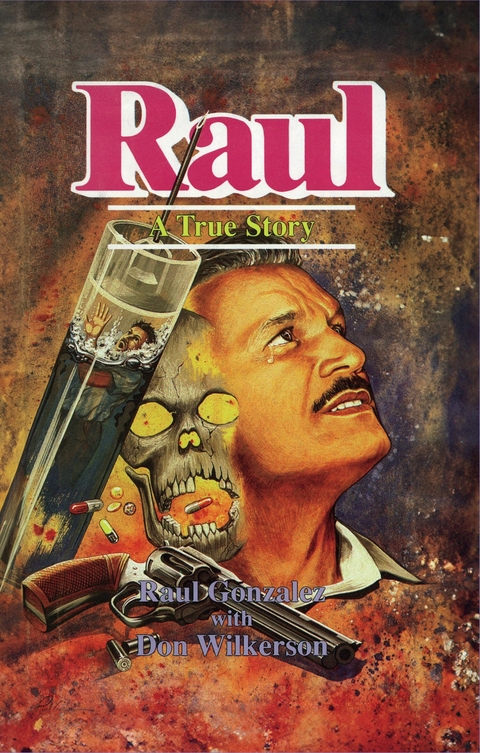
Raul (eBook)
224 Seiten
Bookbaby (Verlag)
979-8-3178-2514-0 (ISBN)
Bishop Raúl González, D.Min.? December 11, 1941 - July 5, 2009 Bishop Raúl González went to be with his Lord and Savior on Sunday, July 5, 2009. He was born on December 11, 1941 in Bayamon, Puerto Rico. He was one of seven brothers and sisters, son of Maria Luisa Villanueva and the late Pedro González. Bishop González was married in 1967 to Lady Guillermina Gongon González. They had four wonderful children, Colonel Raúl E. González, U.S. Army, Yvette Hopping, Reverend Esther González-Torres and Braulio, and four grandchildren, Jade González, Jason Ricardo, Daniel Raúl and Rey David Hopping. Bishop González was personally acquainted with the power of Jesus Christ to save and transform lives. In 1969, he was delivered from eleven years of drug addiction and saved by the power of Jesus Christ. His life was radically transformed and he received the calling to minister deliverance in Teen Challenge. Like the Apostle Paul, he was as one born out of season, for his call to the ministry and office of Bishop was not only unconventional, but indeed miraculous. He was a living testimony that with God all things are possible. He always focused on the work of the Lord with his wife 'Lady Willie' by his side. One of Bishop's favorite sayings was: 'There is a treasure in the addict'.
Raul's story shows that there is truly "e;victory in Jesus."e; It is a positive expression of the power of the gospel for those who are ensnared, abusing their body through drugs. With so many in our nation needing help and hope, this book is timely....I could hardly put the manuscript down.?? -- Tom Philips, D.Min. ?Senior Crusade Director?Director of Counseling and Follow-upBilly Graham Evangelistic AssociationBishop Gonzalez first came to Hartford, CT in 1971 to help start Youth Challenge, a faith-based residential drug free program for men and women. In 1974, Bishop Gonzalez became the Executive Director of Youth Challenge of Connecticut, Inc. He also served as the President of Youth Challenge International, providing leadership in the establishment and oversight of missions in Florida, Puerto Rico, Guatemala, Costa Rica, Venezuela, Dominican Republic, Kenya and Peru. Bishop Gonzalez had a shepherd's heart. His vision for the City was evident in that he, along with Pastor Willie, founded and pastored Glory Chapel International Cathedral in Hartford since 1979. Bishop was the founder and President of the Corinthian School of Urban Ministry in Hartford, CT, and President of the Board of Directors for Youth Challenge International School of Ministry, Wildwood, FL, all functioning under the biblical mandate expressed by the Lord Jesus Christ in Luke 4:18-19, "e;The Spirit of the Lord is on me, because he has anointed me to proclaim good news to the poor. He has sent me to proclaim freedom for the prisoners and recovery of sight for the blind, to set the oppressed free, to proclaim the year of the Lord's favor.. Through Bishop Raul and Lady Willie's ministry of deliverance, thousands of drug addicts, both men and women have been set free. May all the glory and honor go to the Lord Jesus Christ!
One “God Bless You”
Izzy greeted me as I stood at his apartment door. We hadn’t seen each other for weeks. The welcome was not a “Where have you been? I’m sure glad to see you” kind of greeting. Nevertheless, it was cordial. Nodding his head, he motioned for me to go inside.
We were old friends, part of a trio of couples – Izzy and his wife, Fran; Louie and his girlfriend, Julie; and me and my wife, Willie. The ladies had something in common – their mates were dope addicts hooked on heroin and other drugs. The three of us stuck together like soldiers – the women like the wounded on a battlefield.
This visit, however, wasn’t the usual social call.
Separated from my wife, I’d returned from being out of the city, hoping Fran could give me the latest information about what Willie was saying and feeling about me.
But first things first! I asked Izzy for the best and quickest drug connection, Willie would have to wait until I got myself “fixed.”
I said “hello” to Fran. She didn’t appear very excited to see me. I wondered if it was an omen of things to come with my wife.
“Where’ve you been? Izzy asked.
“Detroit! Don’t you remember, I went to a therapeutic drug program?” I answered, looking for sympathy.
Izzy had his problems. Something was troubling him. I sensed it but didn’t want to know what it was. We talked about his “connection.” Being away for even a few weeks meant a lot of changes on the streets and in the local drug scene. I needed to know who was selling what, where, and for how much. I couldn’t wait to get back into the routine – hustle money, cop drugs, fix – then hustle, cop, and fix again and again – three, four, five times a day.
My immediate dilemma was to keep clean long enough to let Willie think the program I’d been in had done some good. Then I’d go “get off.”
“Have you seen Willie?” I asked Fran.
“We talk,” she responded with disgust in her voice.
I was sure they talked about me. I wondered what it was all about. A married drug addict can never be sure what’s in his wife’s mind. How long she would put up with being a junkie’s wife – and near widow – I didn’t know. I felt she loved me and hadn’t given up on me yet. But I lived every day thinking it might be the last, and she’d finally decide it was enough and leave me. I remembered how Mom had taken it as long as she could but then finally left Dad for the sake of her own mental and emotional well-being. I lived with the same fear. This time, I, not my father, was the inflictor of the pain.
While visiting our old friends Izzy and Fran, I tried mustering the courage to face Willie. Our last encounter hadn’t been a good one. She’d given me an ultimatum: either get help or leave home. Since I’d left the program – gotten kicked out, to be precise – I figured I didn’t have much of a chance or grounds for her taking me back.
I thought of the best scheme – to play on her sympathy. When I’d been in hot water with Willie before, I always managed to play on one of her emotional strings and stay in her good graces. I’m about to wear out all the strings. “If she only knew what humiliation and garbage I put up with trying to get detoxified…” I decided that might work.
My effort to try to get cleaned up was an eventful one. At first, I spent ten days in an upstate New York Rehab center getting the heroin out of my system. It didn’t go quickly. I had a two-year “run” – in addict terms, meaning an unbroken period of drug use without the body ever getting cleaned out. Such a long “run” is unusual. Most addicts, in time, get arrested or check into a hospital voluntarily to cut down on the increasing amount of dope the body needs to maintain the “high.” When the drug no longer produces the desired high and is used only to fight off the sickness that comes from not having the drug, the person with an addiction tries to clean out his system so he can recapture the euphoria he used to feel.
It amazed me that I’d gone so long without an arrest, although one close call almost put me behind bars. I’d just left a “shooting gallery” (where people with an addiction hide to shoot dope, often in abandoned buildings) when police raided it. A number of my junkie friends got caught and arrested in the drug sweep. Instead of jail, I, at least, was grateful to end up in voluntary confinement in a drug-free program. But it felt just like jail. Recalling the withdrawal – “cold turkey” – I felt the pain psychologically go through my body all over again.
I’d gotten blasted (used heroin and drank alcohol) before taking the bus upstate – my last high before starting withdrawal.
At the program, they took me to a large day room and showed me a couch – the “famous couch,” I was told – to begin withdrawing. It was called the “Anchor Room.” A large boat anchor hung from the wall. Later, as the pain increased, I looked at the anchor and wished I were tied to it sinking to the bottom of an ocean.
“This is where you’ll spend your days,” I was informed, surrounded by a group of male and female addicts who’d been through the detox rigors already. Their task? To keep me “anchored” to the “couch” during my shakes, agony, and the misery of my body’s violent reaction to cutting off its heroin supply.
The first day passed without much pain. But by nine o’clock the effects of the booze and heroin wore off. I began sweating as if in a sauna. I grew worse by the minute. I wanted to run! The other residents surrounded me, confining me and giving encouragement. They weren’t going to let go.
“I can’t take it! I can’t take it.” I pleaded for help from my “Job’s comforters.” “I can’t kick a two-year run.”
“Hang tough!” I faintly heard their words.
Every time I groaned or moaned someone gave me the “hang tough” encouragement. Their words seemed like hollow nonsense. Later, I appreciated such concern. Yet kicking a habit is an individual battle. I’d have to muster up all the courage and will power to go through the coming pain. Cold turkey, the drug addict’s nightmare, is a long, lonely ordeal- the price paid for past pleasure.
I managed to tell myself “to hang tough” as minutes dragged into hours. Approaching the first night, I felt like I was between vise grips. Someone finally suggested going upstairs to my assigned room to get some sleep. With some assistance, I dragged my body onto the bed. Sleep would have been a welcome relief. I waited in agony for it to come. It didn’t.
Like a snake, I crawled, tossed, squirmed, and slithered in the bed. First hot – then cold – then hot again – then cold again. Mostly, I felt cold – bone-chilling cold. I threw up everything that could have possibly been inside my stomach, then had diarrhea.
I was still only at the end of my first day, and the beginning of my first night. Time I was ticked away like an eternity. With no one but myself and my thoughts and pain to deal with, a mixture of mental and physical torment filled my mind and body. I cursed the decision to enter the program.
During the next three days, the suffering continued to diminishing degrees. I couldn’t eat or sleep. My body weight was down to 150 from my usual 190 pounds.
On day “four” I decided to leave. Two feet of snow covered the ground outside in the Catskill Mountains. I took one look and gave up the idea. I was a prisoner of the elements outside as well as inside my own body.
On day “five” I got some light food inside me, but still couldn’t sleep. The days and nights ran together. During the night I’d lay in bed for a while, then get up and pace the room, walking for long periods. I’d lay back down again. Up and down – back and forth – yet nothing seemed to bring sleep. My body desperately needed rest. During the day I cat napped. My body refused to go into a normal sleep pattern.
The physical agony slowly subsided. But the psychological pain increased in proportion to the easing of the physical. On thought and one thought only plagued my mind. Dope! The memory of the “high” and what even one tiny shot of dope would do for me sent me into fantasy land. I had illusions of a bag of dope on the dresser, the floor, even the sink in the bathroom. It seemed to be everywhere I turned.
“One bag – a half a bag – just a taste…” I asked no one in particular, over and over again, in my mind. It only added to the psychological and emotional battle. Drug scenes rushed through my head. I pictured myself walking down South 9th Street in Brooklyn, meeting the pusher, purchasing the drug, then going to one of my favorite spots to “shoot up.” I imagined the beautiful magic powder poured out of the cellophane bag missing with water, the match heating the cooker, the dropper drawing it up through the syringe, the needle finding a vein, the point piercing the skin into the blood stream, the dope squeezed into it – and waiting, waiting, waiting for the...
| Erscheint lt. Verlag | 3.12.2025 |
|---|---|
| Sprache | englisch |
| Themenwelt | Literatur ► Biografien / Erfahrungsberichte |
| ISBN-13 | 979-8-3178-2514-0 / 9798317825140 |
| Informationen gemäß Produktsicherheitsverordnung (GPSR) | |
| Haben Sie eine Frage zum Produkt? |
 EPUB (Ohne DRM)
Digital Rights Management: ohne DRM
Dieses eBook enthält kein DRM oder Kopierschutz. Eine Weitergabe an Dritte ist jedoch rechtlich nicht zulässig, weil Sie beim Kauf nur die Rechte an der persönlichen Nutzung erwerben.
Dateiformat: EPUB (Electronic Publication)
EPUB ist ein offener Standard für eBooks und eignet sich besonders zur Darstellung von Belletristik und Sachbüchern. Der Fließtext wird dynamisch an die Display- und Schriftgröße angepasst. Auch für mobile Lesegeräte ist EPUB daher gut geeignet.
Systemvoraussetzungen:
PC/Mac: Mit einem PC oder Mac können Sie dieses eBook lesen. Sie benötigen dafür die kostenlose Software Adobe Digital Editions.
eReader: Dieses eBook kann mit (fast) allen eBook-Readern gelesen werden. Mit dem amazon-Kindle ist es aber nicht kompatibel.
Smartphone/Tablet: Egal ob Apple oder Android, dieses eBook können Sie lesen. Sie benötigen dafür eine kostenlose App.
Geräteliste und zusätzliche Hinweise
Buying eBooks from abroad
For tax law reasons we can sell eBooks just within Germany and Switzerland. Regrettably we cannot fulfill eBook-orders from other countries.
aus dem Bereich