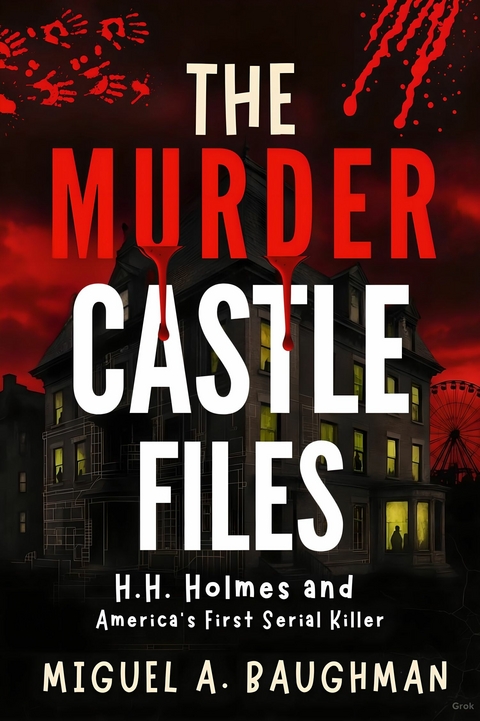
The Murder Castle Files (eBook)
179 Seiten
Seahorse Pub (Verlag)
978-0-00-111181-3 (ISBN)
Step into the twisted mind of America's most notorious killer.
Before Jeffrey Dahmer, before Ted Bundy, there was H.H. Holmes-a charming pharmacist who built a three-story house of horrors in the heart of Chicago. While millions flocked to the 1893 World's Fair celebrating human achievement, Holmes lured unsuspecting victims into his 'Murder Castle,' a labyrinth of gas chambers, secret chutes, and cremation ovens designed for one purpose: systematic death.
Drawing from authentic police records, court transcripts, and harrowing investigations, this meticulously researched account exposes the chilling truth behind the man who pioneered modern serial murder. Watch as investigators uncover soundproof rooms, airtight vaults, and a basement torture chamber that would make your blood run cold.
Discover how Holmes manipulated insurance companies, exploited desperate job seekers, and murdered entire families while maintaining a respectable businessman facade. Follow the relentless pursuit across multiple states as he races to find three missing children-a hunt that would expose the full scope of Holmes's depravity.
This is not legend. This is not folklore. This is the documented horror of the killer who changed America forever-complete with forensic evidence, witness testimonies, and the architectural blueprints of evil itself.
The Castle's Shadow
The summer heat bore down on Chicago's Englewood neighborhood on July 20, 1895, as a team of investigators approached the peculiar three-story building at the corner of Sixty-third and Wallace streets. Detective Frank Geyer, accompanied by insurance investigators and local police, carried with them a warrant and a mounting collection of disturbing testimony from former employees and tenants. The structure before them—a brick and stone edifice spanning an entire city block—had once been known locally as the "Castle," a nickname its proprietor had encouraged during the building's prosperous years. Now, with its architect and owner Herman Webster Mudgett awaiting trial in Philadelphia under the alias H.H. Holmes, the building stood mostly vacant, its windows dark, its reputation transformed from eccentric landmark to object of darkening suspicion. What the investigators would discover inside would force America to confront the existence of a killer whose systematic methods and cold calculation challenged every contemporary understanding of criminal behavior.
Holmes had been arrested in Boston the previous November on charges of insurance fraud related to the death of his business partner, Benjamin Pietzel. The investigation into that fraud had led Detective Geyer on a grim cross-country search that ended with the discovery of three murdered Pietzel children in Toronto and Indianapolis. Yet even as prosecutors built their case around the Pietzel murders, whispers had begun circulating about Holmes' Chicago operations, particularly the strange building he had constructed during the years leading up to the 1893 World's Columbian Exposition. Former employees spoke of odd construction projects, midnight cremations in the building's basement, and the disappearance of multiple young women who had worked or stayed in the Castle. The Chicago Tribune had published preliminary reports as early as July 1895 suggesting that Holmes' building might contain evidence of far more than financial crimes, characterizing it as "a gigantic murder castle" in their reporting.
As Geyer and his team entered the building that July morning, they found themselves navigating a structure that defied conventional architectural logic. The first floor housed commercial spaces—a pharmacy, various shops, and office rooms—that appeared relatively ordinary, though several witnesses had reported false partitions and hidden compartments within even these public areas. The upper floors revealed a more disturbing design philosophy. Hallways ended without warning at blank walls. Doors opened onto brick facades rather than rooms. Staircases led to ceilings. What appeared from the exterior as a standard commercial building proved internally to be a deliberately disorienting maze, constructed according to principles that served no legitimate business or residential purpose.
The second and third floors contained over thirty-five rooms, many fitted with features that transformed them from simple living quarters into something far more sinister. Several rooms had been sealed from the inside with sheet iron, making them airtight when closed. Gas pipes had been installed with fixtures inside these sealed chambers but with control valves located in Holmes' personal office one floor below, allowing occupants to be asphyxiated remotely. The investigators discovered a greased chute that descended from the second floor directly into the basement, wide enough to accommodate a human body. Police reports documented the presence of a massive kiln in the cellar, along with dissection tables, surgical instruments, and what appeared to be custom-built furnaces capable of reaching temperatures sufficient to cremate human remains. In one basement room, officers found a tank filled with corrosive acid, its metal sides eaten away by chemical action.
The building's construction history proved as revealing as its physical features. Building permits and contractor testimonies obtained during the initial investigation revealed that Holmes had employed dozens of different contractors between 1889 and 1891, dismissing each after brief periods and constantly changing the building plans. This pattern prevented any single contractor from understanding the overall design while allowing Holmes to personally oversee the installation of the building's most disturbing features. Financial records showed that Holmes had taken out multiple mortgages on the property, systematically defrauding investors and insurance companies to fund construction while never intending to honor his debts. The building itself was both monument and tool—a physical manifestation of Holmes' methodical approach to exploitation and murder.
Chicago in the 1890s provided ideal conditions for a predator of Holmes' particular talents. The city's population had exploded from roughly 500,000 residents in 1880 to over 1.1 million by 1890, fueled by industrial expansion and the influx of workers, entrepreneurs, and job-seekers drawn to America's fastest-growing metropolis. This explosive growth created an environment where individuals could arrive, disappear, and remain unaccounted for without triggering immediate alarm. The transient nature of the population, the limited communication between cities, and the absence of centralized missing persons databases meant that young women arriving in Chicago to seek employment or visit the World's Fair could vanish without immediate investigation. Holmes had recognized and exploited these conditions with calculating precision.
The 1893 World's Columbian Exposition amplified every advantage Chicago's chaos offered a cunning criminal. The fair brought an estimated 27 million visitors to the city between May and October 1893, overwhelming the city's housing capacity and creating unprecedented demand for lodging. Holmes' Castle, located in Englewood just blocks from the elevated train line providing direct access to the fairgrounds, became a profitable hotel during those months. Young women seeking employment at the fair or affordable lodging during their visits found Holmes' advertisements attractive, his rates reasonable, and his personal charm disarming. Many who checked into the Castle during those months were never seen again by their families, their disappearances lost in the general confusion of the era's limited communication systems and the assumption that they had simply moved on to other opportunities.
The investigation that followed Holmes' arrest would eventually identify at least nine confirmed victims, though the actual number remains unknown and likely far higher. Unlike the passionate, disorganized killers familiar to nineteenth-century law enforcement, Holmes displayed methodical planning, financial motivation, and remarkable self-control. He did not kill in rage or apparent madness but rather as part of calculated schemes involving insurance fraud, property theft, or simply the elimination of inconvenient witnesses. His medical training—he had graduated from the University of Michigan Medical School in 1884—provided him with anatomical knowledge and access to professional equipment, while his charm and intelligence allowed him to move freely through society, assuming aliases, establishing businesses, and maintaining an appearance of respectability even as he orchestrated systematic murder.
The record of Holmes' crimes presents both unusual richness and significant gaps. His 1895 confession, published in the Philadelphia Inquirer while he awaited execution, contains verifiable details mixed with obvious fabrications and fluctuating victim counts. Court transcripts from his trial for the murder of Benjamin Pietzel provide detailed testimony about his methods and movements. Detective Geyer's published account, The Holmes-Pitetzel Case: A History of the Greatest Crime of the Century, offers a contemporaneous investigative perspective. Architectural surveys, insurance documents, and building permits establish the Castle's physical reality. Yet questions persist about the total number of victims, the precise methods employed in some cases, and the full extent of Holmes' criminal enterprises across multiple cities. This account draws from these primary sources while maintaining clear distinctions between established facts, reasonable inferences based on documented evidence, and areas where the historical record remains incomplete.
The significance of Herman Webster Mudgett extends beyond the horrific details of his crimes to his position in American criminal history. Before Holmes, American law enforcement understood murder primarily as a crime of passion, desperation, or clear material gain—the jealous lover, the desperate thief, the feuding neighbor. Holmes represented something different: systematic, patient, and fundamentally predatory. He selected victims based on vulnerability and opportunity rather than personal connection. He killed not in moments of passion but through methodical planning spanning months. He demonstrated that murder could be approached as a business proposition, with victims selected according to their financial value or their potential to create complications for his various fraud schemes. In doing so, he forced American society to acknowledge the existence of a criminal type that existing categories failed to adequately describe—a realization that would reshape approaches to criminal investigation and psychological understanding for decades to come.
The physical evidence gathered from the Castle provided unprecedented documentation of systematic murder. Previous investigations had discovered bodies and established causes of death, but rarely did investigators encounter a purpose-built structure designed specifically to facilitate serial murder. The Castle's features—the gas chambers, the...
| Erscheint lt. Verlag | 28.11.2025 |
|---|---|
| Sprache | englisch |
| Themenwelt | Literatur ► Biografien / Erfahrungsberichte |
| ISBN-10 | 0-00-111181-7 / 0001111817 |
| ISBN-13 | 978-0-00-111181-3 / 9780001111813 |
| Informationen gemäß Produktsicherheitsverordnung (GPSR) | |
| Haben Sie eine Frage zum Produkt? |
 EPUB (Adobe DRM)
Größe: 1,5 MB
Kopierschutz: Adobe-DRM
Adobe-DRM ist ein Kopierschutz, der das eBook vor Mißbrauch schützen soll. Dabei wird das eBook bereits beim Download auf Ihre persönliche Adobe-ID autorisiert. Lesen können Sie das eBook dann nur auf den Geräten, welche ebenfalls auf Ihre Adobe-ID registriert sind.
Details zum Adobe-DRM
Dateiformat: EPUB (Electronic Publication)
EPUB ist ein offener Standard für eBooks und eignet sich besonders zur Darstellung von Belletristik und Sachbüchern. Der Fließtext wird dynamisch an die Display- und Schriftgröße angepasst. Auch für mobile Lesegeräte ist EPUB daher gut geeignet.
Systemvoraussetzungen:
PC/Mac: Mit einem PC oder Mac können Sie dieses eBook lesen. Sie benötigen eine
eReader: Dieses eBook kann mit (fast) allen eBook-Readern gelesen werden. Mit dem amazon-Kindle ist es aber nicht kompatibel.
Smartphone/Tablet: Egal ob Apple oder Android, dieses eBook können Sie lesen. Sie benötigen eine
Geräteliste und zusätzliche Hinweise
Buying eBooks from abroad
For tax law reasons we can sell eBooks just within Germany and Switzerland. Regrettably we cannot fulfill eBook-orders from other countries.
aus dem Bereich