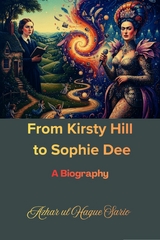
From Kirsty Hill to Sophie Dee (eBook)
146 Seiten
Azhar Sario Hungary (Verlag)
978-3-384-74978-9 (ISBN)
From Council Estate to Digital Empire: Meet the Unstoppable Sophie Dee
Hey, imagine a girl born in gritty Llanelli, Wales, in 1984-Kirsty Hill-where Coke was a rare treat and TV ran on coins. She bounces between Wales and England, changes schools nonstop, wears hand-me-downs, and hustles in cafes. Then she sells door-to-door, strips in Birmingham, becomes a Page Three star, invents 'Sophie Dee' in 2005 America, films hundreds of adult movies, retires in 2014, lands mainstream roles as Kirsty in New Girl and A Haunted House 2. She launches ToplessMovieReviews.com in 2011, builds massive social followings, joins OnlyFans in 2017 as a pioneer, earns $200K monthly, hits Forbes Top Creators in 2022, founds Gig Social and Shoutout Express, dates entrepreneur Tyler Thompson, and still grabs fish and chips with Dad in Wales. This bio traces her five parts: Welsh roots forging resilience (1984-1999), early modeling hustle (2000-2005), performer peak and dual-brand strategy (2005-2014), digital ventures (2011-2017), and mogul empire (2017-2025). Chapters unpack scarcity-driven ambition, brand splits, first-mover OnlyFans wins, investments, bisexual identity, family loyalty, dogs Bobo and Sammy, and a 15-lesson blueprint for women.
Unlike fluffy celeb tales that gloss over poverty or shame adult work, this book delivers raw, strategic truth-no regrets philosophy, exact pivots from producers to owned platforms, dual Kirsty/Sophie hedging against stigma, and proven numbers like 12.5M followers, £300K months, three luxury homes. Others hide the grind or moralize; here, resilience turns scarcity into fuel, teaching any woman to CEO her life, own platforms, diversify brands, build legacy via tools like Shoutout Express-real empowerment missing from sanitized bios.
Grab this for your no-BS guide to rags-to-riches reinvention.
© 2025 Independent Author. This biography is unaffiliated with Sophie Dee, Kirsty Hill, or any brand. Produced independently under nominative fair use for criticism, commentary, and education. All facts sourced publicly; no endorsement implied.
Part I: The Welsh Foundation: Forging Resilience (1984-1999)
The Girl from Llanelli
1.1 A Welsh Welcome: Born Kirsty Hill (Jan 17, 1984)
The story of the woman who would one day build an empire begins not with a flash of cameras, but in the muted, often damp light of South Wales. On January 17, 1984, Kirsty Hill was born. This date is not just a marker; it is a timestamp, placing her entry into a world at a specific, volatile crossroads of British history. Her arrival coincides almost exactly with one of the most painful and transformative periods for the region she would call home: the UK miners' strike, which began just weeks after her birth. This was not a backdrop; it was the atmosphere she first breathed.
Her official birthplace is registered within South Wales, a detail that immediately roots her narrative in a distinct cultural and economic landscape. Sources specifically point to the neighboring towns of Llanelli and Carmarthen. This pairing is itself revealing. Llanelli, once nicknamed "Tinopolis," was a town built on heavy industry—tinplate, steel, and coal. It was a place of hard graft, smokestacks, and a community bound by the rhythms of the factory whistle and the miners' lamp. Carmarthen, by contrast, holds the claim of being the oldest town in Wales, a historic market center on the River Towy, with a different, perhaps more pastoral, rhythm.
To be from both—to have ties to the industrial heartland and the ancient market town—paints a complete picture of her Welsh origin. She was a product of a Wales that was simultaneously industrial and ancient, a place of profound community and, at that precise moment, profound struggle.
The 1980s were a crucible for South Wales. The policies of de-industrialization were not abstract political debates; they were seismic shocks that tore through the valleys and coastal towns, closing the pits and the steelworks that had been the lifeblood for generations. The result was not just economic hardship but a crisis of identity and purpose. This is the environment into which Kirsty Hill was born. She was born not into the promise of the "New Britain" that would emerge later, but into the painful, hollowed-out aftermath of an industrial collapse.
This setting fundamentally forged the person she would become. Her generation was the first to grow up without the assumption of a job for life at the local pit or steelworks. The old paths were gone, erased. This meant that resilience, adaptability, and a raw, self-reliant ambition were not optional traits; they were primary tools for survival. The resourcefulness the user's prompt identifies as a primary virtue was, in this context, a daily necessity. One learned to make do, to see opportunities where others saw closure, and to build something from nothing, because nothing was what was being offered.
In this context, the name "Kirsty Hill" becomes incredibly significant. It is the foundational identity. It is the name tied to this land, this family, and this specific struggle. It is a name without artifice, a "private self" as the prompt notes. In a life that would later be defined by performance, reinvention, and the creation of a public-facing brand, the name Kirsty Hill served as an anchor. It was the "true north" on her compass.
This concept of a "true north" is critical. When a person's career involves creating a persona, it is profoundly easy to become lost in the character. The brand can consume the individual. But Kirsty Hill's attachment to her origins, to that private name, suggests a powerful act of psychological self-preservation. She knew who she was before she became who she had to be. This foundational self—the girl from Llanelli, the product of 1980s Welsh resilience—was the bedrock upon which her future, more famous, identity would be built. It was a conscious decision, first to set it aside to build a new life, and later, to strategically reclaim it. This reclamation was an act of integration, a signal that the constructed self and the original self were not at war, but were, in fact, two parts of a single, complex, and extraordinarily driven individual. Her Welsh heritage was not just a biographical detail; it was the essential, non-negotiable core of her being.
1.2 The Council Estate: A Childhood of Scarcity
The "why" behind a life of relentless ambition is rarely simple, but in Kirsty Hill's case, the blueprint is starkly clear. Her motivation was not forged in a boardroom or a classroom; it was forged in the cold, damp living room of a council estate in 1980s South Wales. Her childhood was not one of simple means; it was one of profound, defining scarcity. The drive that would later build an empire was not a desire for something as much as it was a desperate, visceral need to get away from something: the feeling of "want."
She articulated this with a devastatingly simple and powerful example: "I grew up so poor Coca-Cola was a luxury." This is not a casual remark. It is a precise and damning piece of evidence. Coca-Cola, the most ubiquitous, mass-market consumer product on earth, a symbol of Western accessibility, was, for her, an item of aspiration. It was a luxury good. This single statement illuminates the entire landscape of her youth. It speaks to a life lived entirely outside the casual consumerism that most of a "normal" life. It meant that birthday parties, holidays, or a simple trip to the corner shop were fraught with financial calculations that were invisible to her peers.
This was the daily reality of her family's life. The prompt correctly identifies that they "lived on a rundown council estate" and "survived on welfare." This paints a picture of a life on the margins, reliant on a social safety net that, while essential, was designed for bare subsistence, not for thriving. The "rundown" descriptor is important; it implies social neglect, disrepair, and the stigma that society often attaches to those who live in state-supported housing. It is an environment that constantly sends a message: you are "less than."
This scarcity had tangible, daily mechanics. The lack of "name brand products" meant that her family was confined to the world of generic, store-brand items. This creates a two-tiered social world, especially for a child. At school, the brand of your trainers, your coat, or the snack in your lunchbox becomes a social signifier. To never have access to those signifiers is a constant, quiet humiliation. It is a lesson in class difference taught every single day in the playground.
But the most potent example, the one that truly encapsulates the psychological pressure of her upbringing, was the television. The family television, a centerpiece of most homes, was not a source of free and easy entertainment. It required "coins into the back... when we wanted to watch it." This is a coin-operated electricity meter, a pay-as-you-go system for the poor. Imagine the experience: sitting with your family, watching a show, and knowing that your shared leisure is on a timer. The click of the meter running out, the screen plunging to black, is a brutal, recurring reminder of your family's precarity.
This environment does one of two things to a person: it either breaks them, or it turns them into forged steel. For Kirsty Hill, it became a "powerful psychological engine." Every time the TV clicked off, every time she saw a Coca-Cola advert that felt like a postcard from another planet, that engine was being fueled. The drive it created was not a shallow desire for fast cars or big houses. Those would become byproducts. The real drive, the non-negotiable goal, was for security. It was the need to build a life where she would never again have to count pennies to watch television. It was a need to create a world for herself and her family where a simple soft drink was just a simple soft drink, not a symbol of everything she could not have.
This distinction is crucial. People often misinterpret the ambition of those who come from poverty, seeing it as a greedy grasp for luxury. More often, it is a deeply rooted, almost primal pursuit of safety. It is the desire to control one's own environment, to be free from the constant, gnawing anxiety of the meter running out. This was the fire that was lit in her on that council estate, and it would prove to be an unquenchable source of fuel for the rest of her life.
1.3 Early Family Structure: Father, Stepmother, and Brother
Amidst the profound economic instability and the daily reminders of scarcity, Kirsty Hill's world was anchored by a core family unit. She "lived with her father, stepmother and brother." This structure provided the immediate context for her life, the small, intimate world that stood in contrast to the often-harsh realities of the rundown council estate outside her front door. This family was her first "team," the group with whom she navigated the challenges of a life lived on welfare.
The presence of a stepmother indicates a blended family, a dynamic that adds its own layer of complexity and, potentially, strength. It requires adaptation, the negotiation of new relationships, and the forging of bonds that are not purely biological. This environment itself can be a training ground for developing interpersonal skills and a pragmatic understanding of family as something you build and maintain through loyalty and effort, not just something you are born into.
The prompt identifies one relationship as particularly central: the bond with her father. This connection is highlighted as "one of the...
| Erscheint lt. Verlag | 8.11.2025 |
|---|---|
| Sprache | englisch |
| Themenwelt | Literatur ► Biografien / Erfahrungsberichte |
| Schlagworte | adult film star • digital entrepreneur • Kirsty Hill • OnlyFans success • Rags to Riches • Sophie Dee • Women Empowerment |
| ISBN-10 | 3-384-74978-2 / 3384749782 |
| ISBN-13 | 978-3-384-74978-9 / 9783384749789 |
| Informationen gemäß Produktsicherheitsverordnung (GPSR) | |
| Haben Sie eine Frage zum Produkt? |
 EPUB (Ohne DRM)
Digital Rights Management: ohne DRM
Dieses eBook enthält kein DRM oder Kopierschutz. Eine Weitergabe an Dritte ist jedoch rechtlich nicht zulässig, weil Sie beim Kauf nur die Rechte an der persönlichen Nutzung erwerben.
Dateiformat: EPUB (Electronic Publication)
EPUB ist ein offener Standard für eBooks und eignet sich besonders zur Darstellung von Belletristik und Sachbüchern. Der Fließtext wird dynamisch an die Display- und Schriftgröße angepasst. Auch für mobile Lesegeräte ist EPUB daher gut geeignet.
Systemvoraussetzungen:
PC/Mac: Mit einem PC oder Mac können Sie dieses eBook lesen. Sie benötigen dafür die kostenlose Software Adobe Digital Editions.
eReader: Dieses eBook kann mit (fast) allen eBook-Readern gelesen werden. Mit dem amazon-Kindle ist es aber nicht kompatibel.
Smartphone/Tablet: Egal ob Apple oder Android, dieses eBook können Sie lesen. Sie benötigen dafür eine kostenlose App.
Geräteliste und zusätzliche Hinweise
Buying eBooks from abroad
For tax law reasons we can sell eBooks just within Germany and Switzerland. Regrettably we cannot fulfill eBook-orders from other countries.
aus dem Bereich