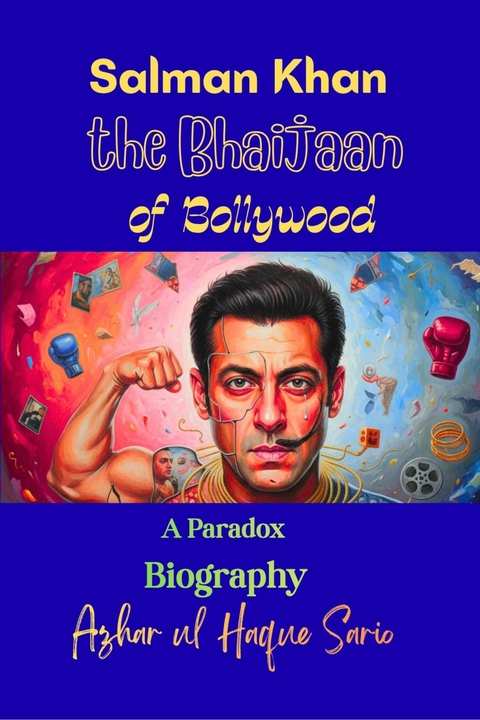
Salman Khan the Bhaijaan of Bollywood (eBook)
170 Seiten
Azhar Sario Hungary (Verlag)
978-3-384-74778-5 (ISBN)
Salman Khan is Bollywood's Bhaijaan. He is loved. He is feared. He is adored. He is controversial. This book tells his full story. From Pathan roots in Indore to Mumbai's Bandra boy. From a struggling debut in 1988 to the king of Eid blockbusters. From the 'Prem' lover to the 'Chulbul Pandey' cop. From courtroom battles to death threats. From Being Human charity to Galaxy Apartments under siege. This is his life in 15 chapters. No sugarcoating. No hero worship. Just facts, timelines, and truth.
This is not another fan book. It's not a PR piece. It's the first biography that connects every dot-family legacy, love disasters, legal nightmares, box office wins, and real-life danger. Other books skip the hard parts. They ignore the poaching case. They hide the hit-and-run truth. They gloss over Aishwarya's abuse claims. This one doesn't. It shows how the same man who plays the perfect son on screen lived with infidelity, violence, and crime off it. It reveals the 'Khan Family Playbook' of crisis control. It tracks his reinvention from flop star to Bhaijaan. And it ends with the 2024 shooting at his home and the murder of his friend Baba Siddique. No other book dares to go this deep, this honest, this complete.
You'll read how his father Salim Khan created the 'angry young man' and how Salman became its opposite-and then its heir. You'll see the 1998 blackbuck killing that still haunts him. You'll follow the 2002 hit-and-run that nearly ended him. You'll witness the rise of Being Human as image rehab. You'll understand why Sikandar failed in 2025. And you'll feel the fear of a 60-year-old star living under Y+ security, hunted by the Bishnoi gang.
This book gives you the paradox: the hero who saves girls on screen but can't save himself in real life. It's the only biography that treats Salman like a man-not a god, not a villain, but a complicated, powerful, flawed human being.
Copyright © 2025. This book is an independently produced work by Azhar ul Haque Sario. It is not affiliated with, endorsed by, or connected to Salman Khan, his family, Being Human Foundation, Salman Khan Films, or any associated entities. All facts are drawn from public records, interviews, and verified sources under nominative fair use for commentary and criticism.
The Pavement and The Breakup (2002)
8.1 The Breakup and Allegations of Abuse (March 2002)
The year 2002 marked a definitive and dark turning point in the public narrative of Salman Khan. This pivot was not driven by a film role, but by the collapse of his relationship with Aishwarya Rai, one of the most visible and celebrated actresses in modern Indian cinema. Their relationship, which reportedly began on the sets of Hum Dil De Chuke Sanam (1999), had been the subject of intense media fascination. Its end was not a quiet, dignified separation. It was a public explosion that irrevocably shattered Khan's existing "Bad Boy" persona and replaced it with something far more sinister in the public's imagination.
In March 2002, Aishwarya Rai confirmed the breakup. Unlike typical celebrity splits, which are often masked by joint statements of "mutual respect," this one unraveled in a series of shocking media reports and, eventually, a powerful statement from Rai herself. She was not silent. She alleged a pattern of behavior that went far beyond simple incompatibility, citing "harassment and abuse" as the reasons for the split.
This was a watershed moment. At the time, Rai was not just an actress; she was a former Miss World, the face of international brands, and a symbol of grace and professionalism. Her decision to go public with such severe allegations carried immense weight.
In interviews and a widely circulated press statement, Rai detailed her experience. She alleged that after she ended the relationship, Khan could not come to terms with it. The harassment, she claimed, was relentless. She spoke of "obnoxious" experiences, alleging that Khan "would call me and talk rubbish" and was deeply suspicious, accusing her of having "affairs with her co-stars."
The allegations then crossed a critical line from emotional harassment to physical violence. Rai "had also claimed that Salman had physically attacked her," adding the chilling, and for many, all-too-relatable detail that "luckily without leaving any marks." This detail was profound. It painted a picture of a woman enduring private trauma while maintaining a public facade of normalcy, as she "would go to work as if nothing had happened."
These claims did not happen in a vacuum. There had been prior public incidents that, in retrospect, seemed to support her narrative. Witnesses had reported Salman Khan causing disturbances on the sets of her films. In one infamous instance, he allegedly created a scene on the set of Chalte Chalte (2003), a film in which Rai was starring opposite Shah Rukh Khan. The disruption was so significant that it ultimately led to Rai being replaced in the film. This event lent credence to her claims of a possessive and volatile pattern of behavior.
Salman Khan has, from that time to this day, consistently and publicly denied all allegations of physical abuse. In one interview, he acknowledged the turbulent nature of the relationship, admitting to emotional outbursts and even "harming himself," but flatly denied ever striking her.
However, the public narrative had been cemented. The allegations were too specific, the source too credible. The story was no longer about a heartbroken "Bad Boy"; it was about a powerful man accused of being a controlling and violent partner.
The controversy was amplified by the reactions of those around them. Salman's brother, Arbaaz Khan, attempted to rationalize the behavior years later. He suggested that such emotional intensity was a product of the relationship itself, implying Rai "made him insecure" and "never publicly accepted the relationship." This sentiment, meant perhaps as a defense, was widely perceived as a form of victim-blaming. It suggested that her lack of public commitment somehow justified or explained the alleged harassment, which only fueled the public relations crisis.
For Salman Khan, the fallout was immediate. For Aishwarya Rai, the consequences were complex. While she gained public sympathy, she also faced the harsh realities of a deeply patriarchal industry. As she stated herself, she was subsequently dropped from several major films, a professional isolation that many interpreted as a direct consequence of her standing up to one of the industry's most powerful men.
8.2 The Hit-and-Run Incident (September 28, 2002)
If the Aishwarya Rai controversy in March had been a character assassination, the events of September 28, 2002, were a devastating, tangible catastrophe. This incident, more than any other, would come to define Salman Khan's public image and legal troubles for the next two decades. It was the moment his "Bad Boy" image, previously confined to film sets and gossip columns, collided with the real world with fatal consequences.
The year 2002 was, without question, his annus horribilis—his horrible year.
In the early morning hours of September 28, just after 2:00 AM, Salman's white Toyota Land Cruiser SUV veered off the road in the Bandra West suburb of Mumbai. This was Khan's home turf, close to his residence at Galaxy Apartments. The vehicle climbed the pavement and "rams a roadside bakery," the American Express Bakery on Hill Road.
The pavement was not empty. It was the sleeping place for a group of homeless workers. The sheer weight and force of the SUV crashing into the bakery's modest structure was devastating. The men sleeping on the pavement stood no chance.
The immediate aftermath was one of chaos and horror. When the dust settled, the human toll was horrific: "one person was killed and four were injured." The man who died was Nurullah Mehboob Sharif. The four injured survivors were Abdul Rauf Shaikh, Kalim Mohammed Pathan, Munna Malai Khan, and Muslim Shaikh.
According to numerous witness testimonies given over the years, Salman Khan was seen in the driver's seat. Witnesses at the scene, including the injured, claimed they saw the actor exiting the vehicle from the driver's side. Crucially, they also alleged that he did not stay to help. Reports from the scene claimed that Khan left the site of the accident before the police arrived in force.
This single detail—the act of fleeing the scene—was toxic. It combined the alleged crimes of reckless driving and intoxication with the profound moral failing of cowardice. The public narrative that formed within hours was not just of a tragic accident, but of a privileged superstar who, after killing one man and maiming four others, fled to save himself.
This incident became the second, and most infamous, of his major legal battles. It was a perfect storm of celebrity, alleged intoxication, and tragedy. The image of the mangled Land Cruiser, the destroyed bakery storefront, and the blood on the pavement became seared into the public's consciousness. It was the definitive crystallization of Salman Khan as a public menace, a man whose recklessness was no longer just a personality quirk but a lethal danger to the public. The pavement, for those five men, was their bedroom. The incident highlighted the stark, brutal contrast between the lives of the city's superstars and the invisible, vulnerable people sleeping on its streets.
8.3 The Arrest and Legal Aftermath (2002–2003)
The legal machinery moved swiftly, at least initially. On the same day as the incident, September 28, 2002, Salman Khan was arrested by the Bandra police. An FIR (First Information Report) was registered, and he was granted bail later that day.
The immediate legal fallout, however, was just the beginning of a complex, 13-year legal saga defined by shifting charges, disappearing witnesses, and intense media scrutiny. The initial charges filed on October 1, 2002, were serious, but the case took a dramatic turn when Mumbai Police invoked Section 304-II of the Indian Penal Code (IPC).
This was a critical legal escalation. The police and prosecution were not treating this as a simple case of rash driving.
Section 304A (Causing death by negligence): This is the lesser charge, often applied in fatal car accidents. It carries a maximum penalty of two years in prison.
Section 304-II (Culpable homicide not amounting to murder): This is a far more severe, non-bailable offense. It applies when a person commits an act with the knowledge that it is likely to cause death, but without the intention to cause death.
By applying Section 304-II, the prosecution was making a powerful argument: Salman Khan allegedly knew, or should have known, that driving a heavy SUV in an allegedly intoxicated state at high speed through residential streets was an act so dangerous that it would likely result in death. This charge carried a potential prison sentence of up to 10 years.
Following the application of this graver charge, Salman Khan was re-arrested on October 24, 2002, and subsequently secured bail from a Sessions Court.
The legal battle then began. In 2003, Khan's defense team challenged the application of Section 304-II. They argued that the incident, while tragic, was an accident and did not meet the high legal standard of "knowledge" required for a culpable homicide charge. They petitioned to have the charge reduced to the lesser Section 304A, rash and negligent driving.
In a significant, albeit temporary, victory for Khan, the Bombay High Court agreed with the defense in 2003. The court dropped the charge of culpable homicide not amounting to murder,...
| Erscheint lt. Verlag | 5.11.2025 |
|---|---|
| Sprache | englisch |
| Themenwelt | Literatur ► Biografien / Erfahrungsberichte |
| Schlagworte | Being Human Salman Khan • Bishnoi threat Salman khan • blackbuck poaching • Bollywood Bhaijaan • Bollywood biography • hit and run case • Salman Khan |
| ISBN-10 | 3-384-74778-X / 338474778X |
| ISBN-13 | 978-3-384-74778-5 / 9783384747785 |
| Informationen gemäß Produktsicherheitsverordnung (GPSR) | |
| Haben Sie eine Frage zum Produkt? |
 EPUB (Ohne DRM)
Digital Rights Management: ohne DRM
Dieses eBook enthält kein DRM oder Kopierschutz. Eine Weitergabe an Dritte ist jedoch rechtlich nicht zulässig, weil Sie beim Kauf nur die Rechte an der persönlichen Nutzung erwerben.
Dateiformat: EPUB (Electronic Publication)
EPUB ist ein offener Standard für eBooks und eignet sich besonders zur Darstellung von Belletristik und Sachbüchern. Der Fließtext wird dynamisch an die Display- und Schriftgröße angepasst. Auch für mobile Lesegeräte ist EPUB daher gut geeignet.
Systemvoraussetzungen:
PC/Mac: Mit einem PC oder Mac können Sie dieses eBook lesen. Sie benötigen dafür die kostenlose Software Adobe Digital Editions.
eReader: Dieses eBook kann mit (fast) allen eBook-Readern gelesen werden. Mit dem amazon-Kindle ist es aber nicht kompatibel.
Smartphone/Tablet: Egal ob Apple oder Android, dieses eBook können Sie lesen. Sie benötigen dafür eine kostenlose App.
Geräteliste und zusätzliche Hinweise
Buying eBooks from abroad
For tax law reasons we can sell eBooks just within Germany and Switzerland. Regrettably we cannot fulfill eBook-orders from other countries.
aus dem Bereich