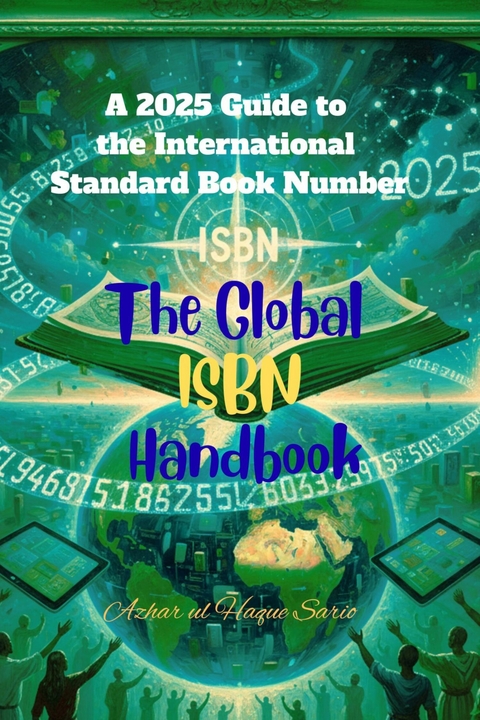
The Global ISBN Handbook (eBook)
200 Seiten
Azhar Sario Hungary (Verlag)
978-3-384-74300-8 (ISBN)
Have you ever wondered why that 13-digit number on the back of a book costs $125 in the United States but is completely free in Canada and India?
This book, The Global ISBN Handbook, is your 2025 guide to the International Standard Book Number. It explains everything about this global 'fingerprint' for books. The ISBN is the most important cornerstone of the publishing industry. It started as a simple warehouse tool in the 1960s. Now, it is a complex digital identifier used in over 200 countries. This handbook deconstructs the entire system. It uses 15 distinct national case studies to do this. You will learn how the old 10-digit system changed to the new 13-digit one. We break down the five parts of the ISBN, from the 'Bookland' prefix to the final check digit. The book explores the global governance framework, starting with the International ISBN Agency. Then, it dives deep into how different countries run their systems. You'll see the privatized, high-cost model in the United States. You'll compare it to Canada's free, government-run system. We explore the industry-led models in Brazil and Germany. We look at government-run systems in Mexico and India. We even cover the unique case of China, where the ISBN is not a simple identifier but a state-controlled publication license. The book also examines the systems in the UK , France , Russia , Japan , Australia , South Africa , Nigeria , and Egypt.
Many books and websites can tell you how to get an ISBN. This handbook is the only resource that explains why the process is so different everywhere you look. It moves beyond a simple 'how-to' and provides a true global analysis. It directly compares the privatized, for-profit models in the US and UK against the free, public-good systems in Canada and South Africa. You won't just learn the price; you will understand the cultural policies, market structures, and legal philosophies that shape that price. This book shows how the ISBN is a 'global mirror'. It reveals how a simple number can be a commercial product in one nation , a tool of cultural policy in another , and an instrument of state control in a third. This comparative insight is the missing piece for any author, publisher, or researcher trying to navigate the complex international publishing market.
Disclaimer: This handbook is an independently produced resource for commentary and analysis. The author has no affiliation with the International ISBN Agency, R.R. Bowker, Library and Archives Canada, the National Press and Publication Administration, or any other national ISBN agency. This work is independently produced under the principle of nominative fair use.
Part I: The Americas
Case Study: United States
1.1 The National ISBN Framework and Governance
In the vast and complex world of publishing, the United States stands apart. It represents the largest single market for books globally, but its operational backbone—the system that identifies every book published—is structured in a way that is unique among major nations. The entire framework for the International Standard Book Number (ISBN) in the U.S. is not a public utility or a government-mandated non-profit. Instead, it is a fully privatized, commercial enterprise. This single structural fact creates ripple effects that touch every author, publisher, retailer, and library in the country.
The sole authority for issuing ISBNs to U.S. publishers is a private, for-profit company named R.R. Bowker. This company, now owned by the data analytics giant Clarivate, was granted this exclusive role decades ago, largely because it was already the central clearinghouse for bibliographic data in the nation. This was not a government handout, but rather an industry evolution; Bowker was the logical choice to manage the new identifier system when it was adopted. This legacy is critical to understanding its modern power. Bowker's authority is not limited to just selling 13-digit numbers. Its primary, and arguably more significant, role is the management of the Books in Print database.
This database is the foundational, comprehensive bibliographic resource for the entire U.S. book trade. Think of it as the "source of truth" for the industry. When a library system wants to know what books are available on a certain topic, it queries a database that draws from Books in Print. When a Barnes & Noble or an independent bookstore wants to order a new title, their system verifies the book's existence, publisher, price, and availability through data derived from Books in Print. Therefore, when a publisher or author purchases an ISBN from Bowker, they are not just buying a product identifier. They are, in effect, paying a fee to list their product in the single most important catalog in the American publishing ecosystem. Without this listing, a book is practically invisible to the established supply chain.
This privatized governance model does not operate in a vacuum. It is deeply interwoven with key industry bodies that set the standards for how book data is communicated. The most important of these is the Book Industry Study Group (BISG), the primary U.S. trade association for supply chain standards. A subcommittee of BISG, the Book Industry Systems Advisory Committee (BISAC), develops and maintains the crucial technical specifications that allow the entire industry to speak the same language.
This "language" includes several key components. The most famous are the BISAC Subject Headings, the standardized list (e.g., "FICTION / Thrillers / Suspense") that every publisher uses to categorize its books, allowing retailers to know exactly where to shelve them, both physically and digitally. BISAC also maintains standards for metadata, electronic data interchange (EDI), and, most importantly, the ONIX (Online Information Exchange) format. ONIX is the universal XML format that publishers use to send all their book information—the ISBN, title, author, description, price, publication date, and BISAC codes—to all their trading partners, like Amazon, Ingram, and Baker & Taylor.
Here, the relationship becomes clear: Bowker provides the unique identifier (the ISBN) and the central database (Books in Print). BISG and BISAC provide the rules of the road and the data format (ONIX) for communicating the information associated with that ISBN. This creates a tightly integrated system where the private entity controlling the identifier works in perfect concert with industry associations to shape the technological and commercial framework of the entire market. This model, funded by the sale of ISBNs, is highly efficient and responsive to industry needs, but it also concentrates immense power in the hands of a single for-profit gatekeeper, establishing the economic friction that defines the market for new authors.
1.2 The Economic Landscape of ISBN Acquisition
The defining characteristic of the U.S. ISBN system is its high-cost, fee-for-service model. For any independent author or new small publisher, the first significant business decision they must make is how to acquire their identifiers, and this choice has profound, long-term consequences. As the exclusive official source, R.R. Bowker sets the price for market entry, and this pricing is structured to heavily favor large, established players.
The 2025 pricing structure is a stark illustration of this. A single ISBN, which is all a hobbyist or a one-time author might believe they need, costs a substantial $125. This price creates an immediate financial and psychological barrier. Bowker leverages economies of scale aggressively. A block of 10 ISBNs is priced at $295, dropping the per-unit cost to $29.50. A block of 100 costs $575, or $5.75 each. For major publishing houses that buy in bulk, a block of 1,000 ISBNs costs $1,500, reducing the per-unit price to a mere $1.50. This pricing strategy places a heavy, disproportionate financial burden on the smallest market entrants—individual authors.
This burden is immediately complicated by the fact that a single "book" is rarely a single ISBN. A separate, unique ISBN is required for each format of a work. An author planning to release a hardcover, a paperback, and an audiobook for a single title will need three distinct ISBNs. This means the $125 single-ISBN option is insufficient for almost any serious author, forcing them to purchase the $295 10-pack as the minimum viable option.
This high-cost barrier has directly spawned two significant alternative markets. The first is a "grey market" of third-party resellers. These are entities that buy 1,000-packs of ISBNs from Bowker at $1.50 each and resell them individually for $20 or $30. For a new author, this seems like an incredible deal. However, the risk is catastrophic. The fundamental rule of ISBNs is that the entity that buys the block from Bowker is listed as the "publisher of record" in the Books in Print database. This means if an author buys a cheap ISBN from "Joe's ISBN Resale," the publisher of their book will be listed as "Joe's ISBN Resale" forever. That reseller, not the author, has ultimate control over the book's metadata. If the reseller goes out of business, the author's book becomes an "orphan," with no way to update its price, cover, or description, effectively forcing them to unpublish it and start over.
The second, and far more dominant, alternative is the "free" ISBN offered by major self-publishing platforms. Amazon's Kindle Direct Publishing (KDP) and IngramSpark, the leading print-on-demand distributor, both offer to provide an ISBN to authors for free. This offer is the central tool of customer acquisition in the indie space. The catch, once again, lies in the "publisher of record." An ISBN provided by KDP lists the publisher as "Independently published." One from IngramSpark lists it as "Indy Pub."
Crucially, these platform-issued ISBNs are non-transferable. A KDP-provided ISBN can only be used on KDP. It cannot be used to print books at IngramSpark or at a local offset printer. If an author builds a sales history and accumulates reviews under that KDP ISBN and later decides they want to move to a different distributor, they cannot take the ISBN with them. They must obtain a new one, republish their book, and lose all the sales velocity and social proof tied to the original identifier. This is the definition of "ecosystem lock-in."
This leads to the most critical strategic decision for a modern author: investing in their own imprint. By purchasing a block of ISBNs directly from Bowker, the author can establish their own publishing company (e.g., "My Awesome Press, LLC"). This name, their name, is then listed as the publisher of record. This single act grants them complete and permanent control over their book's metadata and unassailable flexibility. They can use their own ISBN to list their book on KDP, IngramSpark, and any other platform simultaneously, all pointing back to one central, author-controlled record. This is universally recognized as the mark of a professional independent author.
The U.S. system, therefore, functions as a powerful quasi-monopoly. The high financial barrier to entry set by Bowker is not just a cost; it's a market-shaping force. It makes the "free" offers from major platforms like Amazon incredibly tempting to new authors, funneling them into closed ecosystems. In this dynamic, the "free" ISBN is the bait, and the high official cost of an ISBN is the incentive that makes the bait so effective, strengthening the market dominance of the very platforms that authors may one day wish to be independent from.
1.3 Practical Application and Supply Chain Integration
Obtaining a 13-digit International Standard Book Number (ISBN) is merely the first ticket punched on a long journey. By itself, the number is just an empty container. The true, practical application begins when that number is filled with information. This process, known as metadata registration, is what breathes commercial life into a book, transforming it from a simple manuscript into a discoverable, trackable, and sellable product in the global marketplace.
In the United States, this vital task is handled through Bowker's myidentifiers.com portal. Bowker, as the official...
| Erscheint lt. Verlag | 30.10.2025 |
|---|---|
| Sprache | englisch |
| Themenwelt | Literatur ► Biografien / Erfahrungsberichte |
| Schlagworte | book distribution • Global publishing • ISBN • Metadata • Publishing Economics • publishing industry • Self Publishing |
| ISBN-10 | 3-384-74300-8 / 3384743008 |
| ISBN-13 | 978-3-384-74300-8 / 9783384743008 |
| Informationen gemäß Produktsicherheitsverordnung (GPSR) | |
| Haben Sie eine Frage zum Produkt? |
 EPUB (Ohne DRM)
Digital Rights Management: ohne DRM
Dieses eBook enthält kein DRM oder Kopierschutz. Eine Weitergabe an Dritte ist jedoch rechtlich nicht zulässig, weil Sie beim Kauf nur die Rechte an der persönlichen Nutzung erwerben.
Dateiformat: EPUB (Electronic Publication)
EPUB ist ein offener Standard für eBooks und eignet sich besonders zur Darstellung von Belletristik und Sachbüchern. Der Fließtext wird dynamisch an die Display- und Schriftgröße angepasst. Auch für mobile Lesegeräte ist EPUB daher gut geeignet.
Systemvoraussetzungen:
PC/Mac: Mit einem PC oder Mac können Sie dieses eBook lesen. Sie benötigen dafür die kostenlose Software Adobe Digital Editions.
eReader: Dieses eBook kann mit (fast) allen eBook-Readern gelesen werden. Mit dem amazon-Kindle ist es aber nicht kompatibel.
Smartphone/Tablet: Egal ob Apple oder Android, dieses eBook können Sie lesen. Sie benötigen dafür eine kostenlose App.
Geräteliste und zusätzliche Hinweise
Buying eBooks from abroad
For tax law reasons we can sell eBooks just within Germany and Switzerland. Regrettably we cannot fulfill eBook-orders from other countries.
aus dem Bereich