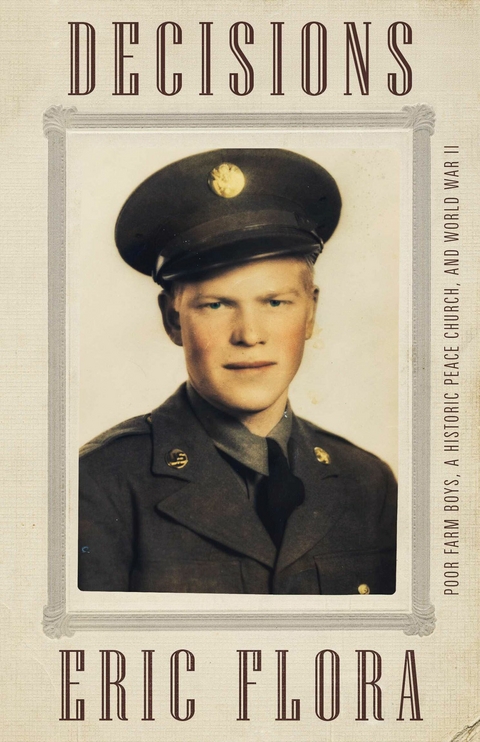
Decisions (eBook)
120 Seiten
Bookbaby (Verlag)
979-8-3178-1577-6 (ISBN)
Eric Flora is an author from Carroll County, Indiana. 'Decisions' is his latest book
The Flora family appeared deeply entrenched in the Brethren faith, tracing their ties to the Brethren tradition back to the mid-1700s. The Brethren movement has a long-standing historical dedication to pacifism and nonresistance, with the Old German Baptist Brethren consistently maintaining the belief that Christians should refrain from all forms of violence and military service. Noah Flora urged three of his sons-Harvey, Carl, and Donald-to pursue noncombat positions with the U.S. Army during World War II, as they were not eligible for exemptions and chose not to pursue alternative service options.
Chapter 1
Flora and Rockwell Families
Noah Flora urged three of his sons, Harvey, Carl, and Donald, to pursue noncombat positions with the US Army during World War II, as they were not eligible for exemptions and chose not to pursue alternative service options. During the war, forty-three thousand men registered as conscientious objectors for various religious, political, and social justice reasons. Similar to Harvey, Carl, and Donald, 58 percent of those chose noncombat roles in the armed services, 14 percent refused any service and went to prison, and the rest entered alternative service programs. Did the Floras view national church decisions as advisory rather than mandatory? Did they believe the church had never officially approved options such as alternative service camps? Did the Floras have a history of poor decision-making and financial difficulties? Why did Harvey, Carl, Donald, and their father disregard the stringent advice of the Old German Baptist Brethren (OGBB), who advised against any military service, even noncombatant roles?
The boys’ father, Noah Henry Flora, was born in January 1886 in Piatt County, Illinois, to Jacob B. Flora and Sarah Jane Miller. Three weeks later, the transcontinental railroad hauled the first load of oranges out of Los Angeles, California. The family moved to Mayville, North Dakota, in the spring of 1893. But because of unethical land agents and poor crops, they soon moved to Milaca, Minnesota, in the fall of 1896. Again, land agents took advantage of them, and in the spring of the following year, the Flora family moved to Dunn County, Wisconsin. In February of the same year, Travelers Insurance Company issued the first automobile insurance policy.
Noah was the seventh generation of the Flora family that was very familiar with OGBB beliefs. In 1903, Noah lived with his parents in Dunn County, where he joined the OGBB church by baptism at age seventeen. Noah later served as a deacon in the OGBB church, and his father, Jacob B. Flora, was an elder in the same church. Noah’s grandfather, Abraham, was an elder in the German Baptist Brethren (GBB) church and sided with the so-called Old Orders in 1881. Abraham’s father, John, served as a deacon in the GBB church.
The Flora connection to the Brethren traces back to at least Noah’s third great-grandfather, Jacob Flora, Sr., who joined the Conestoga congregation on May 1, 1748, in Lancaster County, Pennsylvania. Prior to that, the family had Anabaptist roots, if not affiliation with the Brethren. The Anabaptists came out of the sixteenth century Radical Reformation.
The immigrant Floras may have been Mennonite, another Anabaptist group, when they came to the British American colonies in 1733. Although they emigrated from the Palatinate area of Germany, the Floras almost certainly had earlier roots in Switzerland. Derivatives of the Flora or Flory name, such as Fluri or Flury, are common in the area around the Canton of Solothurn in Switzerland, appearing as early as 1508 in parish records. Almost a century later, in 1602, farmer Arnold Fluri received multiple punishments for affiliating with the Anabaptist. And in 1622, authorities imprisoned a group of Anabaptists, including Hans Fluri, for their beliefs, leading Hans to leave the area.
Prior to 1881, a single Brethren church, German Baptist Brethren (GBB), existed. That year, an Old-Order group, soon known as the Old German Baptist Brethren (OGBB) church, left the primary group. In 1883, the GBB church disfellowshipped several with so-called progressive views, and those progressives formed the Brethren Church. The remaining group, the conservatives, would later change their name to the Church of the Brethren (COB). A year after organizing, the OGBB reiterated: “This Yearly Meeting very cheerfully advises, and even urges and demands, that we ever hold sacred the non-resistant principles of our dear fraternity.”1
For those unfamiliar with the OGBB, a closer look at their teachings on warfare, pacifism, and nonresistance may be helpful. I do not intend to list every decision but only provide a reasonable overview of the church’s teachings. There were no dueling opinions of any significance in official church decisions regarding serving in the military, with the church’s position having been long established since their founding in 1708. However, some individual members obviously held opinions that did not fully align with the official church position on the issue.
In 1781, the church asked, “all brethren to [. . .] take no part in war or bloodshedding.”2 And four years later, the church decided: “We do not understand at all that we can give ourselves up to do violence. We cannot see or find any liberty to use any carnal sword.”3 The same year, the GBB church dealt with the opinions of minister Valentine Powers and his brother, Martin, on: “views about ‘carrying on war,’ which are to be proved especially from the words of Peter [. . .].”4 The church disagreed with Valentine’s views and responded: “But that the higher powers bear the sword of justice, punishing the evil and protecting the good, in this we acknowledge them from the heart as the ministers of God. But the sword belongeth to the kingdom of the world, and Christ says to his disciples: ‘I have chosen you from the world,’ etc. Thus we understand the beloved Peter, that we are to submit ourselves in all things that are not contrary to the will or command of God, and no further.”5
Again in 1790, the Powers’ issue had the attention of annual meeting where the church “unanimously concluded that we desire and pray that the beloved brother, Valentine P., would desist from his strange notion because he has renounced with us before God, angels, and men, all things that are contrary to the wholesome doctrine, and we believe and confess that Christ has forbidden to his followers the swearing of oaths and partaking of war.”6
Johann Valentine Powers had a unique personal perspective on the issue, as he had been a captive of Native Americans from 1758 to 1765. The story goes that he and his brother Michael were returning home from Fort George, Petersburg, Hampshire County, Virginia, when Native Americans attacked and killed Michael, or as other sources show, their father. Valentine never reconciled his views with the German Baptists.
One of the better-known American accounts of Anabaptist nonresistance involved the Amish family of Jacob Hochstetler in Pennsylvania. In the fall of 1757, Native Americans attacked the Hochstetler family. Jacob refused to allow his two sons to defend the family, and the family hid in the cellar while the Native Americans tried to burn them out. While trying to escape from the cellar, Native Americans scalped and killed Jacob’s wife, daughter, and son, and took Jacob and two other sons prisoners. Jacob escaped after three years. The two boys, Christian and Joseph, were prisoners for about seven years before being released. Christian later became a minister in the GBB church.
In 1863, amid the Civil War, the church, at its annual meeting, declined to discuss the question: “How are we to deal with our brethren who have enlisted and gone to the army as soldiers or teamsters, or those who have been drafted, and are gone to the army?”7 The church noted: “We think it not expedient to consider (or discuss) these questions at this time. Still, it is believed, and was expressed, the gospel gave sufficient instruction.”8 Years later, in the lead up to World War II, the church would take a similar approach and refuse to discuss the topic in a public setting, being well aware of the accusations of treason against the COB in January 1918.
At a 1918 conference in Goshen, Indiana, the COB met to discuss what “advice should be given to the church’s young men.”9 The result of the meeting was the Goshen Statement which “affirmed loyal citizenship while also asserting the church’s traditional peace stand.”10 One sentence stated: “We further urge our brethren not to enlist.”11 Third Assistant Secretary of War, Frederick Keppel, suggested charges of treason under the recently passed Espionage Act, and the COB soon advised against the use of the Goshen Statement.
In 1864, the GBB church decided: “It is considered not advisable for any brother, whether a minister or private member, to wear any military clothing [. . .].”12 They also discussed the question: “Is it according to the gospel, and the order of the brethren, to receive and baptize into the church such as are in the military service, bearing arms in this war, or to go into the camps and baptize such, and let them remain in the service, or should they not first get a full discharge before they can be received into the church by baptism?”13 They decided they: “cannot encourage such proceedings [. . .].”14
A question was also raised: “As our national troubles, consequent upon the rebellion now existing in our country, have caused considerable difficulty in our church and have tried our non-resistant principles, [. . .], what counsel will this Annual Meeting give [. . .]?”15 The church says: “[we] believe that the times in which our lots are cast strongly demand of us a strict adherence to all our...
| Erscheint lt. Verlag | 9.10.2025 |
|---|---|
| Sprache | englisch |
| Themenwelt | Literatur ► Biografien / Erfahrungsberichte |
| ISBN-13 | 979-8-3178-1577-6 / 9798317815776 |
| Informationen gemäß Produktsicherheitsverordnung (GPSR) | |
| Haben Sie eine Frage zum Produkt? |
 EPUB (Ohne DRM)
Größe: 5,2 MB
Digital Rights Management: ohne DRM
Dieses eBook enthält kein DRM oder Kopierschutz. Eine Weitergabe an Dritte ist jedoch rechtlich nicht zulässig, weil Sie beim Kauf nur die Rechte an der persönlichen Nutzung erwerben.
Dateiformat: EPUB (Electronic Publication)
EPUB ist ein offener Standard für eBooks und eignet sich besonders zur Darstellung von Belletristik und Sachbüchern. Der Fließtext wird dynamisch an die Display- und Schriftgröße angepasst. Auch für mobile Lesegeräte ist EPUB daher gut geeignet.
Systemvoraussetzungen:
PC/Mac: Mit einem PC oder Mac können Sie dieses eBook lesen. Sie benötigen dafür die kostenlose Software Adobe Digital Editions.
eReader: Dieses eBook kann mit (fast) allen eBook-Readern gelesen werden. Mit dem amazon-Kindle ist es aber nicht kompatibel.
Smartphone/Tablet: Egal ob Apple oder Android, dieses eBook können Sie lesen. Sie benötigen dafür eine kostenlose App.
Geräteliste und zusätzliche Hinweise
Buying eBooks from abroad
For tax law reasons we can sell eBooks just within Germany and Switzerland. Regrettably we cannot fulfill eBook-orders from other countries.
aus dem Bereich