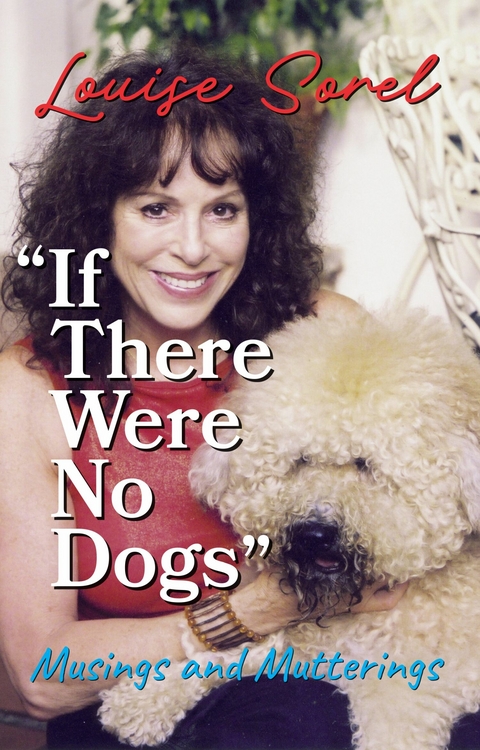
"e;If There Were No Dogs"e; (eBook)
268 Seiten
Bookbaby (Verlag)
979-8-3178-1228-7 (ISBN)
Louise Sorel's father was a Hollywood movie producer and her Egyptian-born mother an actress and musician. She attended Hollywood High School where she studied theater. She was assigned by her drama teacher the challenge of the role of Medea. Ironically and happily, she later became close friends with Dame Judith Anderson, the iconic Medea of the theater world. Louise Sorel began her career on Broadway with actors such as Art Carney, Charles Boyer, and Rita Moreno, and toured with George C. Scott, Walter Pidgeon, and many others. She guest-starred in dozens of TV shows and movies such as Bonanza, Route 66, Kojak, Medical Center, The Flying Nun, Airplane 2, Plaza Suite, Star Trek, and many others. She appeared as Augusta Lockridge on the show Santa Barbara, and has starred as the iconic character Vivian Allemain on the show Days of Our Lives for many years.
The book is a collection of prose pieces and poems by actress Louise Sorel drawn from her life, childhood, and career. Her father was a Hollywood movie producer and her Egyptian-born mother an actress and musician. Louise Sorel began her career on Broadway with actors such as Art Carney, Charles Boyer, and Rita Moreno, and toured with George C. Scott, Walter Pidgeon, and many others. She guest-starred in dozens of TV shows and movies such as Bonanza, Route 66, Kojak, Medical Center, The Flying Nun, Airplane 2, Plaza Suite, Star Trek, and many others. She appeared as Augusta Lockridge on the show Santa Barbara, and has starred as the iconic character Vivian Allemain on the show Days of Our Lives for many years. Louise's life and adventures from which this book comes have been motivated by her love of the theater, her devotion to dogs and other animals, and her many travels.
Wooden Bridge
I carefully teeter across the rickety wooden bridge to my little red school house. Looking down, I can see the wash filled with water, and as I cross this swinging path to school, I wonder if this is a test of my five-year-old courage.
It is 1945 and the world is at war. We even have a bomb shelter in our backyard in North Hollywood, California. This would later turn into some sort of truncated and uninviting swimming pool.
I cross this tinkertoy bridge every morning with encouragement from either my mother or my father. “You’ll be fine Louise. The bridge won’t fall down.”
I am thinking if it’s so fine, why don’t you come with me? But I guess it’s all right since I don’t sense any concern on their part. Usually my mother says, “I’ll see you in a few hours. Go on, Louise, the teacher is waiting, you don’t want to be late.”
“I don’t?” I think. “No, I don’t, but more important, I don’t want to be dead!”
This is kindergarten and I don’t really understand the purpose of it, except that I manage to get there, sit there, wash my hands at least three times, and then get scooped up by my mother, who seems to be able to drive around to the school house avoiding the rickety bridge altogether and then ride in her car while she does chores such as grocery shopping, consuming the loaf of bread she has just bought that never gets to the table in one piece.
When we get home, I zoom through the magical gates that separate our big house from my grandparents’ little house and into my grandmother’s arms.
Aside from our bomb shelter, we had a chicken coop behind my grandparents’ house. It was a large coop with gray wiring and was constructed by my grandfather with great care. We had fresh eggs every morning. I can’t vow as to whether any parts of those chickens were consumed, all I know is that I was constantly being pecked at by one or another of them. This couldn’t be how I developed my obsessive love of animals because every once in a while, I wanted to wring one of their scrawny little necks.
My grandfather was from Odessa. He fled to Egypt and married my Alexandria-born grandmother and managed to bring the family, which had grown to two sons and two daughters, to the United States via Ellis Island. My mother was the oldest and was a gifted pianist at the age of four. Her teacher begged my grandparents to leave her in Alexandria so that she could develop her talents, but of course, they wouldn’t do that.
Ganka (as I called my grandfather) was great with his hands and could build anything. He had a love of women, wrestling, and small exotic fish. Not necessarily in that order.
My most memorable moments with my Ganka were when I would go on a bubble gum hunt and find the sweet pink balls of sugar wrapped in wax paper with cartoons on them. I knew they would be in the top drawer of the dresser but always pretended I was on the hunt.
Ganka had a fish tank that he adored and he would let me sprinkle tiny particles of food at feeding time and he pointed out the names of each of his prized, brightly colored little creatures. He also seemed to have a magical way of making his moustache disappear and then suddenly reappear, telling me he had used fertilizer on his lip. To a small child it seemed like it happened overnight.
My Ganka loved women and there were lots of nude drawings and photos that he had brought from Egypt and Russia that peered at me from various corners of their small living room. I always wondered if my grandmother felt comfortable with them or whether she was not just my grandmother, Fanny, but a passionate Jewess under cover.
Ganka loved wrestling and I would sit in wonder as men punched each other out, thinking it was strange for a man who seemed so gentle and full of humor. He had blue, blue eyes and from early pictures I could see how dapper he was. He had a bad habit of smoking filter Camel cigarettes; taking me aside, pulling out his white handkerchief and blowing into it, this would produce an ugly yellow substance on the cloth, and he would say to me, “Louise, never do this. It’s very bad for you.” Sadly, he never heeded his own advice and died of lung cancer.
He had a huge black Packard with a rumble seat. I didn’t know what that was until years later. But I used to love to jump into it because it seemed to trail behind the car and I felt very independent. Ganka loved working on that car and later ended up running the gas station opposite Republic Pictures where my father worked. This was not very clear to me until I was about eight.
There was a lot I was never told about my family history. I only recently realized that my grandfather had never identified his father. This was owing to the fact that his mother refused to marry, at a time that it was unheard of for women. There was talk that she had an affair with Theodore Herzl, the man who was instrumental in Zionism. We will never really know who my great grandfather was. It doesn’t really matter though because my Ganka was a living gift. He spoke four or five languages.
My grandmother (Nana) was petite and I thought very gentle. But there were times she and my mother would argue in French and the anger was palpable. I remember her kitchen smelling of eggplant salad and fresh bread. I could eat an entire bowl every day and never tire of it. Instead of ice cream I grew up loving savories. Nana would make little utterances when she drove with me and my mother. “Watch, watch. Oy, oy. Watch, watch.” She was fearful and coiled up in some way. She was keenly aware of the tension and fights that went on in the big house with my parents but would try to shut it out. I think it was too painful for her.
Of all the things my father did or didn’t do as a man, he did one great thing and that was to give my grandparents a home with us. He even bought them burial plots. This is something I found out long after his death. It is the most profound thing he ever did in my eyes. Profound and unexpected, as I never knew of him reaching out to anyone. I still sometimes drive by that piece of land in the valley of Los Angeles that is now an unrecognizable collection of condominiums and mourn the two houses that held my tiny world. Two worlds split like atoms.
Music came to me through my mother. There was a beautiful baby grand piano in our living room. It was placed in a giant picture window that was floor to ceiling and it was where I would sit with my mother as she would play French songs or just practice her Mozart or Rachmaninoff or whatever that day would bring. I learned French songs and we would usually sit there at dusk awaiting my father’s return from work. That was always a time of excitement for me. He would arrive at the gates in his big black car and I would feel that everything was complete or at least that our house was all together for the night. It wasn’t until later that I realized he worked almost around the corner or practically in our backyard. Our street dead-ended at a bridge and right across that much sturdier bridge than the one I walked to school on was Republic Studios where he produced films.
My parents met in some mysterious way that I was never privy to. My mother had been hailed as “the next Garbo” and she did two films, but was too frightened to continue, and somewhere along the way, early in her life, my father captured her. It was an odd pairing. My father had come from Philadelphia with a hushed-up history behind him. He had been married, had a child, and then left for Hollywood to make his way. He was a singles tennis champion and that immediately opened up a social world. He worked with the Hollywood trade papers, met a writer, and teamed up for some scripts. In a very short time, he was producing and becoming successful. I just knew he went to work when I was very little. It wasn’t until I was about eight that I became aware of the world he lived in.
“Louise, we are going to lunch with Daddy.” Off we would go. Down the street, turn left, left again, and we were there! How could Daddy be so close and yet seem so far away all day? Why was there such anxiety about his dinnertime arrival when he was just around the corner?
Between the fights and the silences, a schism was created that caused me to well up with fear. How could everything seem to be normal and yet fearful? Why did I want to sleep and eat with Ganka and Nana so often? Why did the bubble gum hold so much more joy than the Christmas gifts?
I am tiptoeing along the cement siding that outlines our driveway. There are three huge Christmas trees that shield our house from the street. I am wearing a dark gray jumper and my hair is a stubborn shade of yellow brown. I get to do this because we have a huge gate that keeps me from going into the street. I don’t always have this freedom because I wander off. At three years of age, I evidently disappeared or so it seemed then. I was found on the second floor trying to climb out a window. This pattern is pretty consistent in my life.
I left home at eighteen. I think I was leaving all my life, and yet I kept thinking I had a safe haven.
My mother smelled of Shalimar, cigarettes, and coffee. My father smelled of Jean Nate and cigars. They both wore glasses. My mother for reading books and music. My father for everything. I did not inherit any of the above. The smells still catch me off guard. Shalimar perfume is almost extinct but I managed one day to find it. A day when my mother’s aura hit hard and I inhaled her so deeply that it hurt. This was six years after she died. The smell made me feel...
| Erscheint lt. Verlag | 5.9.2025 |
|---|---|
| Sprache | englisch |
| Themenwelt | Literatur ► Biografien / Erfahrungsberichte |
| ISBN-13 | 979-8-3178-1228-7 / 9798317812287 |
| Informationen gemäß Produktsicherheitsverordnung (GPSR) | |
| Haben Sie eine Frage zum Produkt? |
 EPUB (Ohne DRM)
Größe: 2,0 MB
Digital Rights Management: ohne DRM
Dieses eBook enthält kein DRM oder Kopierschutz. Eine Weitergabe an Dritte ist jedoch rechtlich nicht zulässig, weil Sie beim Kauf nur die Rechte an der persönlichen Nutzung erwerben.
Dateiformat: EPUB (Electronic Publication)
EPUB ist ein offener Standard für eBooks und eignet sich besonders zur Darstellung von Belletristik und Sachbüchern. Der Fließtext wird dynamisch an die Display- und Schriftgröße angepasst. Auch für mobile Lesegeräte ist EPUB daher gut geeignet.
Systemvoraussetzungen:
PC/Mac: Mit einem PC oder Mac können Sie dieses eBook lesen. Sie benötigen dafür die kostenlose Software Adobe Digital Editions.
eReader: Dieses eBook kann mit (fast) allen eBook-Readern gelesen werden. Mit dem amazon-Kindle ist es aber nicht kompatibel.
Smartphone/Tablet: Egal ob Apple oder Android, dieses eBook können Sie lesen. Sie benötigen dafür eine kostenlose App.
Geräteliste und zusätzliche Hinweise
Buying eBooks from abroad
For tax law reasons we can sell eBooks just within Germany and Switzerland. Regrettably we cannot fulfill eBook-orders from other countries.
aus dem Bereich