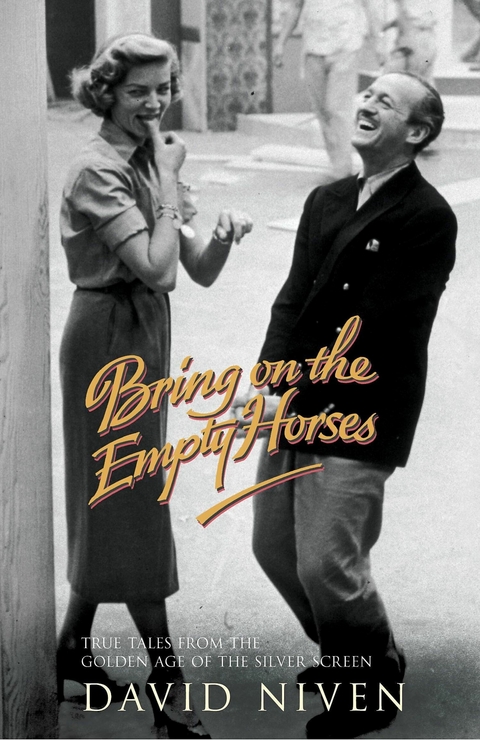
Bring on the Empty Horses (eBook)
258 Seiten
Publishdrive (Verlag)
978-0-00-103390-0 (ISBN)
David Niven recalls his time in Hollywood during its heyday. He recounts stories and anecdotes of the stars, producers, directors, tycoons and oddballs, many of whom were his friends.
THE PLAYPEN
WHEN Gertrude Stein returned to New York after a short sojourn in Hollywood somebody asked her… 'What is it like — out there?'
To which, with little delay and the minimum of careful thought the sage replied… 'There is no "There" — there'.
To try and describe to the reader the self-styled 'Glamour Capital of the World' it seems best to do so as it appeared just before the outbreak of World War II, because although this book describes some events between 1935 and 1960, that particular upheaval caused the number of inhabitants and automobiles in Los Angeles to double. Up until then there had been plenty of room and fresh air for everyone — one square mile for every four persons to be precise—very little industry, the worst transportation system of any major U.S. city, and clear blue skies without a hint of 'smog' — not a word invented by a local wit, but borrowed from the City of Glasgow where it had justifiably been in constant use since the turn of the century. Later, the reader will find a list of the actors and actresses who were in 1939 under contract to just one of the seven major studios, giving him an idea of the investment the Moguls had in talent and the problems they must have had in keeping that talent gainfully employed.
There were four ways to approach Los Angeles from the East Coast:
(1) By automobile, which took ten days of fast driving and entailed facing red dirt roads across large tracts of Arizona and New Mexico with no prospect of a motel at the end of the day.
(2) By train, leaving New York on the 20th Century Limited at 6 p.m. and standing respectfully aside while famous movie stars smiled for the New York papers as they were escorted by railroad officials along a red carpet to their sleeping compartments. On arrival at Chicago the following morning, the sleeping cars were shunted around the marshalling yards and by noon, were tacked on to the rear of the Santa Fe Chief (steam locomotives until 1939) which two days later puffed to a stop at the Union Station, Los Angeles where the famous movie stars perched on piles of matching baggage, and smiled for the Los Angeles papers.
(3) By plane, which was not for the faint-hearted — a minimum of eighteen cramped and often nerve-racking hours flying in unpressurised and largely unheated twin-engined machines at low altitudes through sometimes appalling weather with the nasty possibility of thudding into either the Alleghenny or Rocky Mountains at one end of the trip, or —
(4) As I did it — by sea, an endless voyage of fluctuating comfort in a 'dry' ship via Cuba and the Panama Canal.
The whole Los Angeles area was subject to frequent earth tremors accounted for by an ill-advised proximity to the San Andreas Fault and on the very day of my arrival in San Pedro I had noted from the deck of S.S. President Pierce that people at dockside beneath a swaying water tower were scurrying about looking nervously upward, wondering which way it would fall. It didn't, as it happened, and the next morning the Chamber of Commerce routinely reassured us that there had been no cause for alarm. But it was perhaps an early warning that I was heading for the breeding ground of stresses and strains.
The 'Film Folk', I discovered, unwound at their favourite playgrounds, the beaches, the mountains at Arrowhead and Big Bear, and the desert at Palm Springs — a tiny colony in the middle of Indian-owned land which boasted a main street and two hotels. Santa Anita Racecourse was also very popular with them and there were various Country Clubs which dispensed golf, tennis, and an extraordinary degree of segregation. Not one had a black member and several refused to have Jewish members, which prompted the Jewish community to start their own Country Club and to take in no Gentiles (they also found oil in satisfactory quantities beneath their fairways which provided them with a splendid opportunity for nose-thumbing): but the 'topper' was the prestigious Los Angeles Country Club which adamantly refused to have anything whatever to do with anyone in the motion picture industry irrespective of race, creed or colour.
Greater Los Angeles, a city which grew more quickly than the city planners had planned, was not remarkable for its beauty and it was necessary to disregard the largely temporary appearance of the buildings and the unsightly forests of poles and overhead wiring and concentrate on its truly remarkable setting in the horseshoe of the San Gabriel Mountains, and the sunsets.
In Hollywood itself, a place of dusty Baroque charm, one important thoroughfare, La Cienega Boulevard, separated with great subservience on either side of an oil derrick pumping slowly like a praying mantis, and in the scrub-covered hills above, underlining its claim to fame, was a forty-foot-high wooden sign — HOLLYWOODLAND.
Beverly Hills, another suburb, had gone against the haphazard planning of greater Los Angeles and when the Rodeo Land and Water Company decided to develop their gently sloping acreage they had the great good taste and foresight to send for an expert from Kew Gardens who planted a different species of tree for every street, and thereafter a fascinating variety of architecture proliferated beneath maples, magnolias, palms, corals, pines, sycamores, flowering eucalyptus, elms, olives, jacarandas and oaks. A home in Beverly Hills was the status symbol of success in the pre-war motion picture industry and the area boasted more private swimming pools and detectives to the square mile than anywhere else in the world. Everything in Southern California seemed to me to be an enlargement — the bronzed and sun-bleached girls and boys of the beaches were representatives of a master race bred in freedom, sunshine and clean air, but if the robins were the size of pigeons and the butterflies had the proportions of bombers, the diminutive honey-hunting humming birds brought things back into perspective as they whizzed merrily about with their tiny waistcoats of turquoise, vermilion and gold flashing in the sunlight.
The relaxed village-like atmosphere of Beverly Hills was very catching and at the hub of the movie social wheel in 'The Brown Derby' restaurant, the men wore loafers, open neck shirts and sports jackets, while the girls, lately liberated by Marlene Dietrich's earth-shaking appearance in a man's suit, appeared enthusiastically in slacks and the waitresses were pretty, would-be actresses in varying stages of disenchantment.
The two tennis clubs most highly regarded by the movie colony were the Beverly Hills and the West Side. The Beverly Hills was by far the better club and the tennis there was of a much higher standard with Fred Perry giving points and taking on all corners, but I myself joined the West Side because the committee had wisely decided that beautiful girls were a more digestible ingredient than perspiring professionals, and I will never forget a fancy dress party on the premises at which a young lawyer named Greg Bautzer arrived, on his face a grin so wide he looked like a Hammond Organ and on his arm, aged seventeen, ridiculously beautiful and dressed as Bo Peep, Lana Turner.
The Home of the Phoney Phone Call was the over-chlorinated pool of the Beverly Hills Hotel around which little-known agents reclined, red-eyed and sweaty, waiting for the loud-speaker to relay messages which they themselves had carefully arranged to be broadcast…
'Mr. Bleepburger please be good enough to call Mr. Darryl Zanuck and Miss Claudette Colbert when you have a moment — urgent.'
Written-out gag writers were also present keeping their ears open for any anecdote that could be twisted to their advantage. 'Fun-ee!… Fun-ee!' they would nod sagely without a glimmer of a smile, then hasten away to make notes, and all the time the long-legged, high-bosomed, tight-assed girls in swimsuits and high heels hopefully ebbed and flowed around the recumbent denizens of the water hole.
In the late thirties the twice-weekly programme presented by most theatres consisted of a newsreel, a cartoon, a 'short', The Second Feature and The First Feature. The whole show lasted for a bum-numbing four hours, but as a result Hollywood was booming with Metro-Goldwyn-Mayer, one of the seven major studios, boasting that it alone turned out one feature film each week.
Edmund Lowe was famous for many films but chiefly for the ones he made in partnership with Victor McLaglen; he and his secretary befriended me soon after my arrival in Hollywood because she decided that I looked like her employer. She had noticed this resemblance when I had been standing outside the main gate of Paramount Studios watching for the stars in their fancy automobiles, and had stood out, apparently, from the curious throng of sightseers and out-of-work 'extras' because in my mouth had been a large cork. This cork and the likeness to Edmund Lowe had so intrigued the lady that she had ordered the chauffeur to return and bring me before her master. Eddie Lowe was a friendly, smiling man; he explained that he was looking for a 'double' and asked if I would be interested in the job. I thanked him and told him that I was hoping to become an actor myself, not mentioning that I thought he looked like my father.
'Why the cork?' he asked. I explained that E. E. Clive, an elderly character actor from the theatre who had cornered the film market in butler and judge roles, had given me a valuable hint on how to increase the resonance of my voice, which he had decided was negligible.
'Get a long cork, my boy,' he had ordered, 'out of a hock bottle preferably — though I doubt if many people drink hock in this backwater — shove it lengthwise between your teeth and, when you have...
| Erscheint lt. Verlag | 26.8.2025 |
|---|---|
| Sprache | englisch |
| Themenwelt | Literatur ► Biografien / Erfahrungsberichte |
| ISBN-10 | 0-00-103390-5 / 0001033905 |
| ISBN-13 | 978-0-00-103390-0 / 9780001033900 |
| Informationen gemäß Produktsicherheitsverordnung (GPSR) | |
| Haben Sie eine Frage zum Produkt? |
 EPUB (Adobe DRM)
Größe: 1,2 MB
Kopierschutz: Adobe-DRM
Adobe-DRM ist ein Kopierschutz, der das eBook vor Mißbrauch schützen soll. Dabei wird das eBook bereits beim Download auf Ihre persönliche Adobe-ID autorisiert. Lesen können Sie das eBook dann nur auf den Geräten, welche ebenfalls auf Ihre Adobe-ID registriert sind.
Details zum Adobe-DRM
Dateiformat: EPUB (Electronic Publication)
EPUB ist ein offener Standard für eBooks und eignet sich besonders zur Darstellung von Belletristik und Sachbüchern. Der Fließtext wird dynamisch an die Display- und Schriftgröße angepasst. Auch für mobile Lesegeräte ist EPUB daher gut geeignet.
Systemvoraussetzungen:
PC/Mac: Mit einem PC oder Mac können Sie dieses eBook lesen. Sie benötigen eine
eReader: Dieses eBook kann mit (fast) allen eBook-Readern gelesen werden. Mit dem amazon-Kindle ist es aber nicht kompatibel.
Smartphone/Tablet: Egal ob Apple oder Android, dieses eBook können Sie lesen. Sie benötigen eine
Geräteliste und zusätzliche Hinweise
Buying eBooks from abroad
For tax law reasons we can sell eBooks just within Germany and Switzerland. Regrettably we cannot fulfill eBook-orders from other countries.
aus dem Bereich