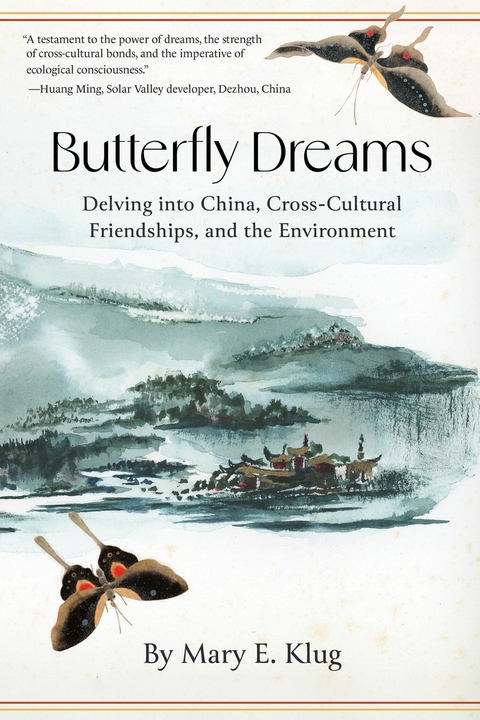
Butterfly Dreams (eBook)
329 Seiten
Green Fire Press (Verlag)
979-8-9899452-9-0 (ISBN)
For 36 years, Mary Klug was a flight attendant for Delta Air Lines. She has been teaching English as a Second Language for several decades, both professionally and as a volunteer. Mary is presently the Vice President of the New England chapter of the US-China Peoples Friendship Association, and an active member of the Pachamama Alliance. She volunteers for the North Shore Node of the environmental group 350MASS. Mary lives with her cat, Emma, in Marblehead, Massachusetts. She can be reached at meklug22@hotmail.com or through her blog: ecojourneyinchina.blog.
"e;Get to China before it changes too much,"e; Mary was advised. It was 1982, and China was beginning to transform itself after years of isolation. When Mary, a seasoned Delta flight attendant, arrived in Hangzhou a year later, her life also began a major transformation. China became her passion-at times her nemesis and ultimately her teacher-as she returned year after year, decade after decade. Butterfly Dreams tells the story of how, through years of friendship and exploration, Mary came to discover her life's purpose: working with others, in China and the United States, to create a sustainable and thriving Earth for all.
Chapter One
Hangzhou, China, 1983
“Just get to China before it changes too much,” my flight attendant colleague had advised a year earlier, transforming the trajectory of my life in ways I could not have imagined.
I pushed the key into the lock, turned it, and shoved the door open, entering my first abode in Hangzhou. The dimly lit corridor barely revealed a dark cavernous high-ceiling room. As instructed, I slipped the wooden part holding the key into the wall slot magically activating the room’s electricity. Western hotels should save electricity like this, I thought as I flipped on the overhead switch, exposing two single beds with red-flowered comforters providing a bit of brightness in the otherwise unadorned room. A thermos and teacups sat on a round table near a huge wooden desk in front of a window, its grey curtains hiding the outside world. An ancient armoire almost reached the ceiling.
I crossed the concrete floor to a huge bathroom with a tub and shower head (though no shower curtain), a Western-style toilet, a sink with a chipped glass shelf, and an equally chipped mirror above. On the shelf sat a comb with a few black hairs, a thick tumbler, and a tiny piece of soap.
Our tour group had been assigned to this guesthouse, situated in a government compound outside Hangzhou proper. China was experiencing a hotel room shortage as she opened her doors wider and wider to the outside world, resulting in groups being assigned to unexpected places—in our case, a guesthouse intended for Chinese officials.
Knock, knock, knock. I opened the door. There was a man with my large suitcase.
“Xie xie (thank you),” I said, nodding to indicate that it was mine. My instinct to give him some coins in thanks was trumped by the warning in my guidebook: don’t tip. A smile was my thanks as I closed the door.
Our first day had been a full one, flying from Hong Kong to Hangzhou, gawking out our huge bus’s windows at roads filled with bikes but few cars, and a lovely welcome at a tea house. I wanted a quick shower before climbing into bed. However, my bathroom ritual when traveling needed to be completed before I could sleep. I dug through my bag, found the Lysol bottle and flip flops. As an 18-year flight attendant veteran, a world traveler, and an obsessive-compulsive to boot, I had packed the tools necessary to make my stay acceptable no matter where I traveled. I dropped the plastic shoes next to the tub, picked up the small roll of rough brown toilet paper, tore off a bit, and folded it into a nice, neat square. I put a teaspoon’s worth of antiseptic and some water on the paper and ran the mixture around the toilet seat, once, twice, three times, making sure I hit every spot. As I turned to sanitize the wash basin and tub, I questioned myself. Do I need to clean them? What was a “real” concern, what wasn’t?
Questioning myself—often leading to intense anxiety—resulted from an Obsessive Compulsive Disorder (OCD) that had plagued me since childhood. Although I had taught myself techniques to combat an obsession, I would know when I was unsuccessful by a flush flowing through me, a warning of the dreaded anxiety to come, demanding an action—in this case, it would insist that I clean the toilet seat again and again and again. Obeying and carrying out the compulsion eventually led to a kind of relief, an exhausting cycle I was too familiar with.
I had no doubts my actions were justified. I would not sit on a toilet outside my home without lining it. But would I be going too far in sanitizing the sink and the tub? The bathroom took on the smell of a hospital as I splashed the liquid inside the bathroom fixtures. I was relieved to feel no flush, no dread. Travel often allowed me to escape my obsessions, indulging my real or excessive habits, letting my mind choose to believe I was justified going the extra bit to feel comfortable in my new environment.
That should do it, I thought as I stepped into the tub without a curtain, figured out how to turn on the water, and tried to keep its splashes inside the bath and out of my mouth.
Clean, I slipped into my flip-flops, thankful I had them. I had been unsuccessful in keeping the water from spraying onto the floor, and the drain in the middle of the room had backed up, leaving a murky puddle around it. Skirting the water, I shivered into my thin pink robe, which barely cut the chill still lingering in the bathroom. Quickly, I used the last of my bottled water to brush my teeth. But what about the morning? The glass tumbler looked thick enough to handle boiled water, so I retrieved the thermos from the bedroom and rinsed out the glass. Filled again with boiled water, it would cool down for my morning brushing. Do as the Chinese do, my guidebook recommended, use boiled water for drinking and brushing teeth, and no singing in the shower because for centuries human waste had been used as fertilizer, contaminating the groundwater.
I slid under the silky red comforter and turned off the light. I was finally in China, and I may have made it before it changed too much. After all, thanks to the new influx of tourists, I was sleeping in a government guesthouse. What strange irony!
Smitten
Jet lag woke me at 4 a.m. I fumbled around the control panel on the bedside table for the light switch and turned it on. Forty watts of light cast an eerie pall over the room as I got up, put on my flip-flops, and traversed the remains of the murky shower water from the bathroom. After morning rituals, I returned to bed and wrapped myself in the silk quilt for warmth against the autumn chill. The guesthouse seemed to have no heating element.
Seated on the bed with my legs in half lotus position, I meditated, repeating my Transcendental Meditation™ mantra, noting when stray thoughts entered my mind, trying not to judge myself, and returning to the sound given to me a year earlier. The technique and relaxation helped with my overactive mind.
A crowing cock broke through the silence, startling me out of my serenity. I opened my eyes and stared at the desk, which was positioned directly in front of the window, making it difficult to open the curtains.
Figuring the sturdy desk could easily support me, I climbed onto it and tugged back the heavy curtain before resuming my cross-legged position. A pale dawn light spread over the misty landscape in front of me, revealing a field with thatched huts and the beginnings of the simple drama that had been performed at daybreak for hundreds of years. A woman threw feed to her chickens. Neatly swept leaves and brush burned in the center of the earth-packed yard behind the hut. Men wearing round straw hats, cigarettes hanging from their mouths, meandered into the field.
Thank you, Universe, for this gift, I thought then, a thanks I would repeat often over the years as my first smitten spark of enchantment with China grew into a fiery, unexpected passion.
By 6:30 a.m. I was itching to start my own drama. I dressed and headed outside, inhaling the aroma of burning leaves wafting through the morning air. Momentarily transported to my childhood home in Ohio, where families used to burn leaves before it was forbidden for environmental and safety reasons, I realized how much I missed the smell.
I exited the compound’s unlocked gate and felt the sense of adventure I cherished when traveling alone. Where would the country road take me? The trees on either side seemed forest deep as I walked down a slight grade to a paved two-lane street, arched with plane trees, under which I saw a few bicyclists and a young woman strolling along with her head down, intent on reading. I came to a cobblestone bridge, crossed it, and followed a path of pine trees leading to willows framing a body of water with shriveling lotus leaves still afloat. Fog hung over elderly men, wearing blue Mao jackets and red-starred hats, as they practiced Tai Chi. On a nearby bench, two men leaned into one another, chatting. I had wandered into one of the parks in Hangzhou’s famous West Lake area: the lake visited by Marco Polo in the 12th century, the lake Chinese couples often chose as their honeymoon destination, and one of the reasons I had picked this tour after reading the saying “Heaven Above, Hangzhou/Suzhou Below.”
As I strolled along the walkway, my red Patagonia windbreaker, like a matador’s cape, drew the attention of meanderers, who were wearing muted colors of blue, grey, and green. I smiled, nodded my head, and greeted them with one of the few Mandarin Chinese phrases I had practiced. It would be half a decade and three more trips before I started a serious study of the language.
“Ni hao (hello),” I said with a smile, and a returned “Ni hao” and smile welcomed me into their peaceful morning.
A path brought me to one of West Lake’s highlights, Red Carp Pond. We would visit it later that same morning, surrounded by Chinese visitors and group after group of foreign tourists. We would all be snapping pictures and feeding the masses of luminescent orange and black carp swimming under the zig-zag bridge leading to a trellised walkway, where brightly dressed children ran around their watchful guardians. All day we would move through site after site at too lively a pace. But I would always remember sharing tranquil moments on my first morning in China with the locals, the carp leisurely swimming in the pond knowing their next meal was on its way. I wanted to linger, but my stomach cried out for breakfast, so I...
| Erscheint lt. Verlag | 15.8.2025 |
|---|---|
| Sprache | englisch |
| Themenwelt | Literatur ► Biografien / Erfahrungsberichte |
| ISBN-13 | 979-8-9899452-9-0 / 9798989945290 |
| Informationen gemäß Produktsicherheitsverordnung (GPSR) | |
| Haben Sie eine Frage zum Produkt? |
 EPUB (Ohne DRM)
Größe: 66,3 MB
Digital Rights Management: ohne DRM
Dieses eBook enthält kein DRM oder Kopierschutz. Eine Weitergabe an Dritte ist jedoch rechtlich nicht zulässig, weil Sie beim Kauf nur die Rechte an der persönlichen Nutzung erwerben.
Dateiformat: EPUB (Electronic Publication)
EPUB ist ein offener Standard für eBooks und eignet sich besonders zur Darstellung von Belletristik und Sachbüchern. Der Fließtext wird dynamisch an die Display- und Schriftgröße angepasst. Auch für mobile Lesegeräte ist EPUB daher gut geeignet.
Systemvoraussetzungen:
PC/Mac: Mit einem PC oder Mac können Sie dieses eBook lesen. Sie benötigen dafür die kostenlose Software Adobe Digital Editions.
eReader: Dieses eBook kann mit (fast) allen eBook-Readern gelesen werden. Mit dem amazon-Kindle ist es aber nicht kompatibel.
Smartphone/Tablet: Egal ob Apple oder Android, dieses eBook können Sie lesen. Sie benötigen dafür eine kostenlose App.
Geräteliste und zusätzliche Hinweise
Buying eBooks from abroad
For tax law reasons we can sell eBooks just within Germany and Switzerland. Regrettably we cannot fulfill eBook-orders from other countries.
aus dem Bereich