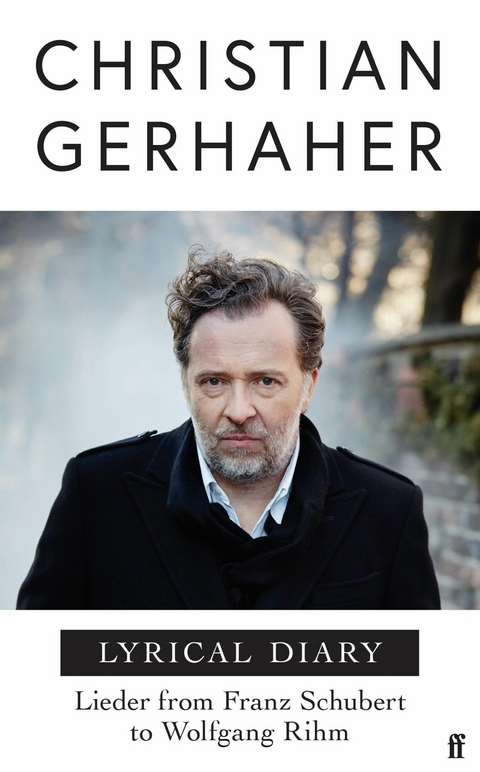
Lyrical Diary (eBook)
256 Seiten
Faber & Faber (Verlag)
978-0-571-35772-7 (ISBN)
Renowned baritone, Christian Gerhaher, is recognised as one of the world's greatest Lieder interpreters. He has devoted himself to lied interpretation for 30 years, in recitals, recordings and teaching, winning all the major prizes. He regularly performs at all the world's major concert halls, including London, Berlin, Amsterdam, Cologne, Paris, Vienna and New York. He is also a highly sought after performer on the opera stage, with productions including Cosi Fan Tutte at the Bavarian State Opera, and Wozzeck at the Royal Opera House, Covent Garden, conducted by Sir Antonio Pappano.
Absorbing insights into music and language by one of the world's greatest Lieder Interpreters. Christian Gerhaher, one of the most important singers of our time, writes vividly of his performing life and the experiences that he has had in over thirty years with the great works of the history of the Lied, from Beethoven's 'An die ferne Geliebte' via Schubert's great cycles, Schumann's varied Lieder, and art songs from Gustav Mahler to Othmar Schoeck and Wolfgang Rihm. He reflects on what these Lieder mean, what makes each of them unique and how they should be performed. An essential addition to the canon of writing on singing.
Here one may certainly admire man as a mighty genius of construction who manages to assemble an infinitely complicated conceptual cathedral on moving foundations and as if on flowing water; of course, to stand on such foundations it must be a building as if made of spiders’ webs, delicate enough to be carried along by the waves, solid enough not to be blown apart by the wind.
friedrich nietzsche (sadly not about Schumann)1
Robert Schumann’s output in terms of lieder may be only about half as extensive as that of Franz Schubert, the ‘inventor’ of the genre, but it is marked by an idiosyncratic consistency. From the outset this is expressed in what can be perceived as a unique drive towards a structured conception. It can be discerned in many respects in relatively familiar dramaturgical ideas in the compositions dating from Schumann’s first year as a lieder composer – in the three most important cycles, but also in smaller forms. Glimpses of the conceptual freedom and diversity of his later years make their appearance early, for example in the Andersen-Lieder, op. 40, which, with their downright malicious emotional descent, prepare the way for the more abstract Lenau-Lieder, op. 90, ten years later.
The conceptual diversity is astonishing from the start. Aus dem Liederbuch eines Malers, op. 36, from 1840 might be a painter’s portfolio imagined in sound, a kind of vocal sonata. The first lied is a cheerful movement; the second, third and fourth lieder form a scherzo with three romance sections; this is followed by a dramatic lied close to Goethe’s Erlkönig and Heine’s Die Lorelei, the whole concluding in the sixth song with an endless melody. The ‘small’ Liederkreis, op. 24, settings of poems by Heinrich Heine, is in my view (apart from the three Romanzen und Balladen, op. 49) Schumann’s most ironic cycle, above all because of the contrast provided by the highly romantic, longing-filled lieder that interpose themselves into the sequence: 3 Ich wandelte unter den Bäumen (‘I Wandered Beneath the Trees’); 5 Schöne Wiege meiner Leiden (‘Lovely Cradle of My Sorrows’); and 7 Berg’ und Burgen schau’n herunter (‘Mountains and Castles Gaze Down’).
Frauenliebe und Leben (‘A Woman’s Love and Life’), op. 42, could in fact be a ‘Life of Mary’ – a daring and exciting attempt to explain Schumann’s textual reduction of Adelbert von Chamisso’s cycle of poems.2 If we wish to stop short of that and still pay homage to the phenomenon of this ‘untimely’ cycle, we can do so in a less spectacular way: with respect not only for the formal structure, but also for the psychologically gripping understanding of the poetry of the Biedermeier period.3 There is no need to damn and incriminate this musically compelling and sensitive cycle with banal references to textual anachronisms; among intellectuals the rejection of the cycle seems to be something one can almost take as read. If the agreement of every work of art with the ethical conviction of the recipient or interpreter were required for its survival, our spiritual world would suddenly be very empty.
The other ‘lied opuses’ from Schuman’s first ‘lieder year’ often reveal an autobiographically based character. As examples we might cite Myrthen (‘Myrtles’), op. 25, and the three settings of opus 30 – both of which will be discussed below.4 They all have a cyclical form that places them beyond mere collections and that can be perceived with varying degrees of clarity.
In the ageing man’s view of invigorating and adored youth there is only a very faint connecting thought in the lyrics of the relatively unknown Lieder und Gesänge, op. 27. On the other hand, this opus has a sequence that connects the individual lieder quite unambiguously in a musical sense: introduction – continuation – resignation – resumption – conclusion. Equally we might mention two ballade triptychs: Drei Gedichte von Emanuel Geibel, op. 30, brings together three views of a man, from the free artist – Der Knabe mit dem Wunderhorn (‘The Boy with the Magic Horn’) – through the humble – Der Page (‘The Page’) – to the victorious – Der Hidalgo (‘The Hidalgo’). In the background is the trial, which was reaching its conclusion, surrounding Schumann’s marriage to Clara, whose legal permission to marry in the closing song, Der Hidalgo, leads to exuberant joy and unconcealed triumph: ‘The zither was for the ladies / The blade for the rival. / So let’s have an adventure. / The sun’s fire is already spent / Beyond the mountains. / Moonlit night’s hours of dusk / They bring news of love, / And with either flowers or wounds / I will return tomorrow.’ Drei Gesänge, op. 31, as if by way of balance, reveals the characters of three women evoked in poems by Chamisso, the first and third of which are engagingly unique and authentic. The ritornello-like chorale of the third song, Die rote Hanne (‘Red-haired Hannah’), effectively yields into Hanne’s fate, which she had hoped might be rather better, and the listener has to follow her. The first song, Löwenbraut (‘Lion’s Bride’), is ecstatically, sensually, almost manically wistful. But in between the two, there is the massive contrast of the Die Kartenlegerin (‘The Fortune Teller’) – a portrait of loquacious immaturity and unnerving superstition, which, with its inflection of a superficially humorous operetta couplet, can only be trying to provoke revulsion in the listener.
Later the structures incline slightly more towards symmetry. Lieder und Gesänge III, op. 77, for example, begins and ends lightly, with difficult transitions to and from Geisternähe (‘Nearby Spirits’), a backward-looking ‘message of love’ that stands at its centre. Or the cycles’ structures incline to the conceptual, for example the theme of ‘loss and farewell’ in Sechs Gesänge, op. 89, settings of Wilfried von der Neun, concluding with Röselein (‘Little Rose’), often delivered with the flirtatiousness of a soubrette, but which for me embodies an exquisite unworldly acceptance of destiny – the only song known to me that parallels Mahler’s Urlicht. Or they approach abstraction and a sensual heightening of poetic language (as in Lieder und Gesänge IV, op. 96, and Sechs Gesänge, op. 107), or to involve the interpretation of figures from literary history (Wilhelm Meister in opus 98a, for example; Elisabeth Kulmann in opus 104; Mary Stuart in opus 135).
Later, another caesura in Schumann’s life was to be significant. The death of the two Mendelssohn siblings in quick succession might explain the two heroic cornerstones of the Byron-Lieder, op. 95: a song for Fanny, Die Tochter Jephtas (‘Jephtha’s Daughter’) – an anonymous, unknown figure, as Fanny was virtually unknown as a composer – and, indisputably, one for Felix, Dem Helden (‘To the Hero)’. These two monumental songs are linked to each other by An den Mond (‘To the Moon’), a lament for them both.5
I find two absurd late works – the carnivalesque and bloodthirsty Husarenlieder, op. 117, with texts by Nikolaus Lenau, and a curious assemblage of three settings of Gustav Pfarrius, op. 119, gripping, brutal and comical. In the Pfarrius songs we are first presented with a fairy-tale idyll that could not be lovelier; it’s hard to imagine a life becoming any more marvellous. Then comes a warning: things will not stay this way, because the owl is threatening the little bird. Finally the owl turns into a creature who greedily sucks a birch tree dry and leaves it to bleed to death. Once again, as in the Kerner-Lieder, op. 35, poems are forced into an association that is entirely unintended by the poet, and are thus made to express a peculiarly free and visionary affiliation. Even in the other little cycles (opp. 45, 51, 53 and 64), in performance I always find the enthralling sense of an entirely deliberate connection.6
I would ask you to forgive this simplistic and subjective vision of Schumann’s songs. The only important thing for me is to make clear my conviction that every Schumann lieder opus is fundamentally characterised by ideas of cohesion both formally and in terms of content, and that each has its own new and different form and dramaturgy.7 This cannot be expressed more effectively, explained more comprehensively, than by Richard Strauss’s comment on instrumental music, that ‘the poetic idea also embodies the form-giving element’.8 The cyclical musical form...
| Erscheint lt. Verlag | 9.9.2025 |
|---|---|
| Sprache | englisch |
| Themenwelt | Literatur ► Biografien / Erfahrungsberichte |
| Kunst / Musik / Theater ► Musik | |
| ISBN-10 | 0-571-35772-5 / 0571357725 |
| ISBN-13 | 978-0-571-35772-7 / 9780571357727 |
| Informationen gemäß Produktsicherheitsverordnung (GPSR) | |
| Haben Sie eine Frage zum Produkt? |
 EPUB (Adobe DRM)
Kopierschutz: Adobe-DRM
Adobe-DRM ist ein Kopierschutz, der das eBook vor Mißbrauch schützen soll. Dabei wird das eBook bereits beim Download auf Ihre persönliche Adobe-ID autorisiert. Lesen können Sie das eBook dann nur auf den Geräten, welche ebenfalls auf Ihre Adobe-ID registriert sind.
Details zum Adobe-DRM
Dateiformat: EPUB (Electronic Publication)
EPUB ist ein offener Standard für eBooks und eignet sich besonders zur Darstellung von Belletristik und Sachbüchern. Der Fließtext wird dynamisch an die Display- und Schriftgröße angepasst. Auch für mobile Lesegeräte ist EPUB daher gut geeignet.
Systemvoraussetzungen:
PC/Mac: Mit einem PC oder Mac können Sie dieses eBook lesen. Sie benötigen eine
eReader: Dieses eBook kann mit (fast) allen eBook-Readern gelesen werden. Mit dem amazon-Kindle ist es aber nicht kompatibel.
Smartphone/Tablet: Egal ob Apple oder Android, dieses eBook können Sie lesen. Sie benötigen eine
Geräteliste und zusätzliche Hinweise
Buying eBooks from abroad
For tax law reasons we can sell eBooks just within Germany and Switzerland. Regrettably we cannot fulfill eBook-orders from other countries.
aus dem Bereich