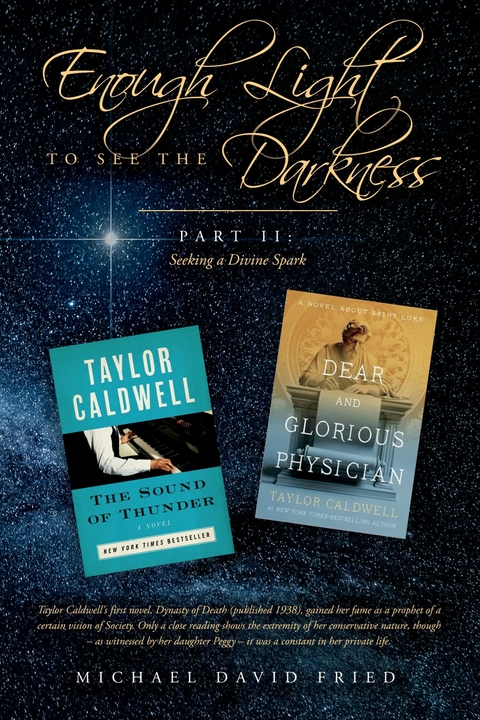
Enough Light to see the Darkness: (eBook)
776 Seiten
Bookbaby (Verlag)
979-8-3178-0207-3 (ISBN)
Michael David Fried is an emeritus professor of mathematics at the University of California at Irvine. His research, which can be found on his website, has four divisions according to the projects of his published papers. On his website, years of newsletters are included, which he wrote while developing the themes of this project and are based on Taylor Caldwell's novels, her daughter Peggy's collected pages, along with his own research on the family. This biography is part two in a series that covers the years of Taylor Cadwell's fame up to her death. Visit Michael David Fried's website here: https://www.math.uci.edu/-mfried
Taylor Caldwell was a late-blooming novelist whose four-novel series, Dynasty of Death, established her as a perennial bestseller and an exposer of deep national conspiracies. However, her massive, highly anticipated tomes failed to earn literary accolades. Affected by Ayn Rand's success, Caldwell made a mid-career shift. Two novels, "e;The Sound of Thunder"e; (1957) and the St. Luke story "e;Dear and Glorious Physician"e; (1959), which she had contemplated writing since she was 12, marked a transformation from her miracle-filled, God-referencing atmosphere to a direct, Jesus-centered approach. While the former discussed brilliance, the latter elaborated on the life of a world-renowned genius. It sold five million copies, positioning her as an original among ultra-conservatives. She inadvertently crafted a key conservative defense: "e;You are attacking my Christianity"e; if you pointed out the hypocrisy, lies, and lack of Christian attitudes in conservative behavior. She refined this behavior through her gaslighting interactions with her daughter, Peggy, leading to Peggy becoming Taylor Caldwell's inseparable buffer to society. Peggy's reward for documenting TC's behavior was lengthy stays on famous ocean vessels that while they lasted alleviated Peggy's ongoing depression. Intertwined in these co-created lives is their resistance to the evolving world of the '60s and '70s.
F.1. What Brought the Change
Taylor Caldwell took Marcion’s vision to heart and crafted her most visionary volume in the middle of her career – an insight gained from a source I know about – counter to what most would have expected of her preternatural conservatism. I found out about it because my mother, Peggy Fried, the first daughter of Taylor Caldwell, eventually had a closer connection to Taylor Caldwell than anyone could have predicted from Peggy’s early relationship with her. I didn’t, though, learn of this from Peggy directly, but from their relationship, as I also learned to what extent Taylor Caldwell’s ambitions were compatible with her personal thoughts.
An old but still not internalized story about many people who receive great adulation and remuneration is their attempt to rise above the rest of us. They wish to live forever, be above the law, and expect idolization from the general public. It’s astonishing how many wealthy individuals believe they can find a way to avoid death, perhaps with God’s help, often confused with having a significant number of human supporters whom they imagine are on their side. The church of the Middle Ages used Purgatory to reinforce this confusion: the belief that the balance with eternity might shift in your favor if, upon your death – while your soul hoped to ascend to heaven – enough living humans prayed for you. This was further supported by prelates speaking to their congregations on your behalf in exchange for your bequeathment to them. The desire for these results hasn’t faded, and the financial route to achieve them hasn’t diminished as a way to merge junk science with mumbo-jumbo.1
In her mid-career, Taylor Caldwell recognized her power as a conservative author with a large audience. We begin with the version of this story that was launched in the sequence of two novels (published in 1957 and 1959). This resulted in a more sophisticated approach to Caldwell’s use of conservative religion and an explosion of interest that saw her tap into a religious appeal embraced even by many secular readers.
Peggy Fried, TC’s daughter, travels the world on ocean liners and to other places as a high-placed tag-a-long with TC. Not her amanuensis, not her valet, not seriously her caretaker, and certainly not a close-at-home editor. As Peggy’s oldest child, I got responses from Peggy only from the world filtered through her mother. Still, unlike others in TC’s orbit, Peggy responded to TC with considerable skepticism.
The value of the details of Peggy’s writing stems from this singular perspective. Several autobiographies on characters’ lives brought a singular characterization of the internal lives of their times. That’s a hard act to follow, but TC had a unique approach to defending conservatism that managed to use one of the most liberal beings ever, Jesus, without her adherents seeming to recognize the cognitive dissonance. Peggy, though, was there for it all, and she remained naive to its significance for reasons unique to her personality. Using Peggy’s own words, I tell it the best I can with footnotes.2
I read Caldwell’s The Earth is the Lord’s (1940 publication, soon after that of Dynasty of Death and in the same year as the second volume on the Barbour family) in 6th grade. That led me to believe, as so many others did, that Caldwell had a vision. This novel on Genghis Kahn may not have been a grand expression of it. Still, it was a forerunner to a critical ingredient in her Mediterranean novels: a magnificent, not entirely explicable, historical personality who had captivated the world. The physical volume in our house (67 Hendricks Boulevard, that home in Buffalo’s suburbs to which we had moved only 1/2 year before) was on the built-ins that abutted the stairs on the second floor. That’s where Peggy placed the volumes Taylor Caldwell produced.
I was so impressed I took this magnificent character to heart, to the point of inculcating him into my pantheon of inspirations:
Jesus Christ, Carl Frederick Gauss, and Genghis Kahn.
Laced with purple prose, The Earth is the Lord’s often spoke of an immense world and those who dared strive within it. Taylor Caldwell’s ambition was to claim she understood the aspirations of the greatest of Earth’s inhabitants.
Still, to understand how Caldwell got to her considerable personal fame and her most profound literary contribution, you must fathom the impact of her Dynasty of Death series. In this, a family from a small Pennsylvania town at the end of the 19th century finds its way as a munitions producer into being a part of America’s growth of empire and influence.
Between 1938 and 1958, Taylor Caldwell produced 20 volumes, one a year. The last of these, The Sound of Thunder (1957), finished roughly half her publication life. In this volume, she polished off themes she had mastered regarding battles between siblings and the control of one dominant personality in a family.
The success of the Dynasty series encouraged Caldwell to believe she could depict characters essential to global events, drawing on the conservative mantra of personality traits that characterized the lesser members of society. At the outset of these publications, leading up to WWII, this endeavor resonated with readers as relevant to newspaper headlines.
William Combs, my grandfather, is in the rearview mirror of her life; however, she needed to finish that divorce and solidify her marriage with Marcus Reback. Her pent-up work for Dynasty … (once its sales were assured) produced several more volumes that sold well, establishing her quite a reputation. Twenty years later, with her increasing fame and status as a marketable writer, she could reflect on her life in an interesting new way by pursuing themes she had always intended, which may have differed from her editors’ choices.
The 1957 to 1959 divide in Caldwell’s writing (and perhaps her life) is “bookended” by the publications of The Sound of Thunder (1957) and Dear and Glorious Physician (1959). A reader of Caldwell’s novels could easily catch her conservatism. One characteristic of it was Caldwell’s insistence that the duplicity and hypocrisy of the North caused the Civil War. For example, in Dynasty of Death, northern munitions makers instigated the Civil War to support the fortunes they could make off its epic battles. In Sound of Thunder, blacks were well aware, according to Caldwell, that they were better off in the ‘loving’ South than they ever were in the cold, brutal North.
The few times Caldwell spoke to my siblings and me when we were young, she insisted how proud we should be of our Southern heritage. She said this goes back to James Oglethorpe, the first Governor of Georgia. She offered my sister a contact with the Daughters of the American Revolution.3
Caldwell was surprisingly close to an apologist for “The Lost Cause,” a Southern phrase for the outcome of the Civil War. Why was she? Her heritage is from the British Isles. Northerners today would be surprised at how much Trumpist talk for a civil war is intended as a replay of the battle between the inheritors of the two sides from 1861. Tracing the threads of TC’s intuitive support of the most conservative aspects of the South while she lived her life primarily in Buffalo, New York, has also to deal with her everyday abrasive personality versus her attempt to claim Jesus as the center of her life. That hardly appears in her personal life, as documented by Peggy, but it starts in her writing with Dear and Glorious Physician at mid-career, and persists in the remainder of her novels.
The big change, though, was for Peggy. Instead of remaining the abused daughter who performed menial tasks, in Peggy’s telling, she rose to eminent status in the coterie around Caldwell. They were solicitous of her opinions regarding Caldwell. That change runs over several chapters, corroborating why Part II doesn’t show Peggy’s simple desire for retribution for her earlier childhood. Instead, it indicates Peggy’s awe at what Caldwell gets away with in her personal interactions.
For Caldwell, the contrast between those two periods is marked by how frankly she advertised her conservative viewpoints as an author by placing her words in the mouths of her characters. In many cases, those words didn’t fit the persona she had portrayed. Further, she was willing to do this with historical figures with serious historical records that she ignored4 when they suited her but used sparingly at times when they were to her advantage.
Here, in 1957, we are well into the capitalist version of progressiveness featured in advertisements from the early 1950s to the early 1960s for the success of capitalism and modernity. It was outlandishly superficial: buffoonish fins on car fenders that visually called “zoooom” as they passed by; gleaming new materials heavy on chrome, in stores as well as on cars; clothing materials that came to bear iridescent colors. For Caldwell, her method for learning about the world was to be a rich, famous voyager. She spent many months aboard ocean liners that appeared as newspaper items, with her as one of its illustrious passengers. The liners themselves were a post-WWII imitation of the ships of the Gilded Age.
Nothing...
| Erscheint lt. Verlag | 31.8.2025 |
|---|---|
| Sprache | englisch |
| Themenwelt | Literatur ► Biografien / Erfahrungsberichte |
| ISBN-13 | 979-8-3178-0207-3 / 9798317802073 |
| Informationen gemäß Produktsicherheitsverordnung (GPSR) | |
| Haben Sie eine Frage zum Produkt? |
 EPUB (Ohne DRM)
Größe: 4,1 MB
Digital Rights Management: ohne DRM
Dieses eBook enthält kein DRM oder Kopierschutz. Eine Weitergabe an Dritte ist jedoch rechtlich nicht zulässig, weil Sie beim Kauf nur die Rechte an der persönlichen Nutzung erwerben.
Dateiformat: EPUB (Electronic Publication)
EPUB ist ein offener Standard für eBooks und eignet sich besonders zur Darstellung von Belletristik und Sachbüchern. Der Fließtext wird dynamisch an die Display- und Schriftgröße angepasst. Auch für mobile Lesegeräte ist EPUB daher gut geeignet.
Systemvoraussetzungen:
PC/Mac: Mit einem PC oder Mac können Sie dieses eBook lesen. Sie benötigen dafür die kostenlose Software Adobe Digital Editions.
eReader: Dieses eBook kann mit (fast) allen eBook-Readern gelesen werden. Mit dem amazon-Kindle ist es aber nicht kompatibel.
Smartphone/Tablet: Egal ob Apple oder Android, dieses eBook können Sie lesen. Sie benötigen dafür eine kostenlose App.
Geräteliste und zusätzliche Hinweise
Buying eBooks from abroad
For tax law reasons we can sell eBooks just within Germany and Switzerland. Regrettably we cannot fulfill eBook-orders from other countries.
aus dem Bereich