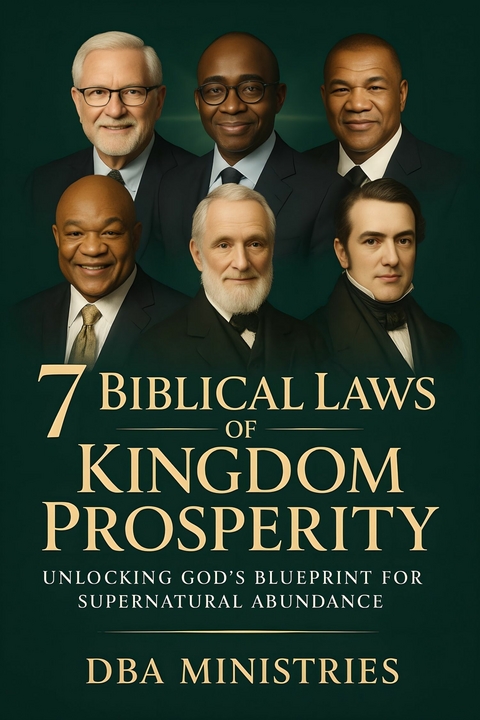
7 Biblical Laws of Kingdom Prosperity (eBook)
191 Seiten
Publishdrive (Verlag)
978-0-00-095692-7 (ISBN)
Are you struggling to reconcile your faith with financial success? Do you wonder if it's possible to build wealth while staying true to biblical principles? Discover the transformative power of Kingdom prosperity through 7 time-tested biblical laws that have led to supernatural breakthroughs for countless believers-no matter their background or income level.
In today's world, many Christians quietly suffer under the weight of debt, lack, or financial instability-unsure how to break free without compromising their faith. Through the powerful testimonies of people like David Green, founder of Hobby Lobby, Strive Masiyiwa, a pioneer in African telecommunications, and George Müller, who supported thousands of orphans purely by faith, this book unveils God's timeless blueprint for abundance.
Whether you're unemployed, living paycheck to paycheck, or simply longing for more stability, this book offers hope. Alongside the biblical principles, you'll receive a 90-Day Turnaround Breakthrough Program-a practical, step-by-step guide designed to help everyday people experience real financial transformation. Through daily actions, biblical insights, and faith-building exercises, you'll begin to see God move in ways you never imagined.
This isn't just another financial self-help book-it's a spiritual roadmap to provision, purpose, and peace. These seven biblical laws have changed the lives of struggling families, single parents, and everyday believers just like you.
Start your 90-day journey today and discover how aligning your life with God's principles can lead to lasting financial breakthrough and Kingdom impact.
Chapter 1: The Law of Stewardship
Featuring David Green (Hobby Lobby)
"Moreover, it is required in stewards that one be found faithful." - 1 Corinthians 4:2
The Garage That Changed Everything
In the sweltering summer of 1972, in a cramped garage in Oklahoma City, 31-year-old David Green hunched over a rickety workbench, meticulously cutting miniature picture frames. The Oklahoma heat was unbearable, with temperatures soaring above 100 degrees, and the garage offered little relief. Sweat dripped onto his work surface as he carefully measured each piece of wood, knowing that precision was everything when you couldn't afford to waste materials.
With just $600 borrowed from a local bank—money secured only after Barbara had to co-sign the loan because David's credit wasn't sufficient—a second-hand frame chopper that wheezed and rattled with each cut, and a vision rooted in unwavering faith, David and his wife Barbara laid the foundation for what would become Hobby Lobby. This wasn't just another entrepreneurial venture; it was a covenant with God, a decision to build a business that would honor Him in every transaction, every policy, and every relationship.
The $600 represented more than startup capital—it was everything they had left after paying bills, buying groceries, and covering the bare necessities for their growing family. Barbara had counted and recounted the money, her hands trembling as she realized they were literally betting their family's future on David's vision. "What if this doesn't work?" she whispered one evening as they sat in their small kitchen, surrounded by order forms and half-finished frames.
David took her hands in his, calloused from years of retail work and now stained with wood glue. "Barbara, I believe God is calling us to this. Not for our glory, but for His. We're not building David Green's business—we're building God's business. He'll provide what we need, when we need it."
This wasn't a story of entrepreneurial genius or sheer luck—it was a testament to the Law of Stewardship, the biblical principle that everything belongs to God, and we are merely managers entrusted with His resources. David Green's journey from a $600 startup to a retail empire that would grow to over 900 stores and generate billions in annual revenue offers profound lessons in faithful stewardship, revealing how aligning your financial life with God's ownership unlocks supernatural abundance.
Understanding the Law of Stewardship: More Than Management
Stewardship is the cornerstone of Kingdom prosperity, a divine mandate rooted in the fundamental truth that God owns everything. Psalm 24:1 declares, "The earth is the Lord's, and everything in it, the world, and all who live in it." This isn't merely a theological concept—it's a practical reality that transforms how we view every dollar, every opportunity, and every resource that passes through our hands.
In biblical times, a steward was far more than a servant or employee. The Greek word "oikonomos" referred to a trusted household manager who possessed significant authority and responsibility. These individuals managed vast estates, controlled financial resources, supervised other servants, and made decisions that could affect entire communities. They owned nothing but had the power to act on the master's behalf, knowing they would give account for every decision.
The steward's position was one of both privilege and pressure. They enjoyed access to resources beyond their personal means, but this access came with absolute accountability. A faithful steward could expect increased responsibility and trust; an unfaithful one faced severe consequences. This ancient role provides a perfect metaphor for our relationship with God's resources.
As believers, we are God's stewards, entrusted with money, time, talents, and opportunities—not as owners, but as managers answerable to Him. This perspective radically alters our approach to wealth, success, and financial decision-making. Instead of asking, "How can I maximize my profit?" we ask, "How can I best manage God's resources for His purposes?"
David Green embraced this truth with unwavering conviction from the very beginning. "We're not owners," he would say repeatedly to employees, family members, and anyone who would listen, "we're stewards. God owns it all, and we're just managing it for Him." This wasn't a platitude or a clever marketing slogan—it was a guiding principle that shaped every aspect of Hobby Lobby, from its business practices to its employee policies to its massive charitable giving.
The Theological Foundation of Stewardship
The concept of stewardship permeates Scripture, beginning in Genesis when God entrusted Adam and Eve with dominion over creation. This original mandate wasn't about ownership but about responsible management. Humanity was called to be caretakers, not proprietors, of God's creation.
Throughout the Old Testament, we see this principle reinforced. The Israelites were reminded that the Promised Land belonged to God, and they were merely tenants (Leviticus 25:23). The Year of Jubilee, observed every fifty years, reinforced this truth by redistributing land and releasing debts, preventing the permanent accumulation of wealth by any individual or family.
Jesus expanded on this theme through numerous parables. The Parable of the Talents (Matthew 25:14-30) illustrates how God entrusts different amounts to different people, expecting faithful management and multiplication. The Parable of the Unjust Steward (Luke 16:1-13) teaches that how we handle earthly resources determines our trustworthiness with spiritual riches.
The Apostle Paul reinforced this principle in his letters, particularly in 1 Corinthians 4:2, where he writes, "Moreover, it is required in stewards that one be found faithful." This verse became David Green's life motto, reminding him daily that faithfulness, not success, was the primary requirement for stewardship.
The Early Years: Poverty as Preparation
David Green's understanding of stewardship wasn't developed in prosperity—it was forged in the crucible of poverty. Born in 1941 in Altus, Oklahoma, during the waning years of the Great Depression, David grew up in a family of eight where financial scarcity was a constant companion. His father, a pastor of a small Assemblies of God church, earned a meager salary that rarely exceeded $100 per month, often supplemented by odd jobs like selling eggs door-to-door, repairing furniture, or working construction when his health permitted.
The Green family lived in a modest two-bedroom house where privacy was a luxury none of the children enjoyed. David shared a bed with his brothers, and hot water was a weekend treat. Meals were simple affairs—beans, cornbread, and vegetables from their small garden. Meat was reserved for special occasions, and even then, it was stretched to feed the entire family.
Yet, despite their material poverty, the Green household was rich in faith and character. David's mother, a woman of remarkable faith, demonstrated stewardship principles daily. She tithed from their grocery money, even when it meant the family would skip meals. David vividly remembers watching his mother count out coins for the offering plate, her hands steady despite the uncertainty of where their next meal would come from.
"Son," she would tell him, "God owns everything. When we give Him His portion first, He makes sure we have what we need." This wasn't theoretical theology for the Green family—it was lived experience. Time and again, provision arrived in miraculous ways: a neighbor would appear with a bag of groceries, an anonymous gift would arrive in the mail, or David's father would receive an unexpected payment for pastoral services.
One particularly vivid memory shaped David's understanding of God's provision. It was winter, and the family had run out of heating oil with no money to buy more. The temperature had dropped below freezing, and the children huddled under blankets, trying to stay warm. David's father gathered the family for prayer, asking God to provide fuel for the furnace.
The next morning, a truck pulled up to their house. The driver explained that he had been instructed to deliver oil to their address, but he couldn't find a record of who had ordered it. "Someone must have paid for it," he said, "but I don't have any paperwork." The family never discovered who had provided the oil, but they knew God had heard their prayer.
These experiences etched a profound truth into David's heart: God is the true owner of all resources, and faithful stewardship—including tithing in times of poverty—invites His provision. This wasn't a prosperity gospel message but a practical understanding of God's faithfulness to those who acknowledge His ownership.
As a teenager, David worked in his family's small retail store, a five-and-dime operation where he learned the basics of customer service, inventory management, and the value of hard work. He wasn't a natural academic, struggling in school and lacking the credentials for traditional success. His grades were mediocre, and he showed little interest in pursuing higher education. But he possessed something more valuable than academic achievement: a tenacity born of faith and a belief that God could use his efforts, however humble, for greater purposes.
The store taught David valuable lessons about business, but more importantly, it reinforced his understanding of stewardship. He watched his father treat every customer with dignity, regardless of their ability to pay. He saw his parents give away merchandise to families in need, trusting that God would replenish their inventory. He learned that business success...
| Erscheint lt. Verlag | 1.7.2025 |
|---|---|
| Sprache | englisch |
| Themenwelt | Literatur ► Biografien / Erfahrungsberichte |
| ISBN-10 | 0-00-095692-9 / 0000956929 |
| ISBN-13 | 978-0-00-095692-7 / 9780000956927 |
| Informationen gemäß Produktsicherheitsverordnung (GPSR) | |
| Haben Sie eine Frage zum Produkt? |
 EPUB (Adobe DRM)
Kopierschutz: Adobe-DRM
Adobe-DRM ist ein Kopierschutz, der das eBook vor Mißbrauch schützen soll. Dabei wird das eBook bereits beim Download auf Ihre persönliche Adobe-ID autorisiert. Lesen können Sie das eBook dann nur auf den Geräten, welche ebenfalls auf Ihre Adobe-ID registriert sind.
Details zum Adobe-DRM
Dateiformat: EPUB (Electronic Publication)
EPUB ist ein offener Standard für eBooks und eignet sich besonders zur Darstellung von Belletristik und Sachbüchern. Der Fließtext wird dynamisch an die Display- und Schriftgröße angepasst. Auch für mobile Lesegeräte ist EPUB daher gut geeignet.
Systemvoraussetzungen:
PC/Mac: Mit einem PC oder Mac können Sie dieses eBook lesen. Sie benötigen eine
eReader: Dieses eBook kann mit (fast) allen eBook-Readern gelesen werden. Mit dem amazon-Kindle ist es aber nicht kompatibel.
Smartphone/Tablet: Egal ob Apple oder Android, dieses eBook können Sie lesen. Sie benötigen eine
Geräteliste und zusätzliche Hinweise
Buying eBooks from abroad
For tax law reasons we can sell eBooks just within Germany and Switzerland. Regrettably we cannot fulfill eBook-orders from other countries.
aus dem Bereich