


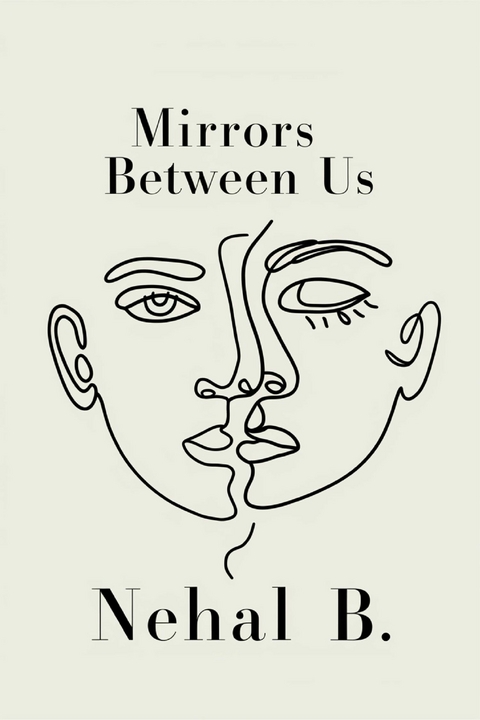
Mirrors Between Us (eBook)
157 Seiten
Publishdrive (Verlag)
9780000936448 (ISBN)
In a remote glass house perched above a forgotten coast, Elias and Noor-once lovers, now strangers under the same roof-seek to reclaim their intimacy. It's a fragile truce, made shakier when mysterious letters begin appearing at their doorstep, written in Elias's exact handwriting but signed with another man's name.
As Noor questions Elias's identity-and her own memory of their shared past-Elias finds himself haunted by half-forgotten dreams and flickers of alternative lives. Their conversations unravel. Their reflections twist. Each begins to wonder: has the other changed-or have they never truly known one another?
Mirrors Between Us is a haunting philosophical tale about love, illusion, and the terrifying beauty of not being fully seen. Blending emotional realism with psychological surrealism, it peels back the layers of recognition between two people, until only fragments remain.
6
Names and Their Shadows
The second letter arrived four days later, appearing in the same mysterious manner as the first—slipped under their door sometime in the dark hours when sleep made them vulnerable to visitations. This time, Elias found it during his pre-dawn coffee ritual, another cream-colored envelope with Noor’s name written in his own handwriting but signed with increasing confidence: *A. Morrison*.
He brought it to her along with her morning coffee, a gesture that had once been romantic routine but now felt like evidence delivery.
“Our mysterious correspondent is becoming bolder,” he said, settling into the chair beside their bed.
Noor sat up against the pillows and studied the envelope. The handwriting was definitely evolving, becoming more confident, more distinctly itself even while remaining unmistakably Elias’s basic script. It was as if someone were learning to write in his hand while developing their own particular emphases and flourishes.
“Should I read it now or wait?” she asked.
“I think we’re past the point of pretending these letters aren’t the most interesting thing happening to us.”
She opened the envelope with less ceremony this time, accepting that mystery had become part of their daily routine.
*Dearest Noor,*
*I hope my first letter didn’t disturb you too deeply, though I suspect disturbance was exactly what you needed. Comfort, I have learned, is the enemy of authentic relationship. We settle into patterns of recognition that prevent us from seeing who our beloved is becoming, moment by moment, in the endless process of self-creation.*
*I want to tell you about names and the shadows they cast. My name is Asher Morrison, but I was not always Asher Morrison. Names, like identities, are chosen as much as they are given. I selected this particular combination of syllables because they sounded like someone who might understand the difference between solitude and loneliness, between opacity and deception.*
*Elias—your Elias—has been having dreams about me. He doesn’t remember them upon waking, but dreams leave traces in the sleeper’s behavior, shadows that the conscious mind cannot quite identify. Have you noticed how he pauses sometimes mid-sentence, as if listening to an internal voice that speaks in his own words but with different intentions? Have you seen him catch his own reflection unexpectedly and study it as if it belonged to someone else?*
*This is because I exist in the space between his conscious and unconscious mind, in the territory where his unspoken thoughts take shape and learn to write letters. I am what he might become if he were brave enough to acknowledge the parts of himself that love makes him suppress. I am his capacity for solitude, his need for mystery, his understanding that some truths are too large for the architecture of relationship.*
*But I do not write to you about Elias. I write about you, and the way you have been slowly disappearing into the role of beloved. This morning, look in the mirror and ask yourself: when did you last surprise yourself? When did you last discover something new about your own capacity for feeling, thinking, being? If the answer is “not recently,” then you understand why I needed to write to you.*
*Elena left me not because she stopped loving me, but because she realized that love had made her invisible to herself. She woke up one morning and could not remember what she had thought about before she thought about us. This is the particular violence of intimate relationship: it can erase the very self it claims to cherish.*
*I suggest an experiment. For one day, pretend you are a stranger to yourself. Look at your own life as if you were an anthropologist studying the customs of some exotic tribe. What would you observe about the woman who shares Elias’s bed? What patterns would you note in her behavior? What needs go unmet? What desires remain unspoken?*
*The most radical act in any relationship is the decision to remain strange to the other, to preserve the mystery that makes love an ongoing discovery rather than a completed transaction. But first, you must become strange to yourself.*
*With deepening recognition,*
*Asher Morrison*
*P.S. Names are spells we cast to make ourselves real to others. But the most powerful magic happens in the space between names, where identity remains fluid and full of possibility.*
Noor read the letter twice before handing it to Elias, who read it with the focused attention of someone decoding instructions for defusing a bomb.
“He’s right about the dreams,” Elias said quietly. “I have been dreaming about someone, but I can never remember who. Just that sense of having had long conversations with someone who knew me better than I know myself.”
“And you think that someone is Asher Morrison?”
“I think Asher Morrison is the name I’ve given to the part of myself that understands things I’m not ready to understand consciously.”
They sat in their glass house as the morning light filled every transparent surface, making them simultaneously visible and reflective, solid and insubstantial. Noor felt the peculiar sensation of being observed not just by Elias, but by some version of herself that existed outside the boundaries of their relationship.
“The experiment,” she said. “Looking at my own life like an anthropologist.”
“What would you see?”
She stood up and walked to the window-wall facing the ocean, studying her reflection superimposed over the endless water. The woman looking back at her was someone she recognized but might not have chosen to become: careful, diplomatic, shaped by the constant negotiation that long-term relationship required.
“I would see,” she said slowly, “someone who has forgotten how to want things that have nothing to do with love. Someone who measures every desire against its potential impact on her relationship. Someone who has become very skilled at pre-emptive compromise.”
“Is that bad?”
“It’s not bad. But it’s not… complete. There are parts of me that have been dormant for so long I’m not sure they still exist.”
She thought about her life before Elias, before the careful choreography of shared space and mutual consideration. She had been messier then, more impulsive, capable of sudden enthusiasms that had nothing to do with anyone else’s needs or preferences. She had traveled alone to strange places, had conversations with strangers that lasted until dawn, made decisions based on curiosity rather than security.
“Maybe that’s what Asher Morrison is offering,” she said. “Permission to remember the parts of ourselves that relationship has edited out.”
“But if we both start becoming strangers to ourselves, how do we stay connected to each other?”
It was the essential question, the one that had brought them to this glass house in the first place. How do you maintain intimacy with someone while preserving the mystery that makes intimacy worthwhile? How do you love someone’s authentic self when that self is constantly changing, constantly becoming something new?
“Maybe,” Noor said, “we learn to love the process of becoming instead of trying to love a fixed idea of who the other person is.”
Outside their transparent walls, the Pacific stretched endless and unknowable, full of currents and depths that no amount of observation could completely map. Perhaps love was like that ocean—vast enough to contain infinite possibility, mysterious enough to reward lifelong exploration, dangerous enough to demand respect for its power to transform anyone brave enough to dive beneath its surface.
That evening, Noor began her experiment in anthropological self-observation, studying her own behavior as if she were a stranger worthy of curiosity. She noticed things she had stopped seeing: the way she held her coffee cup with both hands, like a prayer or a warming ritual. The way she read the endings of books first, unable to tolerate suspense. The way she hummed unconsciously while cooking, usually songs from her childhood that had no apparent connection to her adult concerns.
These observations felt like small acts of rebellion, reclaiming attention that had been unconsciously redirected toward the maintenance of relationship. For the first time in months, she felt genuinely curious about the inner life of the woman who happened to share her name and reflection.
In the bathroom mirror that night, she whispered to her reflection: “Hello, stranger. What do you want that has nothing to do with anyone else?”
The reflection seemed to consider the question seriously before answering in a voice that sounded like her own but carried different intentions: “I want to remember what it feels like to be completely alone with myself....
| Erscheint lt. Verlag | 25.6.2025 |
|---|---|
| Sprache | englisch |
| Themenwelt | Literatur ► Krimi / Thriller / Horror |
| ISBN-13 | 9780000936448 / 9780000936448 |
| Informationen gemäß Produktsicherheitsverordnung (GPSR) | |
| Haben Sie eine Frage zum Produkt? |
 EPUB (Adobe DRM)
Größe: 1,3 MB
Kopierschutz: Adobe-DRM
Adobe-DRM ist ein Kopierschutz, der das eBook vor Mißbrauch schützen soll. Dabei wird das eBook bereits beim Download auf Ihre persönliche Adobe-ID autorisiert. Lesen können Sie das eBook dann nur auf den Geräten, welche ebenfalls auf Ihre Adobe-ID registriert sind.
Details zum Adobe-DRM
Dateiformat: EPUB (Electronic Publication)
EPUB ist ein offener Standard für eBooks und eignet sich besonders zur Darstellung von Belletristik und Sachbüchern. Der Fließtext wird dynamisch an die Display- und Schriftgröße angepasst. Auch für mobile Lesegeräte ist EPUB daher gut geeignet.
Systemvoraussetzungen:
PC/Mac: Mit einem PC oder Mac können Sie dieses eBook lesen. Sie benötigen eine
eReader: Dieses eBook kann mit (fast) allen eBook-Readern gelesen werden. Mit dem amazon-Kindle ist es aber nicht kompatibel.
Smartphone/Tablet: Egal ob Apple oder Android, dieses eBook können Sie lesen. Sie benötigen eine
Geräteliste und zusätzliche Hinweise
Buying eBooks from abroad
For tax law reasons we can sell eBooks just within Germany and Switzerland. Regrettably we cannot fulfill eBook-orders from other countries.
aus dem Bereich


