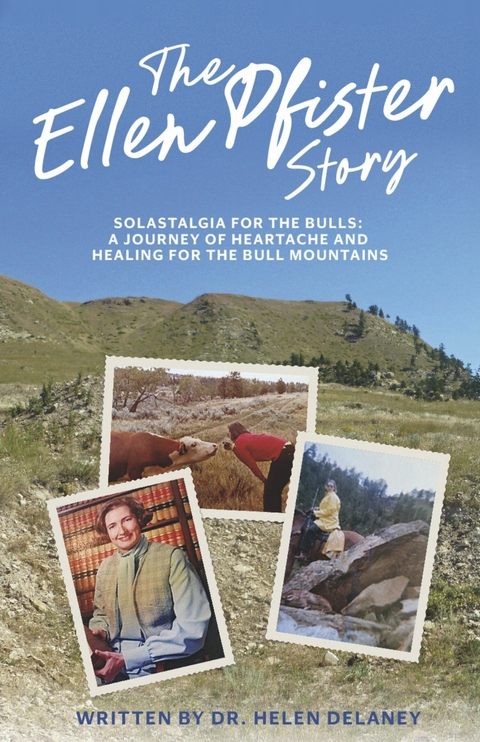
Ellen Pfister Story (eBook)
180 Seiten
Bookbaby (Verlag)
979-8-3178-0901-0 (ISBN)
Dr. Helen Delaney is a former nuclear engineer and technical writer for the former TRW, Inc. Ballistic Missile Division. She also has a Doctor of Ministry and has written commentaries for Thomas Nelson Bible Publisher on two Bible projects - 'Sisters in Faith' and 'The Breathe Life Bible.' She is an international speaker who utilizes her analytical skills to deliver thought-provoking, systematic teaching and writing, which she also utilized in her memoir, 'Coloring Outside the Lines.' She and her husband, George, live in Georgia and have a daughter, son-in-law, and three wonderful grandchildren.
What would draw Ellen Pfister, J.D., to full-time ranching in the Bull Mountains northeast of Billings, Montana? Was it growing up on a ranch and experiencing the lifestyle and hard work of ranching year after year? No, not exactly. It was a process for Ellen to learn to appreciate what her parents and other family members did for a living. That process eventually came full circle, giving Ellen a challenging but fulfilling adult life on the ranch. Ellen did not discover that ranching was a part of her career path until after finishing law school at Ole Miss. Then, seven years later, the Consolidation Coal Company knocked on Ellen's mother's door in Shepherd, Montana, in the summer of 1970. That horrifying knock dramatically changed the course of their lives. With photos included, Ellen Pfister paints a vivid picture of a woman who continues to fight for the beauty of Montana's land and water. Ellen's primary concern was that coal mining would irreparably damage the land and water supplies, which are essential for a ranch in an arid landscape of sandstone, sagebrush, and ponderosa pine trees stunted by periodic droughts. Ellen said, "e;I'm trying to figure out how to protect myself; if you do not have water, you have to go somewhere else,"e; and leaving Montana to be destroyed was not an option. This is a great read for anyone seeking inspiration to persevere through challenges, particularly environmentalists, conservationists, and women pursuing careers outside the norm.
Chapter 1
The Early Stages of
Ellen’s Formative Years –
1939 to 1957
Setting up for a New Life
When William Pfister’s father died in 1939, it freed William and his new wife, Louise, to consider whether to stay in Wyoming or move somewhere else and start anew. They would have stayed in Wyoming, but neither William nor his sister, Ella, wished to operate in partnership, and Ella would not sell to William and leave.
Ellen’s father, William, took the money from his sister’s buyout of the family land and his share of his father’s estate in Wyoming to buy a ranch on Pryor Creek in Montana near the Crow Reservation. William noticed that the best cattle at the Omaha Stockyards came from the Crow Reservation in Montana, one of the country’s largest reservations, with more than 2 million acres. The Crow tribe originated in Ohio but was pushed west by enemy tribes: Lakota (Sioux) and Cheyenne. The famous Battle of the Little Bighorn, known as Custer’s Last Stand, was fought on the Crow reservation around 1876, but the Crow tribe was on the side of the U.S. government against their mutual enemy, the Sioux.
William purchased the land on Pryor Creek in 1939, and he and his wife, Louise, arrived in December with one mattress, six soup plates, 200 head of cows, and 4000 sheep, trailing the livestock up the Creek to their new home. They had finally escaped the restrictions of family obligations and could operate on their own. Ellen’s mother, Louise, was excited about the move because she thought she could attend church and finally have a social life. After all, they were only 12 miles outside of Billings. But there were seven wire gates and several miles of dirt/mud roads between their home and the paved road leading to Billing. She went to town maybe twice a year.
Ellen Louise was born three years after they moved to Pryor Creek, Montana, and she was named after the two smartest women that her father, William, knew – his mother, Ellen, and his wife, Louise.
William Holding His Newborn, Ellen
When Ellen was nine months old, her father bought a second ranch in the Bull Mountains in October 1942 for $1.95/acre from the estate of Thomas Tollefson, a Norwegian bachelor farmer. However, some land around the Bull Mountains in the late 1940s was sold for $5-$8/acre, but it was never as expensive as land in the South because Montana simply did not produce as much rain. If you don’t have rain, you don’t get much production.
Tollefson was fortunate to get a section of land with some water on it, so he hung in there when other landowners were discouraged and leaving. The nugget of land that William bought from Tollefson’s estate for $1.95/acre was the five or six sections that Tollefson had purchased from the railroad, which he paid off after 30 years just before a stallion killed him in his corral.
Tollefson had done a lot of work on the property, including small grain farming, herding and shearing sheep, building buildings, and raising cavalry remounts since it was also good horse country. Cavalry remounts were horses raised in a government program set up after WWI to maintain a source of remounts for the cavalry in case of war. The federal government worked with ranchers like Tollefson by providing stallions to continue the bloodlines of cavalry horses. Montana had one of the remount depots near the Bull Mountains.
It was called the Bull Mountains because when the buffalo herds traveled, the younger bulls would eventually whip out the old dominant bulls, and the old bulls were not allowed to stay with the herd. When the old bulls hung out in the Bull Mountains until they died, they had good shelter, good winter feed, and live water. However, Buffalos disappeared from the area once the land was homesteaded, but there were quite a few buffalo skulls found when Ellen’s dad bought the ranch.
Ellen’s Childhood Years
Happy Ellen at 1 with Uncle Arch Huey (Louise’s Brother)
Ellen at 3 with Aunt Eunice Huey (Louise’s Brother Bill’s Wife)
Ellen’s earliest memory was going out in the hills with her mother to get a Christmas tree when she was about three or four. And then, that year, her parents gave her an old-time cradle that Ellen remembers being just the right length to fit it – head to toe.
Ellen also remembers how wonderful it was when they made their infrequent trips to Billings because riding on the paved roads was exciting, where the car rode smoothly and fast. Once they got to town, Ellen’s mother had a harness to put on Ellen so she could not run off.
One of Ellen’s fondest childhood memories was playing with her animals back on the ranch. There were several dogs and cats on the ranch for playmates, but her favorites were a pair of young Billy Goats.
Ellen and Her 2 Playmates – The Billy Goats
Days out on the ranch were quiet and solitary for her, so the goats became Ellen’s playmates, and she spent a lot of time with them. The goats were joined with a leather loop, so they moved together and could not wander off. Once, she got mean, tied a washtub to their leather loop, and turned them loose; the noise of the dragging tub frightened them terribly. The goats were also mischievous. They once ate a horse’s tail off as high as they could reach on their hind feet and would often slide down the trunk of her father’s 1939 Chrysler and scratch it up.
One of Ellen’s worst childhood memories was standing in an anthill on the edge of a cellar, watching the ants swarming up her legs and being “too dumb” to move out of the anthill. So, she just stood there yelling until she was rescued. When Ellen was not outside playing, she spent her time playing inside or on the porches with a 1920s-type painted pink metal kid’s stove and stuffed toys that Ellen moved from room to room. Not many kids were in Pryor Creek, but one little boy had a crush on Ellen. But she was uninterested and did not care “two cents” about him.
Once Ellen was school-age, her parents faced new challenges. The school was a long way up Pryor Creek, and it was attended by the children of people that Billing town people called the ‘Honyockers and Indians,’ a derogatory reference to homesteaders and native tribes. They were not the people Ellen’s father had in mind for his daughter to be around at school. In addition to being tired of the Indian politics involved in getting leases and using horses to put up 800 tons of hay every year, her father decided to sell their Pryor Creek ranch when Ellen was five in search of a better school district.
Ellen at 5 with Her Dad Before Leaving Their Pryor Creek Ranch
Ellen was a tall girl at five; it was assumed that she was more mature than most girls her age. Her father convinced Ellen’s mother to agree to put Ellen in a boarding school for nine months at St. Mary’s Catholic School in Deer Lodge, Montana, 250 miles away, so they could focus on selling the ranch at Pryor Creek. And that decision completely changed little Ellen from an extrovert to becoming just the opposite. She went from being “everybody’s my friend” to “I’m taking you under advisement and not being hail-fellow-well-met” with people. In other words, going from being sociable and friendly to being cautious and aloof.
Ellen has fought with that change in her personality her entire life, but that was a drastic change for a five-year-old to go from an everyday close relationship with her family to only seeing her folks twice that year – Christmas and Easter - and to suddenly go from being free to roam at the ranch to strict rules and confinement, was devastating. Then, to make matters worse, the one nun whom Ellen liked and who liked Ellen had left the school when Ellen returned from the Christmas break.
Little Ellen felt so alone and had no one to support her that she started to envy the “day hops”—the students who went home to their folks at night. But Ellen’s parents wanted to be able to sell the ranch on Pryor Creek and move their house into the settlement of Lockwood without being distracted by a busy five-year-old.
Before boarding school, Ellen’s mother would read Bible stories to her, but she was not used to being in a religious environment. When the nuns were preparing the students for First Communion, the protocols were new for Ellen. The first time she went to church, the nuns lined them up across the pew, and she heard this wonderful music for the first time.
You see, there was no music at Ellen’s house because it was during the war, and they only listened to the radio once a day at 4 p.m. They always listened to “H. V. Kaltenborn,” an influential American radio commentator known for his instant and lucid analyses of news events, like the war, as they happened. This choir singing at the back of the church sounded heavenly to Ellen, and she turned around to see what it was and where it was coming from. Suddenly, the long arm of the nun reached down the pew, tapped Ellen on the shoulder, and said, “You do not turn around in church. It’s a sin.”
Ellen was...
| Erscheint lt. Verlag | 25.6.2025 |
|---|---|
| Sprache | englisch |
| Themenwelt | Literatur ► Biografien / Erfahrungsberichte |
| ISBN-13 | 979-8-3178-0901-0 / 9798317809010 |
| Informationen gemäß Produktsicherheitsverordnung (GPSR) | |
| Haben Sie eine Frage zum Produkt? |
 EPUB (Ohne DRM)
Größe: 16,8 MB
Digital Rights Management: ohne DRM
Dieses eBook enthält kein DRM oder Kopierschutz. Eine Weitergabe an Dritte ist jedoch rechtlich nicht zulässig, weil Sie beim Kauf nur die Rechte an der persönlichen Nutzung erwerben.
Dateiformat: EPUB (Electronic Publication)
EPUB ist ein offener Standard für eBooks und eignet sich besonders zur Darstellung von Belletristik und Sachbüchern. Der Fließtext wird dynamisch an die Display- und Schriftgröße angepasst. Auch für mobile Lesegeräte ist EPUB daher gut geeignet.
Systemvoraussetzungen:
PC/Mac: Mit einem PC oder Mac können Sie dieses eBook lesen. Sie benötigen dafür die kostenlose Software Adobe Digital Editions.
eReader: Dieses eBook kann mit (fast) allen eBook-Readern gelesen werden. Mit dem amazon-Kindle ist es aber nicht kompatibel.
Smartphone/Tablet: Egal ob Apple oder Android, dieses eBook können Sie lesen. Sie benötigen dafür eine kostenlose App.
Geräteliste und zusätzliche Hinweise
Buying eBooks from abroad
For tax law reasons we can sell eBooks just within Germany and Switzerland. Regrettably we cannot fulfill eBook-orders from other countries.
aus dem Bereich