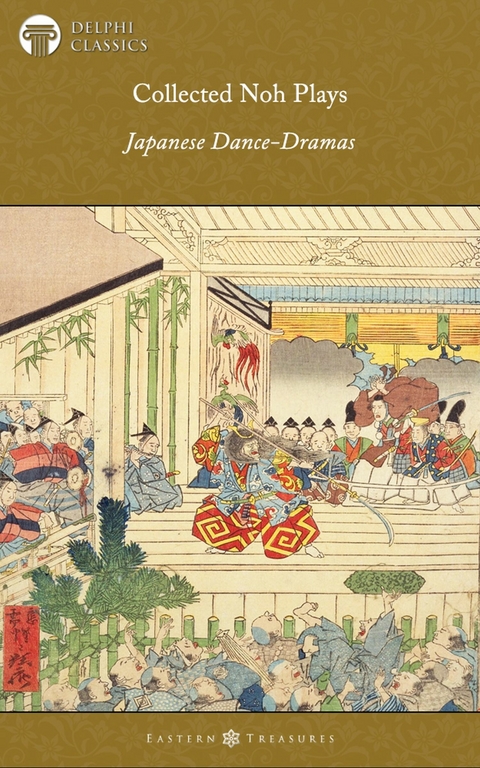
Delphi Collected Noh Plays (eBook)
1487 Seiten
Delphi Publishing Ltd (Verlag)
978-1-80170-261-4 (ISBN)
A major style of Japanese dance-drama, 'Noh' is the oldest surviving theatre form in the world, boasting a history of over 700 years. Noh plays are often based on tales from traditional literature, featuring a supernatural being transformed into a human hero that narrates the story. The literary form integrates masks, costumes and various props in a dance-based performance, requiring highly trained actors and musicians. Noh remains popular today in Japan, where there are almost one hundred Noh theatres, attended by hundreds whenever a performance takes place. Delphi's Eastern Treasures Series provides eReaders with rare and precious texts of Asian literature, featuring prominent works of history, fiction, religion, poetry and philosophy. This eBook presents a wide selection of classic Noh plays, with illustrations, an informative introduction and the usual Delphi bonus material. (Version 1)
* Beautifully illustrated with images relating to Noh theatre
* A wide selection of Noh plays in English translation
* Translations by Joji Sakurai, Arthur Waley and Basil Hall Chamberlain
* Concise introduction to the Noh form
* Excellent formatting of the play texts
* Easily locate the sections you want to read with individual contents tables
* Features a bonus resource section, with three informative texts - discover the incredible history of Noh theatre
CONTENTS:
The Translations
Brief Introduction: Noh Theatre
The Maiden's Tomb (c. 1400) by Kan'ami Kiyotsugu
Kagekiyo (c. 1410) by Zeami Motokiyo
Tamura (c. 1380) by Kan'ami Kiyotsugu
The Sumida River (c. 1430) by Kanze Motomasa
Atsumori (c. 1420) by Zeami Motokiyo
Ikuta (c. 1420) by Zeami Motokiyo
Tsunemasa (c. 1420) by Zeami Motokiyo
The Robber (c. 1480) by Konparu Zenchiku
The Hat Maker (c. 1540) by Miyamasu
Benkei on the Bridge (c. 1480) by Hiyoshi Sa-ami Yasukiyo
Kagekiyo (c. 1420) by Zeami Motokiyo
The Potted Trees (c. 1383) by Zeami Motokiyo
Sotoba Komachi (c. 1380) by Kan'ami
The Cormorant-Fisher (c. 1400) by Enami no Sayemon
The Damask Drum (c. 1350)
Princess Hollyhock (c.1420) by Zeami Motokiyo
Kantan (c. 1420) by Zeami Motokiyo
The Hōka Priests (c. 1480) by Zenchiku Ujinobu
The Feather Mantle (c. 1420) by Zeami Motokiyo
The Valley-Hurling (c. 1450) by Konparu Zenchiku
The Pool-Sacrifice (c. 1420) by Zeami Motokiyo
Early Snow (c. 1500) by Koparu Zembō Motoyasu
Haku Rakuten (c. 1420) by Zeami Motokiyo
Nakamitsu (c. 1420) by Zeami Motokiyo
Abstraction (c. 1420) by Zeami Motokiyo
The Resources
Religious Plays (1901) by Osman Edwards
Introduction to Nō (1913) by Marie C. Stopes
The Nō Plays of Japan (1922) by Arthur Waley
A major style of Japanese dance-drama, 'Noh' is the oldest surviving theatre form in the world, boasting a history of over 700 years. Noh plays are often based on tales from traditional literature, featuring a supernatural being transformed into a human hero that narrates the story. The literary form integrates masks, costumes and various props in a dance-based performance, requiring highly trained actors and musicians. Noh remains popular today in Japan, where there are almost one hundred Noh theatres, attended by hundreds whenever a performance takes place. Delphi's Eastern Treasures Series provides eReaders with rare and precious texts of Asian literature, featuring prominent works of history, fiction, religion, poetry and philosophy. This eBook presents a wide selection of classic Noh plays, with illustrations, an informative introduction and the usual Delphi bonus material. (Version 1)* Beautifully illustrated with images relating to Noh theatre* A wide selection of Noh plays in English translation* Translations by Joji Sakurai, Arthur Waley and Basil Hall Chamberlain* Concise introduction to the Noh form* Excellent formatting of the play texts* Easily locate the sections you want to read with individual contents tables* Features a bonus resource section, with three informative texts discover the incredible history of Noh theatreCONTENTS:The TranslationsBrief Introduction: Noh TheatreThe Maiden s Tomb (c. 1400) by Kan'ami KiyotsuguKagekiyo (c. 1410) by Zeami MotokiyoTamura (c. 1380) by Kan ami KiyotsuguThe Sumida River (c. 1430) by Kanze MotomasaAtsumori (c. 1420) by Zeami MotokiyoIkuta (c. 1420) by Zeami MotokiyoTsunemasa (c. 1420) by Zeami MotokiyoThe Robber (c. 1480) by Konparu ZenchikuThe Hat Maker (c. 1540) by MiyamasuBenkei on the Bridge (c. 1480) by Hiyoshi Sa-ami YasukiyoKagekiyo (c. 1420) by Zeami MotokiyoThe Potted Trees (c. 1383) by Zeami MotokiyoSotoba Komachi (c. 1380) by Kan amiThe Cormorant-Fisher (c. 1400) by Enami no SayemonThe Damask Drum (c. 1350)Princess Hollyhock (c.1420) by Zeami MotokiyoKantan (c. 1420) by Zeami MotokiyoThe Hoka Priests (c. 1480) by Zenchiku UjinobuThe Feather Mantle (c. 1420) by Zeami MotokiyoThe Valley-Hurling (c. 1450) by Konparu ZenchikuThe Pool-Sacrifice (c. 1420) by Zeami MotokiyoEarly Snow (c. 1500) by Koparu Zembo MotoyasuHaku Rakuten (c. 1420) by Zeami MotokiyoNakamitsu (c. 1420) by Zeami MotokiyoAbstraction (c. 1420) by Zeami MotokiyoThe ResourcesReligious Plays (1901) by Osman EdwardsIntroduction to No (1913) by Marie C. StopesThe No Plays of Japan (1922) by Arthur Waley
THE MAIDEN’S TOMB
SCENE
The fields of ONO near the hamlet of IKUTA in Settsu, in the early spring.
[The Priest enters]
PRIEST
Far through the country has my journey lain,
Far through the country has my journey lain,
And to the capital I speed my way.
I, a priest, am from the country, from the Western districts coming.
To the capital, which hitherto my eyes have never seen.
The paths along the coast are manifold,
The paths along the coast are manifold,
That on this journey I have traced, and oft
My way has lain by boat across the sea.
Over the sea and mountains stretching wide
I watched the sun rise up and set again,
And now I reach Ikuta which I know
Only by name as in Tsu province fair,
The hamlet of Ikuta now I reach.
SPIRIT AND MAIDENS
Green shoots we gather, young green shoots of spring,
And here in Ono by Ikuta blows
The morning breeze so chill, so chill and strong
It turns and billows out our flapping sleeves.
MAIDENS
While in the distant mountains, on the pines
The snow has even yet not disappeared.
SPIRIT AND MAIDENS
Oh, near the Capital the time has come
To gather in the fields the shoots of spring.
It makes our hearts glad just to think of that.
SPIRIT
But from the Capital this place is far,
MAIDENS
And we are country folk and therefore live
A humble life here by Ikuta’s sea.
Our lives and work are of the lowliest
And to the field of Ono every year
Without the thought of pleasure do we come.
The footmarks of the many village folk
That go to gather the young shoots of spring
Have left wide tracks across the snowy field.
And tread a path, where else there would be none.
And tread a path, where else there would be none.
The young green shoots that grow on field and marsh
We now must gather. When the snow has gone
They will already have become too old —
Though still the wind blows cold thro’ shady copse
And on the field of Ono lies the snow,
The seven herbs of early spring-time sprout
In Ikuta then let us pluck the shoots,
In Ikuta then let us pluck the shoots.
PRIEST
O good people, will you tell me if toward Ikuta I’m nearing?
MAIDENS
As thou dost know the name of Ikuta
There should have been no need to ask us that!
SPIRIT
Dost thou not know it from the many views
That scattered far and wide portray the place?
First of all, dost thou not know it as the forest of Ikuta?
See, the many clustered tree tops which are true to this its name.
MAIDENS
And there the stream thou hast now deigned to cross,
It is the far-famed river Ikuta.
SPIRIT
In the early breath of spring-time (like the shallows of the river)
Do we gather, ‘neath the snowy cloak, the young shoots of the field.
MAIDENS
And this field, too, where little sprouts as yet
Are growing, why as Ono know’st it not?
SPIRIT AND MAIDENS
The sweet wild cherry blossoms that do grow
In Miyoshino and in Shiga too,
The maple leaves of Tatsuta and those
Of Hatsuse — they would be surely known
By those who lived beside the poet’s home.
But we, though living in this place know not
The forest or the copse of Ikuta.
So ask us not, for we know nothing here.
PRIEST
Ah yes. Unfolding now before my eyes
The views I know — the forest, river, sea,
And mist, the scenes of Ono now expand!
And the far-famed tomb of Ikuta, the Maiden’s Tomb, where is it?
SPIRIT
Ah, in truth, the Maiden’s Tomb! That is a place that I have heard of;
Whereabout it is I know not, yea, I know not in the least.
MAIDENS
But prithee, traveller, these useless things
We beg thee ask us not, we prize the time
When we can gather these young shoots of spring.
SPIRIT
And thou thyself, too, journeyest in haste,
So wherefore dost thou tarry with us here?
MAIDENS
Thereon an ancient poem has the words —
CHORUS
I
“A charming hindrance to the traveller
Are they who pluck young shoots in Ono’s field
In Ikuta.” Why ask then useless things?
II
“Thou, Watchman of the field of Tobuhi
That lies in Kasugano, go and see,”
“Thou, Watchman of the field of Tobuhi
That lies in Kasugano, go and see
If it is not yet time to pluck the shoots.”
Thou, traveller, that to the capital
Likewise dost haste, how many days hast thou?
“For his sake do I go to the spring fields
To gather the young shoots, though on my robe
Cling still the cold, unmelted flakes of snow.”
Let us then gather, snowy though it be
And on the marsh the thin ice still remains,
Pushing aside the sprouting watercress,
Let us then gather the green-coloured shoots
Let us then gather the green-coloured shoots.
III
Would there be much to gather? For the spring
Is very early yet — and young shoots hide.
SPIRIT
“The spring-time comes, but as I see the snow
Upon the plain, I think of the old year.”
The young green shoots of this year still are few
So we must gather those with older leaves.
CHORUS
And yet, although the leaves are old and sere
The young green shoots are fresh as the new year.
Guard then thyself, thou field of the young spring!
SPIRIT
To the field of spring,
To the field of spring,
To pluck violets
He came, and then
Only purple leaves
Of the weeds culled he
Who came gathering.
CHORUS
Ah, yes, the colour of affinity
Has brought to my sad thought the memory
Of Love’s light bridge which was asunder torn.
SPIRIT
The aged stems of plants once gone to seed
In Sano district still may sprout again,
CHORUS
And their green colour will be purple dyed.
SPIRIT
The Shepherd’s Purse of Chōan —
CHORUS
And the hot shepherd’s purse, a useless thing,
And other herbs white rooted, like the dawn,
Which, hidden by the snow we may mistake
And gather in the place of those we want.
CHORUS
The morning breeze in Ono still is cold
The lower branches of the pine trees still
Are weighted down with snow. Where hides the spring
We cannot tell. And though the river breeze
Blows cold, our billowing sleeves are colder far.
Let us go home, although we leave unplucked
Some of the young green shoots, let us go home.
PRIEST
Now there is something I would speak of unto thee if thou permittest —
All the maidens who were gathering the young greens have departed
Save thyself, and wherefore then art thou alone remaining with me?
SPIRIT
For the Maiden’s Tomb but just now thou didst ask me. I will show thee.
PRIEST
Yes, indeed, I do desire to see it and I pray thee show me.
SPIRIT
This way honourably follow. And the Maiden’s Tomb is this!
PRIEST
What its history, and why then, is the Maiden’s Tomb so calléd?
Pray minutely tell the story.
SPIRIT
Then will I the tale unfold.
Once upon a time a maiden who was called Unai did live here,
And two men there were, called Chinu and Sasada, and they loved her.
And to her upon the same day, in the same hour, both declaring
Fervent love, they sent two letters. But she thought that if she yielded
Unto one, the other’s anger would be deep, and so to neither
Would she yield (and then her father said the truest shot should win her).
But upon Ikuta’s river did the two men’s flying arrows
Pierce together but one water-fowl, and pierce the selfsame wing.
And then I thought, how cruel now I am.
The wild fowl’s troth, though plighted deep and true
Is broken for me, and the happy pair —
Mandarin ducks — for my poor sake must bear
The pain of separation. Piteous!
So, with my life dismayed, I’d throw myself
Into Ikuta river’s flowing tide
Here in the land of Tsu. Ikuta stands
Merely a name to such a one as I.
CHORUS
These were her last words, as she took her way
Into the river’s water. When they found
They buried her beneath this mound of clay.
Then the two men, her lovers, came to seek
Her tomb. No longer will we live, they said,
And like the stream of Ikuta, the tide
Of their remorse rose up. Each with his sword
Ended the other’s life.
And that was too my sin! That too my sin!
What can become of such a one, so full
Of sins? I pray thee therefore give me help!
So saying ‘neath the tomb once more she sank
Yea, down beneath the tomb once more she sank.
[Ghost of Unai appears]
PRIEST
Short as a young stag’s horns in summer time
The night of sleep! The weeds grow on her tomb,
And from their shade appears again the ghost.
I’ll raise the voice of prayer. “Thou spirit soul,
Awake thyself to understanding true,
Enter Nirvana casting off from thee
Delusions of thy life and of thy death.”
GHOST
Oh, the wide field, how desolate it is —
My own deserted tomb and nothing else!
Only wild beasts contending for the dead
Which come and go in gloom, and o’er the tomb
The watching spirits flying in the wind
That circling ever beats upon the pines.
The heaven’s lightening, and the morning dew
Are still before my eyes, and symbolise
The world of Earth, as transient as they.
How many of the lonely tombs are those
Of Youth, whose lives are so unlike...
| Erscheint lt. Verlag | 21.6.2025 |
|---|---|
| Reihe/Serie | Eastern Treasures |
| Sprache | englisch |
| Themenwelt | Literatur ► Lyrik / Dramatik ► Dramatik / Theater |
| Schlagworte | Basho • complete • Drama • Japan • Kabuki • Seami • Zeami |
| ISBN-10 | 1-80170-261-6 / 1801702616 |
| ISBN-13 | 978-1-80170-261-4 / 9781801702614 |
| Informationen gemäß Produktsicherheitsverordnung (GPSR) | |
| Haben Sie eine Frage zum Produkt? |
 EPUB (Ohne DRM)
Digital Rights Management: ohne DRM
Dieses eBook enthält kein DRM oder Kopierschutz. Eine Weitergabe an Dritte ist jedoch rechtlich nicht zulässig, weil Sie beim Kauf nur die Rechte an der persönlichen Nutzung erwerben.
Dateiformat: EPUB (Electronic Publication)
EPUB ist ein offener Standard für eBooks und eignet sich besonders zur Darstellung von Belletristik und Sachbüchern. Der Fließtext wird dynamisch an die Display- und Schriftgröße angepasst. Auch für mobile Lesegeräte ist EPUB daher gut geeignet.
Systemvoraussetzungen:
PC/Mac: Mit einem PC oder Mac können Sie dieses eBook lesen. Sie benötigen dafür die kostenlose Software Adobe Digital Editions.
eReader: Dieses eBook kann mit (fast) allen eBook-Readern gelesen werden. Mit dem amazon-Kindle ist es aber nicht kompatibel.
Smartphone/Tablet: Egal ob Apple oder Android, dieses eBook können Sie lesen. Sie benötigen dafür eine kostenlose App.
Geräteliste und zusätzliche Hinweise
Buying eBooks from abroad
For tax law reasons we can sell eBooks just within Germany and Switzerland. Regrettably we cannot fulfill eBook-orders from other countries.
aus dem Bereich