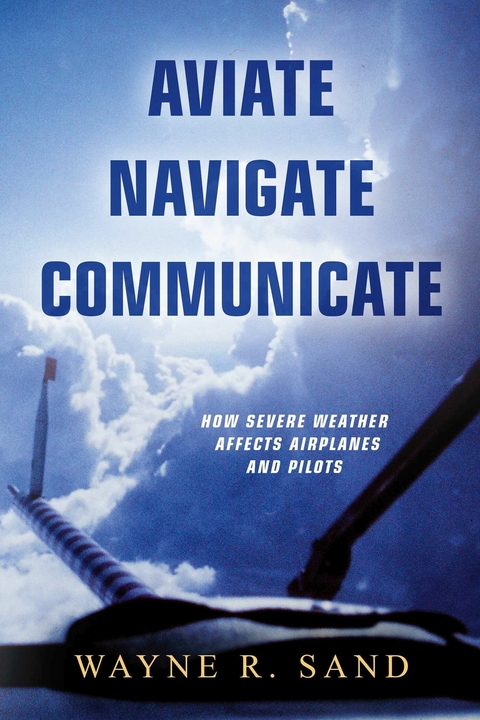
Aviate Navigate Communicate (eBook)
284 Seiten
Bookbaby (Verlag)
979-8-3178-0225-7 (ISBN)
Wayne Sand, a Montana native, started his flying career by being taught how to fly in Super Cubs by a crop sprayer while in high school and then by becoming a flight instructor throughout college. Wayne has an extensive piloting career and has flown for different universities to support weather research by a variety of scientists. While conducting research flights, he often flew through hazardous weather such as thunderstorms, icing, microbursts, lake snow events, and snowstorms to collect data. Wayne was also a pilot for the United States Navy in Vietnam and the Mediterranean, flying jets from aircraft carriers. He later joined the National Center for Atmospheric Research (NCAR), where he was the deputy director of the research applications program and helped develop wind shear and microburst warning systems for the FAA. Alongside his impressive piloting career, Wayne holds a Master of Science degree in meteorology and a PhD in atmospheric science. When he left NCAR, Wayne went on to open an aviation weather consulting business where he examined aviation accidents where the weather was the main cause or a factor. He continued flying his own light airplanes as part of his business. He has taught a continuing education course on aircraft icing for the University of Kansas for over twenty years. Based on his diverse flying experience with hazardous weather, his education in atmospheric science, and his consulting, Wayne felt compelled to share some of the lessons he learned with pilots and others through an entertaining, interesting narrative.
"e;Aviate Navigate Communicate"e; is the story of Wayne Sand's life flying into and learning about severe weather. When a flight instructor tells a pilot to avoid a weather phenomenon, they need to understand why, based on their personal and their airplane's limitations. "e;Aviate, Navigate, Communicate"e; is also a priority sequence learned early in every pilot's career; however, while flying, especially during difficult situations, pilots have trouble remembering and/or applying the sequence. Flying the airplane (Aviate) is always the number one priority, then keeping spatially oriented (Navigate), and lastly, talking to somebody about it (Communicate). Remembering to follow each of these steps while simultaneously coping with a severe weather encounter can become a daunting task, even for the most experienced pilots. Having spent a lifetime as a pilot, weather researcher, and aviation weather consultant, Wayne has extensive experience in the world of weather and piloting an aircraft in adverse weather. This book describes some of the aviation weather-related experiences and lessons learned by Wayne throughout his career in an entertaining and educational way. These lessons will help pilots better understand the atmosphere we all live and work in, what to avoid, and why. Since learning to fly in his teenage years, Wayne has always been taught to keep his priorities straight: aviate, navigate, and communicate. He was blessed to be initially trained to fly by a former World War II flight instructor who believed in seat-of-the-pants flying, providing him with a strong aviation foundation. With this foundation, Wayne built a successful aviation career that helped further weather-related science. Within these pages, take on an in-depth discussion of the hazards associated with stratiform and cumuliform clouds; discover the dangers of wind shear, microbursts, and icing; and understand the continued need to learn all about Mother Nature and the importance of the attitudes required of pilots to keep themselves and their airplanes safe. All readers are guaranteed to become enlightened and entertained by the experiences, descriptions, and insights Wayne offers.
Part 1 My Flight Training and Experience – An Abbreviated Autobiography
1.1 Learning to Fly and First Pilot Jobs
People learn to fly for all sorts of reasons. In my case, a fascination with machinery in general and airplanes in particular motivated me to want to be around aviation with the hope of someday learning to fly. I enjoyed hanging out at the grass airport in my hometown of Valier, MT, while I was still a high school student. My version of how I “lucked out” and started in aviation involved making a pest out of myself at the airport. Ora Lohse, the Fixed Base Operator (FBO), finally got tired of seeing me around and offered me a flagman and chemical loader job for his weed and insect crop spraying business.
The fringe benefits of this job included meeting at his house at 2:30 AM (that is right, in the morning while it is still very dark) for breakfast seven days a week. Then, I drove a chemical truck, towing an old Jeep to some remote stretch of road or grass landing strip, and drove the open-cab Jeep to the field to be sprayed. I acted as a marker for each crop spraying pass so Ora could ensure the entire field was chemically treated.
This was a challenging way to get into aviation since teenagers love sleep. Constant sleep deprivation constituted only one step above the revolting task of cleaning toilets on an airliner because you love aviation. But I loved aviation and would endure any hardship for the opportunity! Airplane exposure all day, every day. Also, I was around my pilot boss and other pilots who frequented the airport or came to watch Ora’s aerial exhibition as he dodged trees and power lines while applying chemicals to a grain field. This job drove my whole life during four summer crop spraying seasons—total immersion in aviation.
The best part of the job, even before I started pilot training, was that it solidified my interest and knowledge of airplanes from the ground up. I fueled the airplane, changed the oil, washed it, and helped with the required maintenance. During the spray season, Ora accumulated 12 hours daily on the engine tachometer (which recorded the engine’s running time) while flying within three feet of the ground. Ora had tremendous genes since he only slept 2.5 hours a night, augmented by a 30-minute nap during the day. At about 5 feet 10 inches and 165 pounds, his bald head, usually covered by a ball cap, fascinated me the most. To me, his bald head placed him as an eternal 60-year-old.
He constantly asked his body to perform expert piloting maneuvers in the often overloaded 135-hp Piper Super Cub. It had a chemical tank mounted in the rear seat. He sat between the 75-gallon chemical tank and the engine, almost certain death in the event of an accident. Constant stick and rudder input was required while maneuvering to make precise passes down each field while avoiding the ground, trees, and power lines.
Following my second season working for Ora and just before starting college, his nephew, Carlton, joined us to help with the ground chores. Carlton had just graduated from veterinarian school and wanted to learn to fly before starting his career as a veterinarian.
When the crop spraying season was over, Ora removed the spray booms and chemical tank from his Piper Super Cub and started teaching us how to fly using his primary work tool.
He loved flying and believed in seat-of-the-pants flying—flying by the feel of the airplane without relying on instruments. He was a hard-core stick and rudder pilot and a civilian basic flight instructor during WWII.
Ora was so oriented toward seat-of-the-pants flying that he could not fly by referring to instruments if his life depended on it. He tried to learn to fly with reference to instruments numerous times but could not. So, he taught us seat-of-the-pants flying twice daily, every day, for six weeks. He wanted us to have a feel for the airplane. To demonstrate his attitude toward feeling the airplane, I flew one of the crop-spraying airplanes a few years later to another airport for maintenance. After returning, I informed Ora that the airspeed indicator did not work. He replied, “Wayne, if you need an airspeed indicator to fly that airplane, you should not be flying it!”
Carlton, the veterinarian, and I learned everything to pass our private pilot’s check ride in the Super Cub with a tail wheel (no nose landing gear) and no radio. Ora also wanted us to learn the communication part of flying and how to fly a tricycle landing gear airplane. So, we repeated the whole private pilot course in a Cessna 172, a straight-tailed tricycle landing gear airplane. That airplane did have a basic whistle-stop Very High Frequency (VHF) radio. It was a state-of-the-art radio then, but it was one step above two tin cans and a string by today’s standards. The radio required that you set the transmitter frequency and then “tune” the receiver to that same frequency by using the whistle-stop to confirm the radio was receiving on the same frequency used for transmitting. It also had a low-frequency Automatic Direction Finder (ADF) with a needle pointing toward any low-frequency transmitter, like an AM radio station or aviation ADF navigation radio site—an inconceivably basic avionics package by today’s standards. At the time, it met the avionics requirements for flying in clouds.
At that time, 40 hours of flight time in a single-engine airplane was required before a private pilot check ride with an FAA pilot examiner. After six weeks and 75 flight hours of training and practice from the day we started serious flight training, we took our Private Pilot’s check ride in the Cessna 172. Thanks to Ora’s efforts, we both passed our written tests and flight checks on our first try. We were now private pilots with all the privileges that we were entitled to exercise.
Ora taught us rules from the beginning: rule one, AVIATE (fly the airplane first); rule two, NAVIGATE (always know where you are and where you are going); and rule three, COMMUNICATE. It helped that the Super Cub did not even have a radio or intercom, so we never got to that part while learning to fly it. Our focus was rule one: Aviate. Learn how to control the airplane and make it do what you want.
His method of teaching flying was that there were no holds barred as to when or where he could give us a simulated engine failure. He instilled in us the need to constantly be aware of places to land and that we always had to fly the airplane first (AVIATE). Then, be prepared to NAVIGATE to a suitable landing site in case of a simulated (or real) engine failure. There was rarely anyone to talk to over the vast open farm and ranch lands of western Montana, so we did not deal with the COMMUNICATE part until we started flying the Cessna 172. There still was not anybody to talk to anyway, other than making blind transmissions in the traffic pattern at Valier.
As a former flight instructor for the military, Ora felt we should be prepared for anything. Yes, a Super Cub and a Cessna 172 can do spins, and we did them to become “fairly” comfortable with unusual attitudes. He knew a stall and spin entry in the traffic pattern while preparing to land or just after takeoff was a deadly threat. We needed to understand how to avoid these situations. He taught us how to safely handle a stall recovery (without a spin entry) if we were stupid enough to stall close to the ground. He required that we be prepared for an engine failure in the traffic pattern. He often gave us simulated engine failures while close to the ground.
After watching him spray crops for two seasons, I was accustomed to seeing airplanes flying close to the ground. Altitude is usually your friend while flying—more altitude is generally better. Early training equipped me to be comfortable flying close to the ground. As part of our training (and his experience as a crop sprayer), he taught us to be acutely aware of things like power lines and towers. I do not recall ever being intimidated or afraid to fly close to the ground. Some of this came from watching Ora fly close to the ground daily as he sprayed fields.
He also insisted that we know the locations of, and be familiar with, all the airports in the area and along our flights’ routes. He taught us to be “reasonably” comfortable landing on roads and pastures. I say reasonably comfortable since I do not think pilots should ever be comfortable with off-airport landings—too many things can go wrong. Before our first solo flight, he exposed us to off-airport landings and takeoffs with the Super Cub. We had to assess the safety of our selected emergency landing location and judge whether or not we could safely land there and take off.
Later in our training, and when he was familiar with the site, we occasionally landed out of a simulated engine failure. He could easily recognize a safe landing site for the Super Cub and knew the precise locations of all airports in western Montana. Ora was highly attuned to the potential of an engine failure since he had experienced a few and wanted us to be prepared. As a crop sprayer, he routinely flew off roads and pastures. During my career, I experienced a few engine failures in single-engine and multi-engine airplanes. In two of these cases, I safely landed off-airport without further damage to the airplane.
One day, Ora was spraying a wheat field for weeds, and I was flagging with the Jeep (marking each pass so he could adequately space the next pass). I saw him hit a power line as he pulled up at the end of a spraying pass. A power line came...
| Erscheint lt. Verlag | 5.6.2025 |
|---|---|
| Sprache | englisch |
| Themenwelt | Literatur ► Biografien / Erfahrungsberichte |
| ISBN-13 | 979-8-3178-0225-7 / 9798317802257 |
| Informationen gemäß Produktsicherheitsverordnung (GPSR) | |
| Haben Sie eine Frage zum Produkt? |
 EPUB (Ohne DRM)
Größe: 7,1 MB
Digital Rights Management: ohne DRM
Dieses eBook enthält kein DRM oder Kopierschutz. Eine Weitergabe an Dritte ist jedoch rechtlich nicht zulässig, weil Sie beim Kauf nur die Rechte an der persönlichen Nutzung erwerben.
Dateiformat: EPUB (Electronic Publication)
EPUB ist ein offener Standard für eBooks und eignet sich besonders zur Darstellung von Belletristik und Sachbüchern. Der Fließtext wird dynamisch an die Display- und Schriftgröße angepasst. Auch für mobile Lesegeräte ist EPUB daher gut geeignet.
Systemvoraussetzungen:
PC/Mac: Mit einem PC oder Mac können Sie dieses eBook lesen. Sie benötigen dafür die kostenlose Software Adobe Digital Editions.
eReader: Dieses eBook kann mit (fast) allen eBook-Readern gelesen werden. Mit dem amazon-Kindle ist es aber nicht kompatibel.
Smartphone/Tablet: Egal ob Apple oder Android, dieses eBook können Sie lesen. Sie benötigen dafür eine kostenlose App.
Geräteliste und zusätzliche Hinweise
Buying eBooks from abroad
For tax law reasons we can sell eBooks just within Germany and Switzerland. Regrettably we cannot fulfill eBook-orders from other countries.
aus dem Bereich