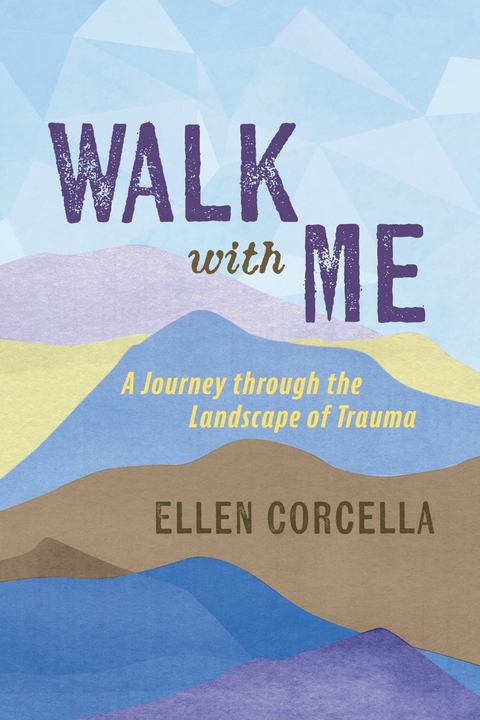
Walk with Me (eBook)
244 Seiten
Bookbaby (Verlag)
979-8-3509-9860-3 (ISBN)
An ordained minister with the Christian Church (Disciples of Christ), Corcella spent ten years as a hospital chaplain caring for critically ill, injured, and dying patients and their families. After graduating from Christian Theological Seminary, she received additional training in trauma informed clinical care, mindfulness and medication practices from the Center for Mind-Body Medicine, and Palliative Spiritual Care from California State University Shiley Haynes Institute. Prior to entering the ministry, Corcella was a New York City prosecutor who lead complex cases involving mobsters, drug traffickers and violent criminals. She is a graduate of Georgetown University Law Center and George Washington University. She founded the network 'Faith & Resilience' to provide resources and reflections about faith, spirituality, trauma and loss; and currently serves as an Elder and leads the Green Chalice and Social Justice Ministries at Zionsville Christian Church. She lives at home with her dog, Hope, and her cat, Harriett. Corcella is available as a workshop leader, speaker, and preacher and her additional writings may be found at www.ellencorcella.com.
What happens when a federal prosecutor's past childhood trauma finally catches up with her in the courtroom of her own soul?Ellen Corcella built her identity around being unbreakable as a New York City prosecutor. At the height of her career prosecuting mobsters and murderers, Corcella's carefully constructed world shattered under the weight of buried childhood trauma. Her journey from the federal courthouse to hospital corridors as a trauma chaplain reveals a profound truth: we don't move beyond our wounds we learn to walk with them. With unflinching honesty and hard-won wisdom, Corcella shares stories that will break your heart and rebuild your faith. Racing to meet patients on their worst days comforting parents after car accidents, baptizing dying prisoners, singing hymns with suicidal patients Corcella discovers that embracing our own brokenness is the key to offering authentic hope to others. This raw memoir shows how trauma-informed spiritual care transforms both healer and wounded. Walk with Me is more than a memoir it's a comprehensive guide for anyone walking alongside others in pain, searching for meaning in suffering, or learning to live with their own trauma. Complete with practical resources and a study guide designed for both individual reflection and group discussion, this book serves as an essential companion for trauma survivors, chaplains, counselors, and faith communities seeking to create healing spaces
Introduction:
The Chaplain
No minister can save anyone. We can only offer ourselves as guides to fearful people.
The Wounded Healer by Henri J.M. Nouwen
I had no idea that evening would change the trajectory of my life. I had no idea that when I walked into the hospital at 8:00 p.m.—on a Saturday night—that I would leave the hospital transformed. I had no reason to suspect my first twelve-hour shift as a chaplain intern would be unlike my other experiences of ministry.
I was in my fifth year at Christian Theological Seminary (CTS) and sat perpetually on the edge of indecision. My prior experience as a student minister persuaded me that I did not want to become a pastor of a congregation. At fifty-eight years old, I did not want to pursue years of added schooling to obtain the doctorate needed to teach at an academic institution. Heck, I could not even decide on a denomination within which to pursue ordination.
I was raised Roman Catholic, an obvious career no-go as only men are ordained. I spent time in the ordination track of the Presbyterians, but I am a far cry from a Calvinist. The Episcopal Church, referred to colloquially as “Catholic lite,” seemed a logical choice, but my embedded Roman Catholicism would not allow me to accept King Henry the VIII as the legitimate founder of a denomination. In any event, the nearest Episcopal seminary was in another state. As a single mother raising her teenage daughter, there was no way I was moving.
CTS is an ecumenical seminary founded by a small mainline Christian denomination known as the “Christian Church (Disciples of Christ).” I liked the name, Disciples of Christ. I longed to be Christ’s disciple—to follow Jesus and to serve others as Jesus taught us. More interestingly—and this is a bit of insider’s baseball—the Disciples of Christ had no theology, no doctrinal creeds, no set of beliefs that one had to memorize, and no oath of allegiance to give. The Disciples believe that Jesus is the Christ, the Son of God. Worship includes communion every Sunday, and all are welcome at the communion table. I could handle that. So, in the fall of 2015, I persuaded the denomination’s regional minister to accept me as a candidate for ordination.
In addition to courses on the Bible, theology, and Christian history, a seminarian needed to engage in practical ministry: a year of student ministry in a congregation and a semester in an acute health care facility as a chaplain intern. I began my clinical pastoral education (CPE) in late August of 2015. Several weeks later, that Saturday night, I was assigned my first weekend shift as a chaplain “intern.”
My duty was to shadow a senior resident chaplain to “learn” my role as chaplain. I met him in a building next to the sprawling hospital campus. As fate (yes, it was fate) would have it, Rick Cruse was the designated “trauma” chaplain. He specialized in responding to patients transported to the emergency department (ED) with life-threatening injuries caused by car wrecks, gunshots, stabbings, falls, or any sort of outside, unnatural mechanism.
We were getting to know each other when our pagers blared, and we simultaneously looked down to see the words “Trauma One.” “Trauma One” was a system code alerting personnel that a person suffering life-threatening injuries was on their way to the hospital. All people critical to the care of that person had to report to the ED’s trauma bay within five minutes. That personnel included chaplains.
We took off—down a set of stairs, across a parking area, through the automatic doors of the hospital, and down a corridor into a back hallway to a set of elevators—and stopped in front the trauma bay, an ultramodern, technological wonder.
Rick consulted with gathering nurses then waved at me. “Come on, the patient is being air lifted. Let’s go outside.”
I trailed Rick through the ED lobby and into the balmy September night. I leaned my head back, scoured the charcoal gray sky, heard the whirl of helicopter blades and saw a beam of light descending toward the landing pad. As the blades slowed to a halt, Rick turned back to the ED entrance. The automated doors slid open, and we retraced our route through the maze of hallways until we stood again in front of the trauma bay.
I froze in the middle of the commotion and chaos. Medical personnel were jammed into the room, their overflow stretching into the hallway. Nurses hung bags of blood and fluids on hooks protruding from steel poles and situated oxygen tanks and ventilators at the head of the bed. Half a dozen doctors exchanged nervous small talk, and technicians lined the hallway with mobile x-ray and ultrasound machines.
To my right, double metal doors swung open. The helicopter crew, clothed in red-striped, black flight suits, wheeled the patient past the assembled crowd into the trauma bay. I found myself stepping on toes as I did not know the delicate dance between doctors, technicians, and nurses as they moved around the patient. I had no idea where a chaplain stood in the steps, beats, and pace of the ED.
Despite my disorientation, I loved the rush of adrenaline, sense of urgency, and the tension that accompanied the crisis. I was programmed for crisis. I’d spent over twenty years in New York City where everything is full speed ahead and my career as a New York City prosecutor meant every day brought new challenges and new crises to resolve. I found myself adapting to the rhythm of that night.
Rick gathered information from the helicopter crew then grabbed a telephone to notify the family their loved one was in the hospital. Through the night, we alternated between checking the status of our critically injured patients and calming distraught families until a surgeon could speak with them.
Our pagers blared. More incoming. Fluke accidents—a motorcyclist crashing at over 110 miles per hour, a party goer falling backward and fracturing his skull on a sidewalk—flooded the emergency department. One minute, trauma patients were singing with their car radio or heading to dinner with a friend, and the next minute, they were fighting for their lives.
Like a marble splintering a pane of glass, a traumatic event shatters one’s life, and the shards of glass cannot be reassembled to their original form. Trauma patients struggle to return to their normally scheduled lives after these devastating events.
***
I entered the seminary with conviction. I was called by God to serve God’s people. Over the next five years, I lost my bearings. My internal navigation system switched off, and I struggled to find where God wanted me to land. I lost hope I would find God’s purpose for me in ministry. In the bowels of an urban Level One trauma hospital, waiting with families anxious for news of their loved ones, embracing people in deep anguish, praying that God would heed cries for healing, the signal returned. Caring for people on the precipice of life or death—this felt like a mission, a ministry. This was where I was needed; this was where God wanted me to tend to his people. My heart beat with passion. My brain blinked caution. Did God really think inserting me into the volatile mix of trauma and human tragedy was a promising idea?
Surely, God knew I would be moving through a minefield. I knew the dark side of trauma: not the kind of devastating, single-event trauma like an auto accident or the catastrophic collective trauma a community suffers after a tornado, hurricane, or other natural disaster. Rather, I knew intimate trauma, the type of trauma a parent inflicts on a child, not once but repeatedly over the course of childhood. I assiduously avoided placing myself in situations that might send me on an emotional rollercoaster. I avoided speaking about my childhood or my mother. My deepest secret was that I had borne the brunt of ongoing childhood trauma and could not escape those memories and fears, no matter how far I ran from home.
That night working in the ED foretold the dangers that awaited if I followed my heart and God’s bidding. In the early morning hours, Rick and I saw a physician demanding a mother accept that her daughter was going to die. I cringed at the doctor’s callousness, while Rick slowed our approach to the room, his eyes giving away his shock at the doctor’s public rebuke of a grieving mother. We met the mother, weeping in despair and disbelief, at her daughter’s bedside. Her daughter was dying, and none of the machines or medicines could save her. Rick introduced us and started to offer words of comfort when we were again paged to the ED.
I returned later that night to a mom keeping vigil over her dying daughter. Overcome by a despairing sense of my own inadequacy, I scolded God: You have sent a novice when this mom needs an expert, a real chaplain who knows how to comfort, console, and calm her despair. I have no idea what to do.
I sat across from Mom, with her dying daughter between us, trying to bridge the emotional distance. An instinct from deep inside took over, and I found myself asking, “Can I see a picture of your daughter?”
“She taught Bible study.” Tears flowed. “She never did anything wrong. Why is this happening?”
Little did I know then, I would repeatedly step into that space where death hovered between a mother and daughter. I would find myself attending to a mother who was begging God to explain why her daughter had to die or with a daughter wondering why her mother would never...
| Erscheint lt. Verlag | 24.4.2025 |
|---|---|
| Sprache | englisch |
| Themenwelt | Literatur ► Biografien / Erfahrungsberichte |
| ISBN-13 | 979-8-3509-9860-3 / 9798350998603 |
| Informationen gemäß Produktsicherheitsverordnung (GPSR) | |
| Haben Sie eine Frage zum Produkt? |
 EPUB (Ohne DRM)
Größe: 3,7 MB
Digital Rights Management: ohne DRM
Dieses eBook enthält kein DRM oder Kopierschutz. Eine Weitergabe an Dritte ist jedoch rechtlich nicht zulässig, weil Sie beim Kauf nur die Rechte an der persönlichen Nutzung erwerben.
Dateiformat: EPUB (Electronic Publication)
EPUB ist ein offener Standard für eBooks und eignet sich besonders zur Darstellung von Belletristik und Sachbüchern. Der Fließtext wird dynamisch an die Display- und Schriftgröße angepasst. Auch für mobile Lesegeräte ist EPUB daher gut geeignet.
Systemvoraussetzungen:
PC/Mac: Mit einem PC oder Mac können Sie dieses eBook lesen. Sie benötigen dafür die kostenlose Software Adobe Digital Editions.
eReader: Dieses eBook kann mit (fast) allen eBook-Readern gelesen werden. Mit dem amazon-Kindle ist es aber nicht kompatibel.
Smartphone/Tablet: Egal ob Apple oder Android, dieses eBook können Sie lesen. Sie benötigen dafür eine kostenlose App.
Geräteliste und zusätzliche Hinweise
Buying eBooks from abroad
For tax law reasons we can sell eBooks just within Germany and Switzerland. Regrettably we cannot fulfill eBook-orders from other countries.
aus dem Bereich