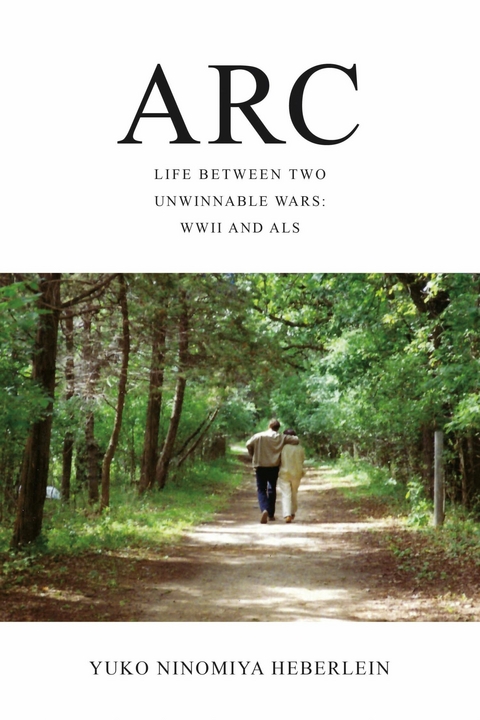
Arc (eBook)
164 Seiten
Bookbaby (Verlag)
979-8-3509-8820-8 (ISBN)
Yuko Ninomiya Heberlein was born in Japan during World War II and graduated from the Tokyo University of Arts as a violin major. She came to the USA in 1966 and received her MFA in Music from the University of Minnesota. In 1969, she joined the St. Paul Chamber Orchestra as its First Violinist. Yuko went on to teach violin at Carnegie Mellon University in Pittsburgh, earn a second master's degree in Japanese Linguistics, teach Japanese at University of St. Thomas in St. Paul, and release a CD 'Music for the Young Paganini.' She and her husband, an internationally recognized German scientist in thermal plasma, were married for 44 years before he passed away from ALS.
"e;Arc: Life between Two Unwinnable Wars: WWII and ALS"e; is a memoir by a Japanese woman who was born during WWII and survived the A-bomb in Hiroshima. She grew up amid the aftermath of the unconditional surrender and witnessed how her native country rebuilt itself from a bombed-out wasteland to the world's second economic giant in 20 years. After graduating from Tokyo University of Arts, she came to America as a scholarship student and spent her adult life as a professional violinist. She married a German physicist/engineer who endured a traumatic childhood in WWII Germany. He lost his brother and his father was taken as a POW, consequently dying due to the hardship. Despite their tough beginnings in countries that are 5,500 miles apart, they managed to build successful careers, raise two children together, and enjoy rich and happy lives. This stretch of time the author calls "e;the Arc"e; expanded high above their trauma to create a beautiful and expansive circle over their lives. During their 46 years together, however, she witnessed how her husband's childhood exposure to war was even tougher than hers, leaving life-long adverse effects on him, psychologically and physically. Their arcs came to an end when an incurable disease, ALS (also known as Lou Gehrig's disease) afflicted her husband. For 21 months, the author cared for him until his death at home.
Chapter II:
The Sun Still Rose Above Us
War’s Long Lasting Evil
War’s evil effects are extremely complex, diverse, and long-lasting. In 2024, nearly eighty years after WWII, new wars go on in our world. We never seem to learn nor run out of wars, creating new tragedies.
In 1983, when our Schweetaka was in her third grade, she came home one day from her school quite upset. “What happened?” when I asked, she tearfully told me, “Kids called me Nazi and Jap, after we talked about WWII in the class today.” I realized then, nearly forty years after the war, the animosity toward one-time enemies of America was still well alive in the generation of Americans who hardly experienced any adversity of WWII. Those third graders could make my innocent daughter upset and rejected. I could only quietly hope that our Schweetaka would eventually develop enough toughness to take such hostility directed at her. That she was born to a German father and a Japanese mother was not her doing nor fault. And what could I have done for her as her mother?
Schweetaka’s father, Jockel, hardly ever shared about his experience of the war in front of anyone, including us. Only one exception I encountered was when we were attending a party. A Jewish person approached him and asked, “So, as a German, how do you justify the Holocaust?” I saw Jockel’s face stiffen and then heard him reply, “I lost my brother, father, and all of our possessions in the war. Maybe you might not consider that to be enough price.” I knew he was ashamed that he came from Hitler’s Germany, which committed one of the biggest crimes on humanity by killing six million Jews. But then again, what could he do? This encounter made him uncomfortable, and he wished to leave the party quickly. After this experience, until Schweetaka made the “Papa Memory” video, I never heard Jockel talk again about his childhood experience during the war.
I myself ran into hostility for the first time only after I left Japan and started to live in America. While growing up inside our island nation, us Japanese, especially those who grew up post-war, have only a remote and indirect sense of shame or awareness about what aggressions our ancestors committed toward our neighbors. No foreigner would come to Japan and openly or uninvitedly criticize what our military did during the war to them. Thus, if I stayed in Japan, I would have ended more as what we call “Ino nakano kawazu. A frog in a well that doesn’t know the world outside.” When I started to live in a dorm on the University of Minnesota campus, one middle-aged Korean woman stood up and left as soon as I sat at her table in the dining room of our dormitory. That was the first time when I encountered obvious hostility directed at me by Japan’s former occupied people.
While growing up in post-war Japan, I never imagined that I would one day marry a German who was exposed to much harsher war’s evil than myself. Through the forty-six years I shared with Jockel and posthumously looking through the “Papa Memory” video, I would gradually come to better understand that the extent of the effects and damages of WWII could be diverse, complex, and long-lasting. By the time Schweetaka made the video in 2012 I myself rarely thought that I was a war survivor. However, it was quite different for Jockel. In facing increasing loss of mobility brought by ALS, that must have constantly reminded him that he was heading toward his death that this incurable disease will eventually bring, he must have thought of deaths a lot, and that in turn must have reminded him of his childhood when he lived through his immediate family’s deaths. That he chose for the first time to talk about his war-affected childhood toward us as the topic of his personal video, Papa Memory, clearly tells this fact.
Born 5,500 miles away from Jockel’s Germany, here is my story of growing up in war-affected Japan. When I was born in Matsuyama city in 1943, the war that Japan started initially outside of our archipelago had already reached inside our country, and bombing by the American forces started in the preceding year in our major cities. In the South Pacific, Japanese forces were meeting bitter defeats in battles on islands such as Guadalcanal or Midway against Allied forces. By the time I was born, Japan’s eventual unconditional defeat that was to come in less than two years was becoming increasingly evident, although the military government hid the news of defeat from the public by controlling the media.
When I was a child, there was a picture book that described the myth of how our country was created according to Shinto tradition. The bearded male god Izanagi and his wife, the female god Izanami, stood on the cloud in the sky and stirred the chaotic mess under them with a huge stick. Both gods were wearing full-layered robes and long-chained necklaces, and their long black hair was tied in a bunch in a unique fashion. The book said that what dripped from the stick when Izanagi lifted it became islands of Japan. Then, out of Izanagi’s left eye, he created his daughter Amaterasu-Oomikami, the goddess of the sun and light. Amaterasu Oomikami is long claimed to be the deified ancestral symbol of Japan’s imperial dynasty. Our national flag, the bright red circle on a white background, signifies our mystical beginning. When the Japanese military authorities brought Japan into WWII, they claimed that because we were fighting for the emperor, the descendant of the sun god, we would be protected by it.
I don’t remember hearing my parents talk about any gods or religions in our house. As far as I know, my engineer father and my mother were atheists and brought me up as one. And I believe that, likewise, many Japanese kept superficially consenting to the military government, while young men were drafted into war and sent as soldiers to the front in an enthusiastic chorus of the town’s people shouting, “Tennoh Banzai! Long live our emperor!”
I believe it was not the myth but rather the pride of being Japanese that united our nation during the war, with our century-old history, rich culture, crafts, and tradition, along with our natural beauty of our islands. It’s the patriotism, the love, and the pride of being Japanese rather than the myth or brainwashing that our government forced on us that readied us to send men to the front and forced my country people to endure what turned out to be unbearable. As the most miserable and unconditional defeat came in August of 1945, we then learned a very hard lesson: the worthlessness of wars. Our constitution, reformed after the surrender, now resolutely states that Japan denounces war, and we have stayed out of war for the past seventy-nine years.
Senzen-ha, Senchuu-ha, Sengo-ha
There was not a single Japanese person that WWII didn’t impact. Only the degree of and how it impacted us differed. That is, depending on where we happened to be, or how old we were, and, sometimes, simply by sheer force of luck. One way we categorize ourselves is by which generation we happened to belong to. As devastating as WWII was for all of us, I grew up seeing the different ways the war impacted us: Senzen-ha, the prewar generation; Senchuu-ha, the war generation; and Sengo-ha, the post-war generation. While my grandparents belonged to the Senzen-ha, my parents were the Senchuu-ha, and I happened to be the Sengo-ha. I was raised in postwar Japan by Senzen-ha and Senchuu-ha people.
My paternal grandfather, Michiharu, born in 1884, came from a rural mountainous area called Uchiko in Ehime prefecture in the Shikoku Islands. He attended present-day Japan Medical University, and by age twenty, he was making house calls as a full-fledged doctor/surgeon on a horseback treating peasants who lived in isolated farming areas. I wonder what training and certification were required by the Japanese Government then to qualify as a doctor shortly after the turn of the century, but he must have established a good reputation as a skilled doctor among country folks because he was soon able to open his own clinic in central Matsuyama city, a famous hot spring town. An older cousin of mine once told me that our grandfather kept live eels in the pond in his yard and was good at filleting live wiggly eels, separating the spine from the meat when the family decided to grill them to make kabayaki. Considering that he was regarded as a surgeon, his skill of managing a knife well was not all too surprising.
Michiharu was a prime example of a Meiji-Otoko; men from the Meiji era (1868–1912); enterprising, ambitious, big-hearted, and also knew how to enjoy the pleasures that life offered. A scroll painting hangs in the living room of my house in Minnesota, a painting of a bluebell flower done by Takeuchi Seihoh (1864–1942), a noted painter who was a member of the Imperial Fine Arts Academy and was awarded the Order of Culture. This small but beautiful painting (10” × 9”) done on a cloth on a gold background was given to Jockel and me by my mother on our twentieth wedding anniversary. It was originally purchased by Michiharu in an auction in Matsuyama City, which was later inherited by my parents. I remember seeing other art works in his house during our visits as small kids, although he lost a good portion of...
| Erscheint lt. Verlag | 14.2.2025 |
|---|---|
| Sprache | englisch |
| Themenwelt | Literatur ► Biografien / Erfahrungsberichte |
| ISBN-13 | 979-8-3509-8820-8 / 9798350988208 |
| Informationen gemäß Produktsicherheitsverordnung (GPSR) | |
| Haben Sie eine Frage zum Produkt? |
 EPUB (Ohne DRM)
Größe: 1,6 MB
Digital Rights Management: ohne DRM
Dieses eBook enthält kein DRM oder Kopierschutz. Eine Weitergabe an Dritte ist jedoch rechtlich nicht zulässig, weil Sie beim Kauf nur die Rechte an der persönlichen Nutzung erwerben.
Dateiformat: EPUB (Electronic Publication)
EPUB ist ein offener Standard für eBooks und eignet sich besonders zur Darstellung von Belletristik und Sachbüchern. Der Fließtext wird dynamisch an die Display- und Schriftgröße angepasst. Auch für mobile Lesegeräte ist EPUB daher gut geeignet.
Systemvoraussetzungen:
PC/Mac: Mit einem PC oder Mac können Sie dieses eBook lesen. Sie benötigen dafür die kostenlose Software Adobe Digital Editions.
eReader: Dieses eBook kann mit (fast) allen eBook-Readern gelesen werden. Mit dem amazon-Kindle ist es aber nicht kompatibel.
Smartphone/Tablet: Egal ob Apple oder Android, dieses eBook können Sie lesen. Sie benötigen dafür eine kostenlose App.
Geräteliste und zusätzliche Hinweise
Buying eBooks from abroad
For tax law reasons we can sell eBooks just within Germany and Switzerland. Regrettably we cannot fulfill eBook-orders from other countries.
aus dem Bereich