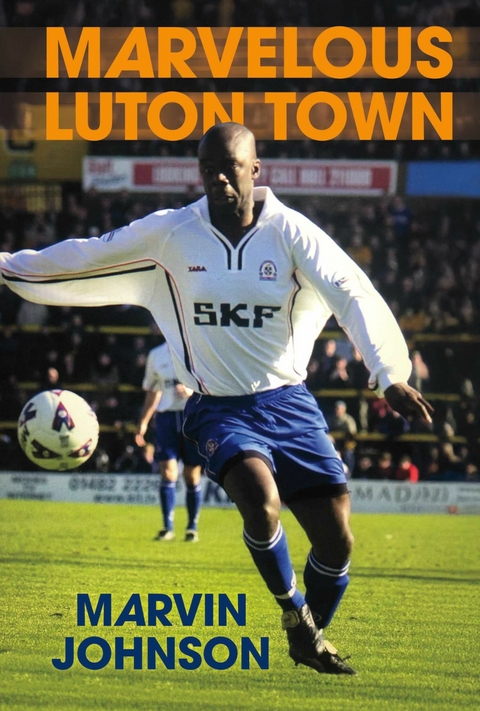
Marvelous Luton Town (eBook)
224 Seiten
Bookbaby (Verlag)
979-8-3509-8624-2 (ISBN)
Born in Wembley, london UK to West Indian parents Laceita and Tommy Johnson in 1968, I was very fortunate to develop a love of Football(soccer) from a very young age and never looked back. It wasn't easy growing up as an Afro Carribean in the 70's but if i had my life again I wouldn't want it any other way. The hardship and challenges i faced because of my heritage is something that still exists today. In this Biography i talk about my life and career becoming a professional player and being involved for over 20 years at my one and only club. It's a journey I am truly grateful and thankful for and if lived again wouldn't change a single thing.
Marvin was born in Wembley, London UK to Afro Caribbean parents from Jamaica and Guyana. While growing up in the 70`s he had to deal with adversities towards his heritage and dreaming of becoming a professional soccer player from a very young age. In this autobiography we get to learn and understand Marvin and his outlook on life as he explains his career as a Youngster to player then his life now as a coach.
CHAPTER 1: Introduction, DIFFERENT
I might have been only nine years of age at the time and I already felt totally at home on a football pitch, but the moment I walked into my new classroom, I felt alone and vulnerable – so different from the opening day at my other school. The whole class had eyes on me and not eyes of excitement, like “Who’s the new kid?” More to the point of “Who’s this kid who’s just landed from another Planet?”
I was calm but very nervous. The only other thing on my mind was my sister Denise. She was a year younger than me and somewhere else, alone in this school. Being the older brother, you feel it’s your duty to look after your sister. It’s like the time I sneaked chocolate in my pocket to Sunday school so we could have something to eat. Every Sunday, we would go to Sunday school for about 10 hours – I’m kidding, but it felt like that. Probably more like four hours, but you have to realise that growing up in a West Indian family in the late 70s was no joke. Don’t answer back, do as you are told and if you are lucky, you’ll make it into your teen years. My sister and I would be with other kids of similar age wanting a snack at some point, but it never came. So I used to sneak chocolate in for us to eat during toilet breaks.
Anyway, back at the school, the headmistress Mrs Last introduced me to my new form teacher and class. I was standing still with my eyes fixed forward. I scanned the room. There was not one other person in the classroom who looked like me. As young kids the age we were, there is no filter and we notice everything. Just like the class seeing me as an outsider or someone with multiple heads, I noticed something strange about all of them. Everyone was white.
How could that be? At break time, when I got to see my sister, she told me it was the same for her in her class. We had just left a school where we felt everyone was the same and equal. Even though you had Asians, Blacks, whites and Indians in the school, no one ever saw anything but a friendly warm face in front of them. There were a total of eight classes for the entire school at Stoke Mandeville. I was in Class 5 while my sister was in Class 4, and we soon realized, after a couple of days, we were the only Black kids in the entire school.
After living on a council estate for five fabulous and wonderful years, Mum and Dad had enough money for us to buy our own home across town, on the outskirts of a village called Stoke Mandeville. I have to admit I really struggled to settle in at first, as did my sister – from kids wanting to touch you or feel your hair. We were literally the kids from outer space. I was confused about how moving literally five to six miles from one place to another could be so different. Some of the kids spoke funny too. They sounded like the Queen: very posh.
The strange thing, though, was that the one person who went out of their way to make me feel welcome was a posh-speaking person. His name ironically was Charles, whom I felt was genuine and showed a willingness to help me settle in any way he could. From the very first day, he raised his hand and said there was a spare place next to him that I could sit. Unfortunately for my sister, she did not get the same welcoming on the first day. A boy she was told to sit next to turned round to the teacher and said, “I’m not sitting next to her, she smells of poo.” A terrible thing for a seven or eight-year-old to say, but what can you do about it? Did he mean that because at that age boys just don’t like girls, full stop? Or was it because of the colour of her skin?
The one other thing that allowed me to find common ground with most of them was when break time came. Just like at Bearbrook, this school played football at break time. Now at this school, the older boys from Class 6, 7, and 8 had their own game going and Class 4 and 5 had theirs. Unbeknown to them, I’d already been playing with older boys for over a year where I used to live. I could see from the standard of our game that I would not simply hold my own, but I would stand out. The difference at this school was that you weren’t allowed to play with a proper full-size ball. Something to do with the playground being small and everyone had to be allowed to play out there and a big ball could hurt a younger kid. So a tennis ball was used at every break and lunch time. After the first week, I and a couple of others from the younger group got invited to play with the big boys. I was still trying to find my feet at this school, but once a ball was in front of me, it made the process easier. Everyone could see that I had very good ability and players on my team were very complimentary.
One day, I had trouble with one boy who was much older than me who was on the other team. Basically, he was the school bully. He was in the oldest class which was Class 8. I had seen him pushing or thumping some of the clever kids from younger classes many times before today. So far he had left me alone, until this one particular day when I had dribbled around him and scored a goal. His mates started laughing at him and he felt humiliated, embarrassed, and was the butt of their jokes for the next few minutes. The next time the ball was on the other side of the field, he jogged past me and said, “Do that again, nig nog, and I’ll break your f’in legs.”
I was frightened and didn’t go near him again during the game. I know what he said to me was wrong but I wasn’t upset, just scared he was going to break my legs. Mind you, it wouldn’t be the only time he called me that before he left the school that year.
Now that particular incident would not be something I would go home and discuss with my mum and dad. I might have been of a young age, but my parents from even earlier than that incident would have spoken about how some people would see me as different because of the colour of my skin. While attending Bearbrook School for the three years I was there, not once do I recall anything like that comment thrown in my direction. All the kids were just kids and I felt there was so much love for one another. Even the teachers at Bearbrook had this way with you that you felt a warmth, and my form teacher Mrs Keen, who I had from when I was six, was the best teacher I ever had. It was like having a family at home and then another big massive family at school – the teachers being the parents and the kids being brothers and sisters.
Stoke Mandeville school was not Bearbrook and I had to make the adjustment. Alongside my football ability, another thing that warmed me to my fellow pupil hearts was my competitiveness. This school did things like country dancing, where a boy had to hold hands with a girl and skip around a hall to some music once a week, with the headmistress leading the lesson. But that is not what I’m talking about regarding competing… although you had to be quick off the mark to ask one of the more popular girls in your class if she’d be your partner for country dancing. I’m actually talking about chess! This school had a chess championship every year for the whole school. Now I didn’t have a clue what this game was, so I decided to watch it when it came around. I watched very closely and picked up the idea of which pieces are allowed to do what, and how. Although it was for the whole school, the actual champion was a boy from my class called Aaron. Aaron stormed to the final and won it for the second straight year running. So the following year, after watching Aaron win the final, I entered the school chess championship. I had practiced at home, playing a neighbour, and although he was older than me, I started to see patterns and certain moves he did frequently. He used to beat me to start off with, but after about seven or eight games, that was it. I never lost to him again.
By the time it came to the chess tournament, I was thinking of so many moves ahead that I wanted to do, and moves he might do to combat that. I won my first couple of rounds comfortably and wasn’t paying much attention to how the draw or brackets were organised. But after winning another two games, a friend said, “You are only two games from the final, you know.” If I were to win my next game, I would meet last year’s losing finalist in the semis.
I won my next game and now I was in the semi-final of the chess championship in my first ever year. In the other semi-final was Aaron, who was the hot favourite again, and last year’s winner. Now you can imagine the games were getting good gatherings, the closer to the final it got. The semi-finals are always played back-to-back. Aaron was to play his first and had already mentioned it was to be him and last year’s runner-up in the final again. Well, if he didn’t actually use those words, he gave off the impression that is what it would be.
I watched his game closely. He won comfortably but had some repetitive moves, which I made a mental note of. As I sat down to play my semi, expecting him to watch, he walked off and said he would be back later to play whoever won. Although I had played well all tournament, it was going to be a real big test, playing last year’s finalist. A closely-fought game, which could have gone either way, saw me get through to the final against Aaron.
I was shocked I had done so well in my first ever tournament, but now I was here, I wanted to give a good account of myself. When Aaron arrived back to play the final, I could see he was surprised I had won. Everyone from our class was there to watch the final. I knew a certain way Aaron was going to play but I was still very nervous because he was...
| Erscheint lt. Verlag | 3.3.2025 |
|---|---|
| Sprache | englisch |
| Themenwelt | Literatur ► Biografien / Erfahrungsberichte |
| ISBN-13 | 979-8-3509-8624-2 / 9798350986242 |
| Informationen gemäß Produktsicherheitsverordnung (GPSR) | |
| Haben Sie eine Frage zum Produkt? |
 EPUB (Ohne DRM)
Größe: 5,7 MB
Digital Rights Management: ohne DRM
Dieses eBook enthält kein DRM oder Kopierschutz. Eine Weitergabe an Dritte ist jedoch rechtlich nicht zulässig, weil Sie beim Kauf nur die Rechte an der persönlichen Nutzung erwerben.
Dateiformat: EPUB (Electronic Publication)
EPUB ist ein offener Standard für eBooks und eignet sich besonders zur Darstellung von Belletristik und Sachbüchern. Der Fließtext wird dynamisch an die Display- und Schriftgröße angepasst. Auch für mobile Lesegeräte ist EPUB daher gut geeignet.
Systemvoraussetzungen:
PC/Mac: Mit einem PC oder Mac können Sie dieses eBook lesen. Sie benötigen dafür die kostenlose Software Adobe Digital Editions.
eReader: Dieses eBook kann mit (fast) allen eBook-Readern gelesen werden. Mit dem amazon-Kindle ist es aber nicht kompatibel.
Smartphone/Tablet: Egal ob Apple oder Android, dieses eBook können Sie lesen. Sie benötigen dafür eine kostenlose App.
Geräteliste und zusätzliche Hinweise
Buying eBooks from abroad
For tax law reasons we can sell eBooks just within Germany and Switzerland. Regrettably we cannot fulfill eBook-orders from other countries.
aus dem Bereich