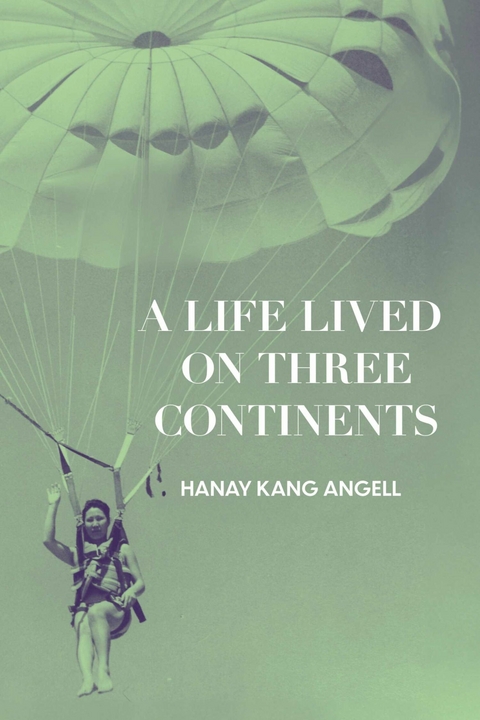
Life Lived on Three Continents (eBook)
268 Seiten
Bookbaby (Verlag)
979-8-3509-6354-0 (ISBN)
Hanay Kang was born and educated in Busan and Seoul, South Korea, then came to the U.S. to study in 1965. Three years later, she worked as a U.N. guide and joined Pan Am Airways to travel the world. She married and lived in Dubai, the Emirates, with her husband and two young children from 1979 to 1986, where she designed furniture and custom office interiors. She owned businesses in Dubai, including American Furnishings and Angell and Withers Design. After returning to New York, she built a successful business designing unique furniture. After closing the business, she decided to devote her time and passion to writing about her eventful and challenging life journey. She is a Parson School of Design graduate, a retired professional member of ASID (American Society of Interior Designers), and former owner of One Angell Desgin Inc. and One Angell International Inc.
A Life Lived on Three Continents is narrated by Hanay Kang, whose life was transformed by the fallout of war in Korea and life anew in America. Hanay was born in Busan in 1944 and educated in Busan and Seoul, South Korea. Tradition clashed with modernity, economic opportunities were slim, and the fiercely independent Hanay migrated halfway across the world - to New York City. She learned English and worked late hours to earn tuition. Three years later, she worked at the United Nations as a guide and Pan Am Airways to travel the world. Then, when she least expected it, a man with intense gazing eyes descended on her life on a Pan Am Transpacific flight, and a passionate romance followed. She married the man who would change her life and built an interracial and blended family. They moved to the United Arab Emirates in 1979 with their two young children and lived and worked there for seven years. She founded a furniture and interior design career that spread its roots to Manhattan while her husband established a law practice in the Arabian Peninsula. The life she built took her across the globe, from South Korea to New York to the Emirates and back to New York. Spanning three continents - and complete with exotic places and unforgettable characters - the reader will discover a survivor's life journey of love and loss, success and failure, despair and triumph, all touching on the very meanings of home, family and self-preservation. After a devastating house fire destroys their home in the Hudson Valley with every memento of their lives. Hanay finds purpose in designing and rebuilding their home, which ultimately helps her overcome the tragedy of the fire. She learns life is a precious gift with all its downfalls and difficulties. She completes her memoir to share her eventful life, the exotic places her family lived and traveled to, and the crises she overcame with readers.
Remembrance
Growing Up in South Korea
I was the sixth child born to a large Korean family when significant changes occurred in my country. No one could focus on minding a newborn, and my arrival into this world came without fanfare. The thirty-five years of Japanese occupation begun in 1910 annihilated the Joseon Dynasty, which ruled the Korean peninsula for over five hundred years. The year after my birth, Japan surrendered unconditionally on August 15, 1945, which ended the Japanese occupation of the Korean peninsula. What followed was chaos brought on by the winners of World War II; the US and the Soviet Union occupied the southern and northern parts of Korea, and they had a tug-of-war, democracy on one side, communism on the other. It forced the country in two directions, and the presence of foreigners and foreign political interests added to the confusion. So my birth indeed marked a turbulent period in Korean history.
I recall my family house in Dong Nae. Black ceramic roof tiles with gardens. In the front my older brother, Hogun, cultivated a flower garden, and in the back Mother grew herbs and vegetables. Mother kept many large ceramic jars with different varieties of kimchi and other ingredients used in Korean cooking. A tall cement wall enclosed the house’s perimeter, and a large water storage tank was near the kitchen. Korean bedrooms served as a place for family meals, to receive guests, and to sleep at the end of each day. A spacious central hall with folding doors connected the two wings of linked bedrooms, and we held a holiday banquet there when other relatives joined us. It was also where I slept with my three older sisters in the summertime, hearing their grown-up chatter and envying them.
The kitchen was on bare ground with two big black pots mounted for cooking. The adjacent room stored large ceramic jars of Korean rice wine in various stages of fermentation; it had a pungent odor. Our house remained quiet, orderly, and spick-and-span clean. Our mother and the older sisters had a rigid routine of hand-mopping the floors on their knees every day. Each morning, Mother also had us fold the mattresses we slept on and put them away, and then we did the reverse to sleep at night. Mother was an exemplary housekeeper, and she used whatever help she could get from my older sisters.
Our father was the third generation of only sons and came from the province of Dae Poe, midway between Seoul and Busan. His mother became a widow, raised our father in their large homestead, and farmed proficiently. Our paternal grandmother was extraordinarily tall for a Korean and strong-minded with a body to match, until the later part of her life when she became ill. She had kept the family house and land and had benefited from our father’s success as a civil engineer. In fact, he owned a sizable construction company. Our maternal grandfather was from a distinguished family of scholars. At the annual national competitions, Grandfather received awards for his scholarly achievement in calligraphy and classic poetry composition. He was handsome, tall, and dignified. He treated our mother (the middle child) the way he treated his two sons, which was unusual in Korean tradition. Our maternal grandmother was from a wealthy family of landowners. She came to marry our grandfather with a large dowry to compensate for her pockmarked face, having been afflicted by smallpox when she was young. This permitted them to own large parcels of land that produced bountiful farm goods with the help of hired workers. They lived comfortably. Our grandmother was an enormously energetic small woman and served sumptuous meals that drew us to their home.
Mother was sixteen when her mother told her that there was a suitor with a marriage proposal from a successful businessman, a wealthy civil engineer. Our maternal and paternal grandmothers were devout Buddhists who traveled to a temple in an isolated mountain and became friends. Curiously, this sparked an unusual offer of matchmaking between a thirty-year-old mature man and a young sixteen-year-old girl. Mother was intrigued by the prospect and persuaded her parents that she would consent to marry only if she liked the man’s look. Mother was permitted to hide behind the kitchen door that provided a good view of anyone walking through the main gate of the home. Mother heard someone clearing his throat and saw a powerful man approach their home. Something about him made her heart pounce, and she could not wait to be his wife. At the time, however, she had no clue that she would soon be redundant. Shortly thereafter, she married the much older man who was almost twice her size—and worldly.
Mother came under pressure to produce a male heir soon after their marriage. She delivered her first child, my eldest sister, Soya, but this disappointed everyone who was waiting for a son. The second girl, Soine (four years later), aggravated everyone. Ginha’s birth, the third girl, received downright hostility. Mother pushed her away, barely wrapped in a blanket, and called her a pig. (At the time, Mother had no idea her number three child would provide her with a comfortable living and thoughtful care in the later part of her life.) Hogun’s birth, on the other hand, stirred joy in our paternal grandmother, a devout Buddhist many of us had never met. It had taken Mother a fourth try to produce a son for whom her mother-in-law had been waiting, and she embraced the much-awaited news with gratitude. Mother recited this important day in her life with such enthusiasm and repeated the tale so often that I can recite the event from memory:
Our paternal grandmother spoke to our mother with gratitude. “Thank you, Ar-ga [my daughter] sent from heaven. I can now leave for my long-awaited eternal journey.”
Mother bowed before her mother-in-law to show her subservience, and she replied in a faint voice, considered a feminine way of speaking. “Kind Mother, I beg of you not to speak of leaving us.”
Our paternal grandmother spread her bony hands on the floor, lifted Mother from kneeling, and said, “I can now tell the ancestors a healthy son was born to carry our family legacy.”
She whispered, “Lay out the clothes for my eternal journey. Then, Ar-ga, give me a bath to cleanse my body for this journey.”
Mother obeyed her mother-in-law and gave her a long hot bath, and she worked fast to complete the sewing of a new silk cloth to cover her Korean mattress and a comforter. Mother heard her mother-in-law chanting a Buddhist prayer with a calm and clear voice. The burning incense enveloped the room, cleansing the smell of an elderly woman who had been ill for a long time. She helped her mother-in-law put on the natural linen Korean dress that had been kept on the shelf folded and waiting in her treasure chest. She helped her mother-in-law down on the newly prepared mattress. The candle beside her bed drew a warm glow to her pale and gaunt face, indicating that she was ready to cross this life for another. Mother was unsure if this was her dream or if she had witnessed a miracle. She saw the rice paper-covered wooden door slide wide and watched two saintly-looking elderly women in white linen dresses step into the room. They walked over to her mother-in-law and raised her from the mattress. She stood up, looked at Mother warmly, and nodded to her slightly. The three old ladies walked out of the room to the yard, and Mother did not see their feet touch the ground. Mother reached out for her mother-in-law, placed her finger under her nostril, and realized that she had left for an eternity.
Mother remembered little about the birth of her fifth child, Hochul, the second son. She said his difficult birth kept her in bed for several weeks, and he was a sickly baby who kept her frightened for his life. Moreover, the Japanese oppression intensified a few months after Hochul’s birth. I asked Mother about my birth and what I was like as a baby, and she dodged me repeatedly. Instead of answering, she talked about the terror of her cousins who got drafted into the Imperial Army of Japan who were fighting against the US in the Pacific Islands. She mumbled that this was a fear that dominated her life. I concluded that my arrival into this world was a nonevent and perhaps rightfully so, being born in a confusing time and as the sixth child. But on the contrary, Mother had plenty of stories to tell about the birth of her pretty youngest daughter, as well as her youngest son, a cute boy, while my existence receded like a fading star at dawn.
Our father was well over six feet tall and had a prominent nose, yellowish-brown eyes, and skinny legs. His shoulders were broad and powerful, but his flabby arms and legs were shrunk by years of physical inactivity—an obvious sign that they had been muscular. Nevertheless, Father accumulated substantial financial assets from working as a civil engineer and owning a sizable construction company during the Japanese occupation of Korea. Father was a young boy when Japan officially annexed Korea in 1910. After completing his engineering studies in Japan, he began working for the occupying country. It gave him an edge over others in getting work, and he prospered. Father had provided a comfortable living even in the later part of the Japanese occupation. However, Japan’s aggressive military expansion impacted Korea’s economy and left it wrecked due to the long years of economic dependency on Japan under their colonial rule.
Then Japan attacked Pearl Harbor on December 7, 1941, and the US declared war on Japan and the remaining countries of the Tripartite Pact, Germany and Italy. World War II concluded in Europe in May 1945, but the war with Japan in the Pacific...
| Erscheint lt. Verlag | 4.11.2024 |
|---|---|
| Sprache | englisch |
| Themenwelt | Literatur ► Biografien / Erfahrungsberichte |
| ISBN-13 | 979-8-3509-6354-0 / 9798350963540 |
| Informationen gemäß Produktsicherheitsverordnung (GPSR) | |
| Haben Sie eine Frage zum Produkt? |
 EPUB (Ohne DRM)
Größe: 2,0 MB
Digital Rights Management: ohne DRM
Dieses eBook enthält kein DRM oder Kopierschutz. Eine Weitergabe an Dritte ist jedoch rechtlich nicht zulässig, weil Sie beim Kauf nur die Rechte an der persönlichen Nutzung erwerben.
Dateiformat: EPUB (Electronic Publication)
EPUB ist ein offener Standard für eBooks und eignet sich besonders zur Darstellung von Belletristik und Sachbüchern. Der Fließtext wird dynamisch an die Display- und Schriftgröße angepasst. Auch für mobile Lesegeräte ist EPUB daher gut geeignet.
Systemvoraussetzungen:
PC/Mac: Mit einem PC oder Mac können Sie dieses eBook lesen. Sie benötigen dafür die kostenlose Software Adobe Digital Editions.
eReader: Dieses eBook kann mit (fast) allen eBook-Readern gelesen werden. Mit dem amazon-Kindle ist es aber nicht kompatibel.
Smartphone/Tablet: Egal ob Apple oder Android, dieses eBook können Sie lesen. Sie benötigen dafür eine kostenlose App.
Geräteliste und zusätzliche Hinweise
Buying eBooks from abroad
For tax law reasons we can sell eBooks just within Germany and Switzerland. Regrettably we cannot fulfill eBook-orders from other countries.
aus dem Bereich