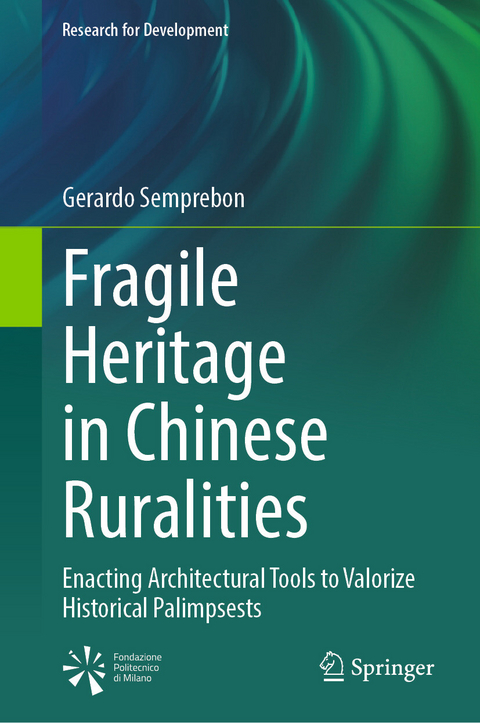
Fragile Heritage in Chinese Ruralities (eBook)
223 Seiten
Springer Nature Switzerland (Verlag)
978-3-031-77517-8 (ISBN)
This book explores the concept of fragile heritage as an architectural legacy and a territorial resource in rural China, emphasizing the significance in safeguarding its unique cultural trajectory, and laying the groundwork for future developments. Chinese rural buildings and settlements encapsulate priceless cultural values, but become increasingly vulnerable, under increasing pressures. Socioeconomic transitions, climate change, political agendas, land rent speculation, awakenings, and commodifications of cultural values, redefine the conceptual and operational framework of countryside transformation, and contribute to the debate on contemporary architectural and urban design. In this context, rural authenticity emerges as a crucial value in architectural morpho-typology, construction techniques, and expressive codes.
The book introduces the notion of fragile heritage as the crossroad between folklore, academia, and practice. Next, it put in place reading methods to frame rural settlements as cultural palimpsests, indissolubly tying architectures to the landscape. These concepts are then applied to a multiscalar analysis of fifteen traditional architectures to uncover rural space and society's physical and cultural dimensions. Finally, it discusses recent revitalization projects, highlighting the potential role of architectural design.
The research methodology relies on fieldwork campaigns in the Fujian and Zhejiang Provinces of China between 2017 and 2019 and a subsequent critical ri-elaboration that leverages the graphic apparatus as the fundamental investigative tool. The central idea put forward in this book is that, between tradition and innovation, the fragile heritage of past societies needs a cultural translation, interpretation, and negotiation to find space and life in the contemporary milieu.
| Erscheint lt. Verlag | 8.1.2025 |
|---|---|
| Reihe/Serie | Research for Development |
| Zusatzinfo | XXVI, 223 p. 137 illus., 112 illus. in color. |
| Sprache | englisch |
| Themenwelt | Literatur ► Biografien / Erfahrungsberichte |
| Geisteswissenschaften ► Geschichte ► Regional- / Ländergeschichte | |
| Sozialwissenschaften ► Politik / Verwaltung | |
| Technik ► Architektur | |
| Schlagworte | ancestral halls • architectural design • China rural revitalization • countryside revitalization • fragile heritage • fragile heritage for sustainable development • Fujian • landscape aesthetic • rural village • traditional settings • vanishing tradition • Vernacular buildings |
| ISBN-10 | 3-031-77517-1 / 3031775171 |
| ISBN-13 | 978-3-031-77517-8 / 9783031775178 |
| Informationen gemäß Produktsicherheitsverordnung (GPSR) | |
| Haben Sie eine Frage zum Produkt? |
 PDF (Wasserzeichen)
DRM: Digitales Wasserzeichen
Dieses eBook enthält ein digitales Wasserzeichen und ist damit für Sie personalisiert. Bei einer missbräuchlichen Weitergabe des eBooks an Dritte ist eine Rückverfolgung an die Quelle möglich.
Dateiformat: PDF (Portable Document Format)
Mit einem festen Seitenlayout eignet sich die PDF besonders für Fachbücher mit Spalten, Tabellen und Abbildungen. Eine PDF kann auf fast allen Geräten angezeigt werden, ist aber für kleine Displays (Smartphone, eReader) nur eingeschränkt geeignet.
Systemvoraussetzungen:
PC/Mac: Mit einem PC oder Mac können Sie dieses eBook lesen. Sie benötigen dafür einen PDF-Viewer - z.B. den Adobe Reader oder Adobe Digital Editions.
eReader: Dieses eBook kann mit (fast) allen eBook-Readern gelesen werden. Mit dem amazon-Kindle ist es aber nicht kompatibel.
Smartphone/Tablet: Egal ob Apple oder Android, dieses eBook können Sie lesen. Sie benötigen dafür einen PDF-Viewer - z.B. die kostenlose Adobe Digital Editions-App.
Buying eBooks from abroad
For tax law reasons we can sell eBooks just within Germany and Switzerland. Regrettably we cannot fulfill eBook-orders from other countries.
aus dem Bereich