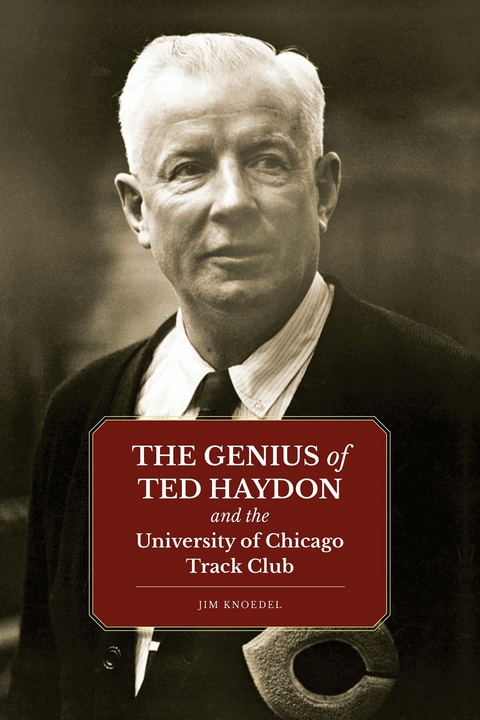
Genius of Ted Haydon (eBook)
240 Seiten
Bookbaby (Verlag)
979-8-3509-8938-0 (ISBN)
For thirty-five years Jim Knoedel was a college coach with stops at Iowa State, Drake, Loyola, Northwestern, and the University of Illinois at Chicago where he spent the last twenty-one years of his career. He is a graduate of the University of Iowa and currently resides in Chicago with his wife Denise.
Edward "e;Ted"e; Haydon was born in Saskatchewan Canada in 1912 and moved to Chicago in1917 where he lived the rest of his life. He was renowned for creating the University of ChicagoTrack Club in 1950, a unique blend of college and club that changed the way track and fieldorganizations were seen. Over the years seventeen club members qualified for the OlympicGames in 1956, 1960, 1964, 1972, 1976, 1980, and 1984 Jan Johnson finishing third in thepole vault in 1972 and Rick Wohlhuter also third at the 1976 Games in the 800 meters. A 1933 graduate of the University of Chicago, Ted spent the first sixteen years of his career as asocial worker during the height of the Great Depression and WWII, one of the neighborhoods hewas responsible for the site of the 1929 St. Valentine's Day Massacre frequented by the likes ofAl Capone and Bugsy Moran. Ted had a wit matched by few, his "e;Being a member of the UCTC is a state of mind. If you thinkyou are, then you are"e; one of the classic lines. The club coach and U of C varsity coach at thesame time, he opened the organization to people of all levels, espousing a Run For Fun mottoto his charges, the eight minute milers just as welcome as those who could break four minutes. He was known to counsel athletes after a bad race with the quip "e;Don't worry about the racetoday, I know you are capable of much worse"e; or "e;If you want to run faster times you'll need torun shorter races."e; Ted's alibi list was legendary, complete with boxes to check the excuse,handed out to all his new athletes and comprised of these examples "e;I wanted to see whatthey gave 3rd place"e; or "e;I felt great and that's always a bad sign."e;He was an assistant coach for the 1968 and 1972 US Olympic teams; also coaching at the '63and '79 Pan American Games, the 1961 Maccabi Games, leading US teams on European andRussian tours in 1958 and 1975, inducted into the USA Track & Field Hall of Fame in 1975. Itwould take a thesaurus to list all Ted's great qualities. He will always be remembered for hissense of humor, a fedora on his head, and the two stopwatches around his neck.
Chapter 1
The Early Years of Ted Haydon
Edward “Ted” Haydon was born March 29, 1912, in Saskatchewan Canada, the second of three boys, his father Eustace was a Baptist Minister in Dresden, Ontario – the Haydon family with roots in England. Eustace made an initial start on his doctorate degree at the University of Chicago before Ted was born, in 1917 moving the family to Chicago to complete work on his PhD in Comparative Religion at the Divinity School – his dissertation entitled, “The Conception of God in the Pragmatic Philosophy.” His degree was completed in 1918, so Eustace began looking for a job, surprised when the U of C offered him a position as head of the Department of Comparative Religion in January of 1919.
For the next sixty-six years, Ted’s home would be in Chicago’s Hyde Park or South Shore neighborhood, both located along the shoreline of Lake Michigan. The Eustace Haydon family lived at 61st and Ingleside Ave, Ted and his brothers attending Fisk Elementary on Langley Avenue, the school just south of the site for the 1893 World’s Fair. The three boys (Hal the eldest and Brownlee the youngest) were quite active, playing all the seasonal sports, learning to swim and skate in grade school, throughout their childhood spending summer vacations in Canada with relatives.
It may have been surprising that the boys were sent to a public school for their primary education when they could have attended the U of C elementary school for free, but Ted was grateful for the opportunity, in a September 22, 1975 Sports Illustrated article by Sarah Pileggi saying.
“We had kids from the Jewish orphanage a block away and tough kids from the 63rd Street area. It was a mixture, and it was a very good experience.”
His freshman year of high school, Ted enrolled at the University of Chicago HS (as it was called back then) on the Hyde Park campus, following in the footsteps of older brother Hal who was a senior. Like his sibling, Ted was popular at U-High, active in many of the same extra-curricular activities, but a non-distinguished member of the prep football and track teams. During his high school years he began working as a counselor at a summer boys camp – Camp Ahmek – located two hours north of Toronto in Algonquin Provincial Park. It was the same summer camp Eustace had taken the boys when they were young, the program part of a national movement to give children wilderness experiences. It was in this setting where Ted’s love for the outdoors first began – fishing from a boat and canoeing from lake to lake, on his days off striking out on his own; one time paddling twenty-eight hours straight before he was back at Camp Ahmek.
The stock market crashed on October 24, 1929; the historic event occurring during Ted’s first season of football with the University of Chicago team. He was on the junior varsity squad (the U of C was in the Big Ten at the time) and only played in scrimmages, never getting off the bench in varsity games, probably because the squad was dominated by seniors. They had a great season, finishing out the year with a 6-3 record, ending in Chicago with a 26-6 spanking of the University of Washington.
Though Ted had a great respect for head coach Amos Alonzo Stagg, his time on the bench sophomore years was not to his liking – when the team finished 2-6-1 – realizing the sport held no future for him. In Hal Higdon’s book, “On the Run from Dogs and People“ Ted spoke of his football experience at the U of C.
“I always claimed I played football for Stagg and under the feet of his first string.”
In 1933, Ted’s senior year, the “Grand Old Man”, as Stagg was respectfully known, was relieved of his coaching duties by university president Robert Maynard Hutchins. Three years of losing seasons (’30-’31-’32) sealed Stagg’s fate, an 18-7 home loss to Wisconsin on November 22, 1932, the final straw. It was an ignominious ending for the seventy-year-old coach (elected to the Football College Hall of Fame in 1951 and the Basketball College HOF in 1959), Stagg’s work ethic, his innovative ideas (the T-formation, on-side kicks, and tackling dummies a few examples), and coaching philosophy, guaranteeing him an elite status in collegiate coaching ranks.
Stagg was a larger than life figure, twenty-five years earlier, in 1905, leading the Maroons to conference titles in football, basketball, track, and baseball, eventually giving up his track and baseball duties to focus on football and basketball. To demonstrate the impact he had on the development of football in the 20th century, today’s winner of the Big Ten football championship game receives the Stagg Championship Trophy, and the DIII NCAA football championship game is named the Amos Alonzo Stagg Bowl to honor his achievements.
In 1905, Stagg (who would be the track and field coach for the 1924 Olympic team in Paris) started a prep track meet on the University of Chicago campus that would run for almost thirty years, called the Stagg Interscholastic Tournament. Elite athletes and teams from throughout the country were invited to the unique two-day track and field event. It was one of the most prestigious meets in the nation, at the 1929 contest over eight hundred prep athletes from twenty-five states competing at Stagg Field (it was named after him in 1913). Only the winners were listed in newspaper articles, so it’s uncertain if Ted ran in this meet, but he must have attended the high-quality event, this contest his first exposure to a national caliber track and field competition.
After his sophomore season of football, Ted put all his athletic attentions into track and field, finding some success in Big Ten competition as his second year of school ended. A natural born leader and an athlete who enjoyed the variety track and field had to offer, over the years he competed in the high and low hurdles (as did brother Hal), the hammer, javelin, discus, and shot, preferring legs on short relays rather than the mile relay. By his senior year Ted was receiving weekly accolades in The Daily Maroon newspaper for his performances.
“Maroon Track Team Trounces Wildcats – Haydon is High Point Man.” (March 7, 1933)
“Captain Ted Haydon’s double victory in the highs and hammer throw as well as a third in the lows.” (May 10, 1933)
Though Coach Merriam said Ted was a “promising hurdler” in newspaper articles, the coach jokingly described the young Haydon as:
“The best slow hurdler I ever had. What he lacked in speed, he made up with form.”
Of note, one of Ted’s teammates on the 1933 U of C track team was freshman by the name of Jay Berwanger, a man who would go on to be the first recipient of the Heisman Trophy in 1935. Jay was a very talented athlete and according to an article in The Daily Maroon (Jan. 6, 1933) “cherishes a secret ambition…to be American’s next Olympic decathlon champion.”
Although there were occasional conflicts with spring football, he had lots of success as a freshman – mostly in the throws and hurdles – by his senior year with football behind him he scored 6350 points in the decathlon for the Maroons. His 1936 mark is still number two on the University of Chicago All-Time Honor Roll – a few spots ahead of Jim Haydon’s 6260 points.
——♦♦♦——
After Ted completed his Bachelor of Philosophy (PhB) degree in social sciences in June of 1933, he decided to pursue his graduate studies the following fall at the University of Chicago with the thought of becoming a college professor like his father. He was awarded a scholarship and began work towards a Master’s degree in Sociology. Classes started at the end of September, Ted taking on a part-time job during the worst years of the Great Depression.
“In the middle of his first year of graduate work he was given a part-time job with Common Ground, a youth work organization sponsored by the Chicago Congregational Union.” (University of Chicago Magazine, Nov. 1955)
Ted had been dating Golde (pronounced Gold-ah) Breslich since their U-High days, by their senior year of college an article in “The University Woman” section of May 10, 1933, The Daily Maroon, describing the Psi Upsilon pair as the couple who were putting on “one of their justly famous dinners.”
Before his first year of graduate school was finished, Ted and Golde announced their engagement, and in December of 1934 they were married, the ceremony performed by Eustace at Bond Chapel on the U of C campus. The part-time job with the Chicago Congregational Union soon became a full-time offer, and he dropped out of his graduate studies, in the midst of the Great Depression a steady job more important than a graduate degree.
His new position was part of the Chicago Arts Project (CAP), a delinquency prevention initiative funded by the State of Illinois’ Department of Welfare. CAP was created by Clifford Shaw in 1932 “founded on the belief that communities could reduce juvenile delinquency by improving neighborhood life” (The Story of Chicago Area Project – Robert Lombardo). They selected three Chicago neighborhoods to focus on – the Near North Side, the Near West Side, and the Near Northwest Side – all areas of the city where poverty and organized crime were a daily fact of life.
The goals established by CAP were to develop youth recreational opportunities, improve the community environment, and deal with delinquency issues; all of this by utilizing established organizations – ones such as the Catholic Church, Boy Scouts,...
| Erscheint lt. Verlag | 6.1.2025 |
|---|---|
| Sprache | englisch |
| Themenwelt | Literatur ► Biografien / Erfahrungsberichte |
| ISBN-13 | 979-8-3509-8938-0 / 9798350989380 |
| Informationen gemäß Produktsicherheitsverordnung (GPSR) | |
| Haben Sie eine Frage zum Produkt? |
 EPUB (Ohne DRM)
Größe: 3,1 MB
Digital Rights Management: ohne DRM
Dieses eBook enthält kein DRM oder Kopierschutz. Eine Weitergabe an Dritte ist jedoch rechtlich nicht zulässig, weil Sie beim Kauf nur die Rechte an der persönlichen Nutzung erwerben.
Dateiformat: EPUB (Electronic Publication)
EPUB ist ein offener Standard für eBooks und eignet sich besonders zur Darstellung von Belletristik und Sachbüchern. Der Fließtext wird dynamisch an die Display- und Schriftgröße angepasst. Auch für mobile Lesegeräte ist EPUB daher gut geeignet.
Systemvoraussetzungen:
PC/Mac: Mit einem PC oder Mac können Sie dieses eBook lesen. Sie benötigen dafür die kostenlose Software Adobe Digital Editions.
eReader: Dieses eBook kann mit (fast) allen eBook-Readern gelesen werden. Mit dem amazon-Kindle ist es aber nicht kompatibel.
Smartphone/Tablet: Egal ob Apple oder Android, dieses eBook können Sie lesen. Sie benötigen dafür eine kostenlose App.
Geräteliste und zusätzliche Hinweise
Buying eBooks from abroad
For tax law reasons we can sell eBooks just within Germany and Switzerland. Regrettably we cannot fulfill eBook-orders from other countries.
aus dem Bereich