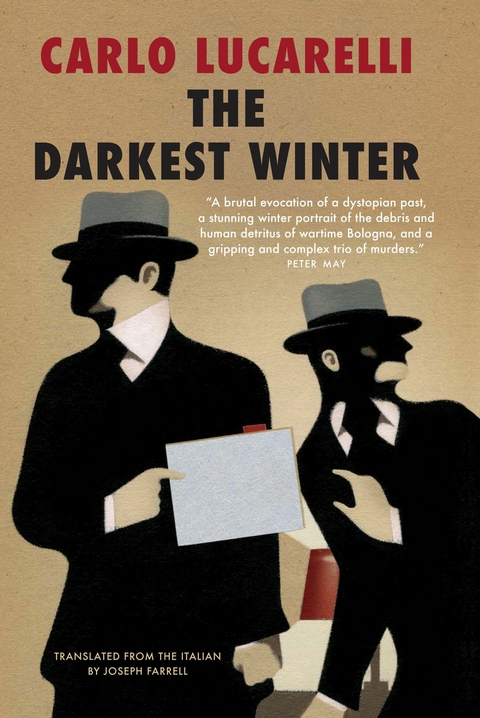
The Darkest Winter (eBook)
304 Seiten
Open Borders Press (Verlag)
978-1-916788-75-6 (ISBN)
Carlo Lucarelli (born 26 October 1960) is an Italian crime-writer, TV presenter, and magazine editor. He was shortlisted for the Gold Dagger in 2003 for the novel Almost Blue.
Il Resto del Carlino, Friday, December 1, 1944 – xx111, Italy, Empire and Colonies, 50 centesimi.
the enemy squanders its forces against the unyielding defence of the wehrmacht– new lethal german weapons devised for war at sea – battalions of the war-wounded volunteer for anti-aircraft and anti-parachute duties. In a locality in northern Italy the wounded and the injured flock to request admission to the Battalions whose banners carry the motto “Honour and Sacrifice”.
Report from Bologna: mattresses and clothing stolen. Mattresses and clothing to the value of 20,000 lire have been stolen from the damaged home of 53-year-old Dario Guizzardi, also known as Andrea. the blackout. Schedule: from 17.10 to 19.00.
just like in italy: Read the correspondence from Italian workers serving in Germany. In general these comrades say that, irrespective of their zone of employment, they retain a perfect impression of being still in Italy. these are the facts, judgment is yours.
The German pulled open the door and stuck his head inside the car, careful not to strike his helmet against the framework. He had taken off a glove and held it dog-like between his teeth, while in his other hand he clutched a sub-machine gun, his index finger padded with rough wool filling the trigger guard. He took the neatly prepared documents which Franchina offered him, and stood for some time staring impassively at the faces of the two men, the younger at the wheel with blackheads on his face and hair smoothed into well-oiled waves, and De Luca at his side, sunk into the seat of the 1100, wrapped in his plain overcoat which was too light for a winter which was already bitterly cold.
Franchina gave a forced smile, which the German did not reciprocate. He stretched over to look under the vacant seat in the rear, accidentally snagging the metal gorget of the Feldgendarmerie which trailed from the heavy material of his coat in the opening as he pulled back. He opened the door further, not just because he could not wriggle free, although he was a stout, heavily built individual, but also to indicate they were not to close it, and moved off.
Vicebrigadiere Aurelio Franchina kept him in sight as he walked over to a similarly substantial colleague who was resting his backside on a motorbike sidecar, his wrists at either end of a Machinenpistole around his neck, a cigarette barely visible between his gloved fingers.
He said, “Damn these Germans, Comandante. They’re real buggers.” Under his breath, he gave a soft whistle of admiration, exhaled from between his lips in a puff of breath.
De Luca looked away. Two militiamen from the Black Brigade were seated on a pile of debris alongside one of the smaller arches of porta Saragozza, right under the sign which pointed to the entrance to the Sperrzone in the centre of Bologna, alongside another, smaller one which said verboten and had been cut in half by falling debris during the last bombing raid. They too were smoking peacefully, their rifles across their knees.
De Luca reached for the handle to wind down the window, rapped his knuckles on the car door to attract their attention and with a nod of his head indicated the woman who was standing in front of them with her documents in her hand and a bag held tightly under her arm, stamping her feet on a pile of dirty snow. It was still early, the curfew had just ended and there was no-one out and about except her.
The militiamen stared at him, then the one with the little square beard in the Italo Balbo style restrained the other who was on the point of losing his temper, his furious eyes turned towards De Luca. He put out his cigarette, stubbing it delicately on a brick, put it into his jacket pocket and got to his feet to examine the woman’s documents. The slightest of glances, his attention elsewhere, he did even make her open the bag which had on one side traces of flour, contraband flour, certainly purchased on the black market from a mill outside the walls. De Luca, too, watched her from there, in the middle of the road.
The German leaning on the sidecar also raised his head when he heard the knocks on the car door. He seemed to have been struck by De Luca’s air of authority because he handed the documents back to his colleague, although he was still examining the first of them, the identity card belonging to Franchina, who repeated, “Damn these Germans, how tough they are.”
De Luca said, “Careful, Franchina. I have lived in Rome and I know the jargon, but here in Bologna if they hear you saying ‘Damn these Germans,’ they might misunderstand.”
Franchina blanched.
“Oh God, sir, I had no intention … you know what I mean … you know what it really means, don’t you? It was a compliment, I swear.”
He was babbling, and when the soldier put his head back inside the car, he swallowed hard. He took the documents and hurriedly handed them over to De Luca so as to free his right arm for a salute, to which the German made no acknowledgement.
“They can’t have heard me, can they?” he muttered, pulling too quickly at the gearstick, causing it to screech. De Luca grabbed the door handle as the car bounced along the tram tracks.
“Calm down, Franchina, I was joking. Where are we going exactly?”
“Via … what’s it called … Senzanome. The street with no name. Really, Comandante, that’s what it’s called.”
“I know. It’s near here. Look, there it is there.”
There were only three people under the portico, but it was so narrow, the narrowest in Bologna, that they seemed to make up a crowd. One was a commissario from the Crime Squad whom De Luca had known from his days in the flying squad. Officer Something, but he could no longer remember what. The other one was also an officer known to De Luca, Maresciallo Something Else. He stepped out from the portico, pulling up the rifle which had been on his shoulder, when he saw the car draw up.
The third was the dead man, seated on the ground, his back against one column and his feet against another, with his knees bent inside that tight space.
“Relax, relax,” said the commissario to the maresciallo, “it’s the Political Division. You’re De Luca, right? What are you doing here? Is this your case? We’ll clear off right away.”
De Luca said, “We were just passing when we saw you.” He recalled that the commissario’s name was Santi. Short and fat, wrapped up in a grey coat which made him appear even more rotund, his nose pointed upwards, like a pig’s. But he was a good policeman.
De Luca went round the dead man’s column into the portico, turning his back on Santi who took a couple of steps back to make way for him.
“May I?” he asked. “A policeman’s curiosity …” – while thinking to himself: when I was one.
Santi shrugged. “Go ahead. I haven’t even touched him. I was waiting for the police doctor. Anyway, we’ve just arrived on the scene. They called last night, but we waited till it was daylight. You know what it’s like in the dark. Between the Germans and the other lot, you just never know. Not that I’ve anything against our German colleagues, don’t get me wrong, but accidents will happen. I was meaning, above all, the partisans, that’s to say the outlaws from the anti-national gangs. With them, you know what it’s like, don’t you? I mean, it’s not that we’re scared, but it’s better to be cautious, isn’t it?”
He was talking faster and faster, obviously anxious, but De Luca was not listening to him. He was kneeling over the corpse, his back turned to the commissario. He was waiting for something, and in fact Franchina, who was standing beside the car in the middle of the street smoking with the maresciallo, shouted over to Santi, who was only too glad to be allowed to move away. De Luca stretched out his hand and unbuttoned the dead man’s coat, a fine camel hair overcoat which would have kept him warm, earlier, when its owner was still alive. Then he took out a piece of folded notepaper which he kept in the inside pocket of his own raincoat and slipped it into the man’s overcoat. Swiftly, struggling somewhat with the beginnings of rigor mortis reinforced by the cold of the night.
He got back to his feet, causing his arthritic knees to creak, called to Santi, moved a couple of steps away, leaned his back against the wall and crossed his arms over his chest.
“Maybe you should take his documents, just to establish who he is,” he suggested.
The commissario made a sign to the...
| Erscheint lt. Verlag | 22.5.2025 |
|---|---|
| Übersetzer | Joseph Farrell |
| Verlagsort | London |
| Sprache | englisch |
| Themenwelt | Literatur ► Krimi / Thriller / Horror ► Historische Kriminalromane |
| Literatur ► Krimi / Thriller / Horror ► Krimi / Thriller | |
| Schlagworte | Action & Adventure Literary Fiction • Albakiara • Alberto Tedeschi Prize • Andrea Camilleri • Anna Mazzola • Antonio Manzini • Barry Forshaw • Bastards of Pizzofalcone • Black Brigade • Blu Notte misteri d’Italia • Bologna • Carlo Lucarelli • Carte Blanche • Commissario Brunetti • Commissario Ricciardi • crime in translation • Crimini 2 • CWA Dagger • Death in August • Detective De Luca • donato carrisi • Donna Leon • Euro Noir • European • Fascist Italy • fiction in translation • Genre Fiction • Giallo • Giulio Leoni • Grazia Negro • historical fiction • Historical thrillers • Hostages • Inspector Montalbano • International Mystery & Crime • Italian Crime Fiction • Italy • Joseph Farrell • Joseph Heller • Kjell Ola Dahl • Leonardo Sciascia • Literary crime • Lucarelli • Michael Ondaatje • Michele Giuttari • murder fiction • Mystery Thriller & Suspense Literary Fiction • Nazis • Nic Costa • Noir • Noir Crime • Open Borders Press • Orenda Books • police procedural • Republic of Salò • Robert Harris • Second World War • The Courier • The Crocodile • The Damned Season • The Darkest Winter • The Day of the Owl • The Red Door • Thrillers WW2 Fiction • Valerio Varesi • Via delle Ocche • ww2 fiction |
| ISBN-10 | 1-916788-75-0 / 1916788750 |
| ISBN-13 | 978-1-916788-75-6 / 9781916788756 |
| Informationen gemäß Produktsicherheitsverordnung (GPSR) | |
| Haben Sie eine Frage zum Produkt? |
 EPUB (Wasserzeichen)
DRM: Digitales Wasserzeichen
Dieses eBook enthält ein digitales Wasserzeichen und ist damit für Sie personalisiert. Bei einer missbräuchlichen Weitergabe des eBooks an Dritte ist eine Rückverfolgung an die Quelle möglich.
Dateiformat: EPUB (Electronic Publication)
EPUB ist ein offener Standard für eBooks und eignet sich besonders zur Darstellung von Belletristik und Sachbüchern. Der Fließtext wird dynamisch an die Display- und Schriftgröße angepasst. Auch für mobile Lesegeräte ist EPUB daher gut geeignet.
Systemvoraussetzungen:
PC/Mac: Mit einem PC oder Mac können Sie dieses eBook lesen. Sie benötigen dafür die kostenlose Software Adobe Digital Editions.
eReader: Dieses eBook kann mit (fast) allen eBook-Readern gelesen werden. Mit dem amazon-Kindle ist es aber nicht kompatibel.
Smartphone/Tablet: Egal ob Apple oder Android, dieses eBook können Sie lesen. Sie benötigen dafür eine kostenlose App.
Geräteliste und zusätzliche Hinweise
Buying eBooks from abroad
For tax law reasons we can sell eBooks just within Germany and Switzerland. Regrettably we cannot fulfill eBook-orders from other countries.
aus dem Bereich