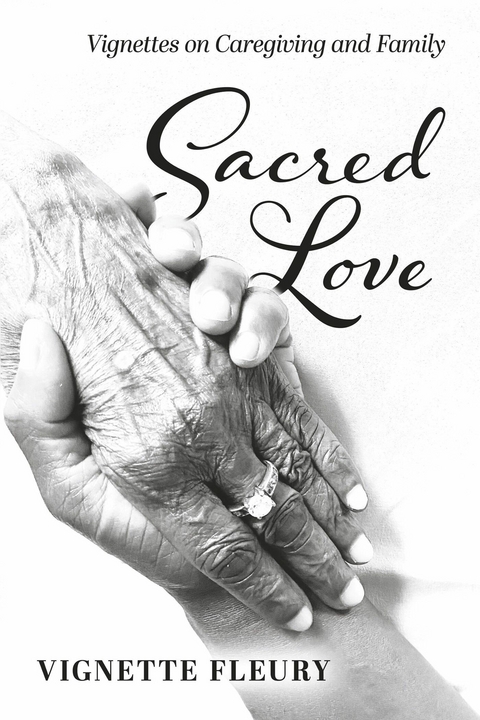
Sacred Love: Vignettes on Caregiving and Family (eBook)
70 Seiten
Bookbaby (Verlag)
979-8-3368-4896-0 (ISBN)
Vignette Fleury became primary caregiver to her mother who has Alzheimer's and her sister, Iraissa who had Down syndrome, in May 2007 after her beloved father died unexpectedly of a heart attack. She cared for both of them in her home until the passing of Iraissa in February 2020. Her mother who is 90 continues to reside with her. Vignette is the proud daughter of immigrants. Her father and mother emigrated to the United States from Haiti and the Dominican Republic respectively. She was born and raised in Brooklyn and moved to Central NJ in 2003. She has a Bachelor degree from Baruch College and worked as an accountant for approximately 17 years. In the Fall of 2009, she walked away from that field and went on to obtain a Master of Arts degree in Bilingual/Bicultural Studies form LaSalle University. She has worked as a Spanish interpreter for approximately 12 years. In 2022 she rediscovered her passion for writing after responding to a call for writing submissions from the McCarter theater and the 'Healing Voices' project. The piece she submitted was included in the McCarter's 'Healing Voices' performance in the Spring of 2022. She went on to write over 20 short stories that she has shared on Moth stages in Philadelphia, New York and Brooklyn. She is currently working on publishing a book of poetry.
Just in the nick of time
I was one of those kids who really enjoyed spending time with her parents. I can still remember sitting on the couch, with my mom and dad, watching The Carol Burnett Show. We would laugh until we cried. That was my idea of a fun Saturday night. Of course, in my teenage years, hanging out with my parents began to lose its allure. My focus shifted to going out with friends and my anticipated adulthood. Like most of my peers, I spread my wings and went away to college. I basked in the glow of my newly found freedom. It was that unique and fleeting form of freedom otherwise known as “living away from home while parents foot the bill.” The years flew by. I graduated, moved back home to Brooklyn, began working as an accountant, and got married. So much changed, but what always remained was the bond I shared with my parents.
That bond is why, on a cold winter morning in February 2003, my father called to tell me that he wasn’t feeling well again and would like to see a doctor but didn’t think he could drive himself. I told him I would be “right there.” I let my husband Phil know what was happening. He suggested that I take my father to an emergency room. I refused. I’d, at that point, had enough experience in Brooklyn Hospital emergency rooms to know that the wait could be interminable. It would be faster to take him to my mom’s primary care doctor. I jumped in the shower and immediately started crying. He had sounded so fragile. Fear washed over me as it sunk in that my dad had to be really sick. You see my father was my rock, always a pillar of strength. I had never witnessed him have anything more than a common cold. In my mind, he was indestructible. During the thirty years that he worked at his job, my father never called in sick. However, in the month before the morning of this phone call, he had been out sick from work three times. Each time, it was due to nausea and upset stomach. After each incident, I suggested that he let me take him to see my mother’s primary care doctor. At that point, I had been assisting my mother with her healthcare needs for years. Dad humored me, but ultimately, he went to a doctor he used to see decades ago. I suspected that his doctor was a quack; he recommended an antacid. My father even told me that the antacid was working and that he felt “fine.”
When I arrived at my parents’ house that morning, my dad seemed to be himself, except for the pained look on his face. He walked to the car with the same straight, upright stride he always had, albeit a bit slower. We drove to the doctor’s office in silence, neither of us knowing what to say, both stunned by this circumstance. We arrived at my mother’s primary care physician’s office to find that he’d been called away to an emergency. I explained my father’s symptoms to the nurse. She sent us to the cardiologist down the hall from their office. When we got there, they had been awaiting our arrival. The cardiologist spoke to both of us in the examination room and then asked me to go back to the waiting area while he examined my father. When he called me back into the room, the cardiologist explained that, as per the EKG results, my father had already had at least one major heart attack.
The doctor looked my dad in the eyes and said, “You must have been feeling really lousy for some time.”
I was stunned. The doctor scheduled a cardiac catheterization in two days and prescribed nitroglycerin tablets. He also instructed him to not attempt to return to work and go immediately to an emergency room if he felt any discomfort prior to the procedure. On our way to the exit, I stopped and thanked the nurse for her quick thinking. We drove to the pharmacy and dropped off the prescription on the way home. I brought my dad home, made sure he was comfortable, and calmly explained everything to my mother before going to pick up the nitroglycerin tablets. I picked up the prescription and sat in my car for a moment. I needed to let my siblings know what was happening before I got back to my parents’ house. My first call was to my sister Janet. I started to explain what happened, but when I said the words, “Dad already had a major heart attack,” I choked on them and started crying. She calmed me down and told me to focus on getting back to our parents’ house and she’d call our sister Reina. I had Dad take the medication as soon as I got back. I stayed there a few hours to make sure everything was as normal as could be expected before heading home. My dad said he felt a bit better after taking the first dose. I told him and Mom to call me immediately if he started to feel any pain.
When Phil got home that evening, I told him everything. He listened intently and said somberly, “We may have some long days ahead.” Phil really loved my dad, so much so that, when I told him, “If something happens to my dad, my mother and sister, Iraissa, would have to come live with us,” he simply said, “Yes, I know.”
When I called my father the next morning, he told me that he felt 100 percent better. I was relieved to hear him sounding like his normal self. A couple of hours later, I got a call from my mother. She had waited until Dad stepped out to call me. She informed me that my father was feeling so well that he didn’t think he needed to have the cardiac catheterization that was scheduled for the next day. “Please talk to your father,” was the last thing she said before we got off the phone. I called Dad on his cell phone and reminded him that the procedure was extremely important, that it was a must, and that Phil and I would be there the next morning at 7:00 a.m. to pick him up and take him.
He said, “I remember. I’ll be ready when you arrive.”
The day of my father’s cardiac catheterization, the cardiologist explained all aspects of the procedure to us, including the possibility of clearing any small blockages they might encounter and putting in stents as needed. We were all encouraged. They told us it would take about two hours. My sisters and brother-in-law met us at the hospital—there is strength in numbers. We decided it would make sense to get something to eat while the procedure was taking place.
When we returned, a nurse approached us as soon as we entered the waiting area. “Are you the Fleury family?” she asked. “The doctor wants to speak to you.”
We all stopped in our tracks. Every one of us knew something must be wrong. In what seemed like seconds, the doctor was in front of us talking. I was able to hear him even though my heart was racing and the sound of it seemed to fill my ears.
The first thing he said was, “We couldn’t do anything.”
The sheer weight of his words robbed us of the ability to speak. We all remained silent, in a state of disbelief. We waited for an explanation.
The doctor continued, “Mr. Fleury’s blockages were too significant for us to address. He will have to have bypass surgery if he’s a good candidate; we’ll run tests.”
My sister Reina yelled, her voice cracking, “If? What does he mean if?” She ran out of the waiting area.
My sister Janet sat down, put her palms together, brought them to her face, and began crying silently. A few minutes passed before I was able to digest what the doctor had said. My father was alive and well and waiting for us in the recovery area. They couldn’t clear his blockages during the catheterization. He would have bypass surgery if he was “a good candidate.” I needed to find out what being a good candidate meant.
I told Janet, “We have to go see Dad, and he can’t see us crying.”
She wiped her tears and we headed to see our father, but we stopped at the nurse’s station first. I spoke with the nurse manager. I asked her what it meant to be a “good candidate” for bypass surgery. She explained that a person wouldn’t be a “good candidate” if they suffered from severe lung, kidney, or liver disease or if they were a heavy smoker or drinker. That information was a soothing balm. I knew that, other than the heart attack, my father’s overall health was good. Relief washed over me. Janet and I walked into our dad’s area. He was his usual self. He was sitting up and talking with one of the nurses. However, his voice, the way he spoke, and the look in his eyes were different than anything I had ever heard from or seen in him. He spoke tentatively in hushed tones. I saw a bit of fear and confusion in his eyes. The turn of events had thrown him for a loop.
The nurse asked my dad, “What about the bypass surgery worries you?”
He said simply, “I’ve never had surgery before.”
Not only had he not had a surgery before but he’d never even been to a hospital other than to visit someone. She replied that “bypass surgery is very common” and that he would be fine. She also said that he might develop blockages in the future, but he wouldn’t need another procedure for at least five years.
Everything moved quickly. My dad’s test results showed that he was indeed a good candidate for bypass surgery. He was transferred to a room in the cardiac ward. His bypass was scheduled to take place in two days. The surgeon who would be doing his bypass came to his room to explain the procedure in detail and answer our questions. That evening, when my sisters and I headed home, we were comforted by the fact that,...
| Erscheint lt. Verlag | 16.10.2024 |
|---|---|
| Sprache | englisch |
| Themenwelt | Literatur ► Biografien / Erfahrungsberichte |
| ISBN-13 | 979-8-3368-4896-0 / 9798336848960 |
| Informationen gemäß Produktsicherheitsverordnung (GPSR) | |
| Haben Sie eine Frage zum Produkt? |
 EPUB (Ohne DRM)
Größe: 7,1 MB
Digital Rights Management: ohne DRM
Dieses eBook enthält kein DRM oder Kopierschutz. Eine Weitergabe an Dritte ist jedoch rechtlich nicht zulässig, weil Sie beim Kauf nur die Rechte an der persönlichen Nutzung erwerben.
Dateiformat: EPUB (Electronic Publication)
EPUB ist ein offener Standard für eBooks und eignet sich besonders zur Darstellung von Belletristik und Sachbüchern. Der Fließtext wird dynamisch an die Display- und Schriftgröße angepasst. Auch für mobile Lesegeräte ist EPUB daher gut geeignet.
Systemvoraussetzungen:
PC/Mac: Mit einem PC oder Mac können Sie dieses eBook lesen. Sie benötigen dafür die kostenlose Software Adobe Digital Editions.
eReader: Dieses eBook kann mit (fast) allen eBook-Readern gelesen werden. Mit dem amazon-Kindle ist es aber nicht kompatibel.
Smartphone/Tablet: Egal ob Apple oder Android, dieses eBook können Sie lesen. Sie benötigen dafür eine kostenlose App.
Geräteliste und zusätzliche Hinweise
Buying eBooks from abroad
For tax law reasons we can sell eBooks just within Germany and Switzerland. Regrettably we cannot fulfill eBook-orders from other countries.
aus dem Bereich