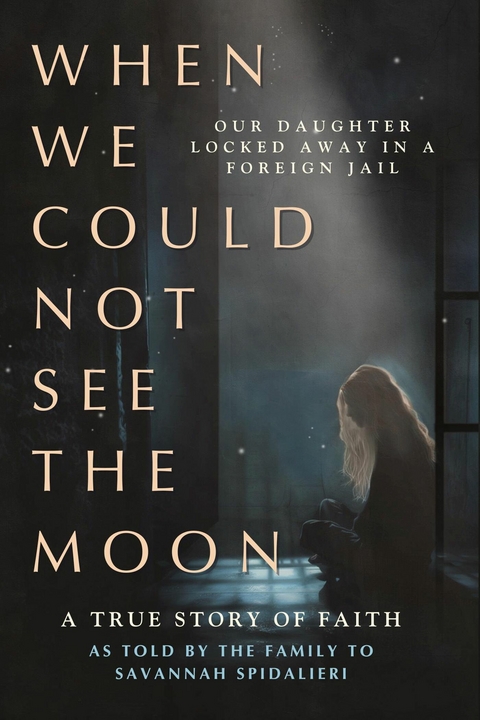
When We Could Not See the Moon (eBook)
295 Seiten
Ballast Books (Verlag)
978-1-964934-09-9 (ISBN)
The real Jon and Tracy live in Idaho, USA. They steadfastly continue to pursue their faith while embracing travel across the world. While both are retired from their respective careers, they remain professionally engaged and enjoy the freedom of controlling their own calendar. The names and locations in this book have been changed to shield and support their daughters in their ongoing healing process from this experience and protect the privacy of all involved.
A family cast in darkness. A daughter in an unimaginable situation. And the guiding light of faith that carried them through. When Jon and Tracy Willems' daughter Hanna ventured across the world for what was supposed to be an exciting year of working abroad in Egypt, things quickly took an unexpected turn, and the family found themselves in the middle of a waking nightmare. Falsely apprehended at customs for suspected drug trafficking, Hanna was placed in an Egyptian jail under unthinkable conditions with no tether to the outside world. As Jon and Tracy struggled to put together the pieces of where their daughter had gone and what horrible fate might await her, Hanna sat thousands of miles away in a crowded and filthy cell. So began Jon and Tracy's fight for their daughter's freedom. But they were not alone. What could have easily been a story of a family's hardship and terror is instead a story of God's grace during their most trying days. At its core, When We Could Not See the Moon is about a family cast in darkness amid the unimaginable situation Hanna found herself in. It's a story of how faith united people across the world and worked through them to provide a guiding light throughout the journey. Though names, locations, and other key elements have been changed or fictionalized to protect those who worked so fiercely to bring Hanna home, the Willems' story is otherwise entirely based in fact. Encompassing the perspectives of parents Jon and Tracy Willems, sister Taylor, and Hanna herself, this harrowing true story captures all the defining characteristics of humanity: despair, distrust, and suffering but also faith, hope, compassion, and community. Dynamic and engaging with excerpts from the journal Hanna kept throughout this unbelievable series of events, When We Could Not See the Moon will speak to parents, people of faith, warriors for justice and anyone who finds themselves lost in the dark, desperately searching for the light.
TWO NIGHTS EARLIER FRIDAY, FEBRUARY 19TH
SHORTLY BEFORE MIDNIGHT JON
Next chapter begins today!
Hanna’s message had come through just as we were preparing to turn in for the night. We’d arrived at the cabin hours earlier—in the dark, as was usual that time of year. And—as was usual that time of year—we’d spent several hours settling in. Our weekend retreat nestled in the deep woods of Idaho is not without its own set of chores and maintenance responsibilities—especially during the winter months.
Idaho snow is as dense and unrelenting as it is beautiful. Often, when we share photos of our wintery accumulation with friends and family in various parts of the world—photos of our cabin picturesquely buried under drifts several feet deep—they marvel at the sheer amount of it.
Snow in this part of Idaho is more than a part of life. In many ways it is life. Two of our major industries—tourism and agriculture—rely on a good snowfall each year. Millions of skiers, snowboarders, and other winter thrill-seekers descend upon Idaho’s numerous resort spots each year to carve fresh tracks in the abundance of seasonal snow. Those in agriculture are counting on a dense snowpack and good runoff to replenish reservoirs that will feed the state’s agricultural areas through another long, dry summer.
I, for one, find myself firmly in both camps. I love to get out to the cabin after a good snowfall to do some snowmobiling, and I also know how important that end-of-season runoff is for the potato industry—the very industry that brought me to Idaho in the first place. So, when the snow comes, we’re grateful for its beautiful inconvenience. We work through it—literally.
Tracy and I built our cabin just about an hour and a half north of our home. We wanted to be close enough to enjoy it often yet far enough away to allow us to fully appreciate the remote and isolated nature. We purchased the land in 2007, began building in 2013, and completed our weekend getaway spot roughly a year later. The winding road we now know so well delivers us almost weekly to our cabin where we indulge in both quiet time together and solitary endeavors. For me, for about a third of the year, those solitary hours mean one thing: snow.
When we arrive at the cabin after a big snow, the chores begin. First, the long driveway needs to be cleared. But the trick here is that the snowblower is kept in the garage—at the end of the driveway.
Tracy has the pleasure of watching from the warmth of the car as I high-step through the deep snow, making my way to the garage. With the snowblower up and running, I blow a path back to the car and one to the house to free Tracy. Once that’s done, I have the task of clearing the rest of the driveway to pull the car in.
My chores don’t end there. Solar panels are a wonderful invention for powering a cabin tucked away in the remote Idaho woods. The thing is they need sun to function. So, more time is spent clearing the panels.
While it seems like a lot of work to be done for a weekend’s enjoyment, the payoff is worth it. I love the opportunity to get out into the vast stillness that is southwestern Idaho covered in snow. There is really nothing quite like it.
But all that blinding, isolated quiet gives you a lot of time alone with your thoughts. Friday, February 19, my thoughts were consumed by my daughter and her impending trip.
I try my best to remain “hands off” in these situations with my children. After all, they are adults, impossible though that still seems to me at times. Sometimes, I’ll admit, Hanna doesn’t make that easy.
As I worked my way through the snow that Friday evening, I reflected on Hanna’s relative silence since her arrival in the Netherlands for a short visit with friends and family before heading on to Egypt.
After nine months with her mother and me at home, she leaves for Amsterdam and drops off the face of the Earth.
This always happens when she goes to Amsterdam. It swallows her up, and we don’t hear from her for days at a time. That is not unusual, but during Hanna’s time at home during the COVID pandemic, I’d grown accustomed to our conversations, and I don’t think I had been fully prepared for them to end so abruptly once she traveled to Amsterdam.
I’m not being sentimental here—I’m thinking specifically about our talks regarding her upcoming trip. When Hanna first told us about her plans to travel to Egypt and live there for a year, I, of course, had questions. She planned to fulfill a dream of becoming a “digital nomad,” as her job as a digital marketing specialist and web analyst gave her the freedom to work from anywhere, but I was wondering if she’d fully thought it through.
You see, Hanna is a dreamer, which is a wonderful thing to be. She is constantly exposing her mother and me to new things— new foods, new experiences, new ideas. We’re better people for it. But she’ll follow a dream on a whim, and as her father, it’s my job to try to look down the road to see just where that whim might take her. I try not to badger. I resist the urge to say, “No, you’re not doing that.” Mostly, I ask questions and let her reach her own conclusions.
There’s something I’ve learned raising children—particularly, raising daughters—that I try to impart on other new fathers as they begin their journeys into parenthood. You will never win an argument. Don’t even try. In fact, the moment it goes from a conversation to an argument you are trying to win, you’ve already lost. This was never more apparent to me than when our daughters were teenagers.
The job of a teenager—their whole purpose—is to become independent. They are in a weird time where they are beginning to separate from you and forge their own path into adulthood. It’s evolutionary. Everything inside of them is screaming to separate, to try things their way. And because of that, you will never win an argument with a teenager. The moment you use your power as a parent to win an argument, you become threatening, and they will never hear a word you have to say.
So, my advice is to make your point, make it in a calm voice, and be direct. Offer your view, and if you can’t be calm, walk away. If you do that, nine times out of ten, they will hear you, and your advice will have a much bigger impact. They won’t admit it, of course. They’ll insist you’re old fashioned, and you don’t get it, but if you make your point with love, it will get through in the end.
Those early years of learning to navigate our boundaries have paid off as my children have grown into adults. We’ve all settled into the roles we play in any conversation, and though I’m sure my direct approach still frustrates them at times, we all know how the conversation is going to go. They present an idea, and I challenge them to look at it from a different angle.
Sometimes, I’ll admit, I’m maybe a bit too direct, and I know I still say things they don’t want to hear. When your adult daughter tells you out of nowhere that she’s moving to Egypt for a year, pointed questions about whether she’s considered all the horrifying ways her plans could go wrong probably aren’t high on the list of responses she’s hoping to receive.
Still, we didn’t argue over it. I didn’t say, “It’s a dumb idea— you shouldn’t go.” Maybe I should have. But what I did do was try to open her mind to my concerns. As long as she knew what they were, maybe she’d have better luck avoiding them turning into realities.
In the days, weeks, and months leading up to her departure, Hanna and I had many of these conversations. Hanna is well-traveled, having grown up in an international family. She’s smart and can take care of herself. Still, there are corners of the world where things work a bit differently. This was my biggest reservation as her father.
Hanna had been to Egypt before on vacation with her now ex-boyfriend, who was Egyptian. I couldn’t help but wonder if the lens Hanna had seen Egypt through on that brief trip was a bit rose-tinted.
This trip would be different. In fact, it wouldn’t be a trip at all. Since she’d be staying there for a year, she’d be more immersed in the culture and would settle into day-to-day life, well off the beaten tourist path. While she saw the excitement in this, I could only seem to see the danger.
I also knew that a pretty, blonde, well-off white woman traveling to Egypt with an Egyptian boyfriend looked a lot different to locals than that same woman arriving alone and attempting to make it her home. Would the wrong person see her day after day and pick up on her routines after noticing she was by herself? Would someone peg her as an easy target for a high ransom?
When I posed these questions to my daughter, I could see the wall go up. Hanna would divert her attention elsewhere, give a short response—“I’ve been to Egypt. I travel all the time. I know how to take care of myself”—and I’d see her mentally wave me off. Dad’s being close-minded again. As if I didn’t know what the world could be like. As if these things don’t happen every day.
They could never happen to her. That’s how she saw it. And I worried that very belief would put her in danger of being proven wrong.
These were the conversations and thoughts that kept parading through my mind that Friday night as I worked my way through the snow.
But Hanna would be fine. That’s what I told myself. I kept clearing that...
| Erscheint lt. Verlag | 24.9.2024 |
|---|---|
| Sprache | englisch |
| Themenwelt | Literatur ► Biografien / Erfahrungsberichte |
| ISBN-10 | 1-964934-09-5 / 1964934095 |
| ISBN-13 | 978-1-964934-09-9 / 9781964934099 |
| Informationen gemäß Produktsicherheitsverordnung (GPSR) | |
| Haben Sie eine Frage zum Produkt? |
 EPUB (Ohne DRM)
Größe: 3,8 MB
Digital Rights Management: ohne DRM
Dieses eBook enthält kein DRM oder Kopierschutz. Eine Weitergabe an Dritte ist jedoch rechtlich nicht zulässig, weil Sie beim Kauf nur die Rechte an der persönlichen Nutzung erwerben.
Dateiformat: EPUB (Electronic Publication)
EPUB ist ein offener Standard für eBooks und eignet sich besonders zur Darstellung von Belletristik und Sachbüchern. Der Fließtext wird dynamisch an die Display- und Schriftgröße angepasst. Auch für mobile Lesegeräte ist EPUB daher gut geeignet.
Systemvoraussetzungen:
PC/Mac: Mit einem PC oder Mac können Sie dieses eBook lesen. Sie benötigen dafür die kostenlose Software Adobe Digital Editions.
eReader: Dieses eBook kann mit (fast) allen eBook-Readern gelesen werden. Mit dem amazon-Kindle ist es aber nicht kompatibel.
Smartphone/Tablet: Egal ob Apple oder Android, dieses eBook können Sie lesen. Sie benötigen dafür eine kostenlose App.
Geräteliste und zusätzliche Hinweise
Buying eBooks from abroad
For tax law reasons we can sell eBooks just within Germany and Switzerland. Regrettably we cannot fulfill eBook-orders from other countries.
aus dem Bereich