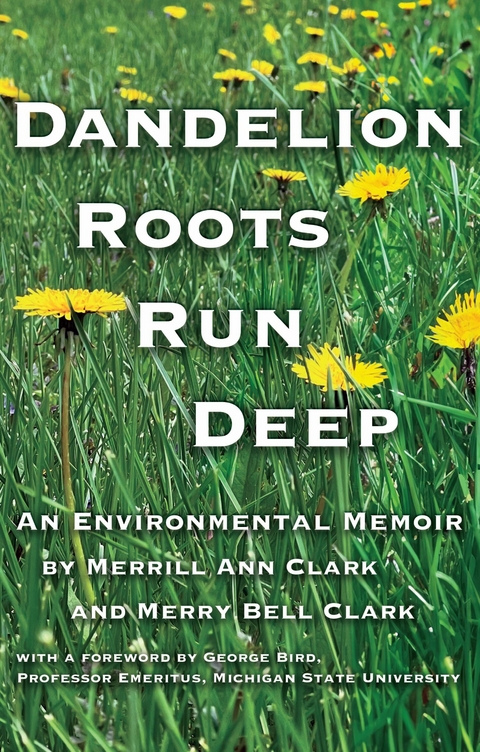
Dandelion Roots Run Deep (eBook)
212 Seiten
Bookbaby (Verlag)
979-8-3509-5863-8 (ISBN)
Merrill Ann Clark grew up in Elgin, Illinois and graduated from St. Charles High School, then went on to earn a Bachelor of Science in Communications from the University of Illinois at Champaign-Urbana. There, she met her husband, John CLARK, and they were married in 1959. They moved to Berkeley, California, where John earned a PhD in bio-chemistry and then they took a road trip to Boston where John had a position waiting for him at MIT. They had their first child in Boston and then John got a job at Notre Dame and they moved to Michigan, living in various locations until starting a 1500 acre organic farm in Cassopolis Michigan in 1980. Merrill was a devoted environmental activist, and always made sure her voice was heard. She was then on the National Organic Standards Board in 1992 which was the first group of people to determine what the term 'organic' would really mean. In 2024, she was awarded the prestigious Women in History Award and the Conservation Award by the Daughters of the American Revolution. She was able to be present for the awards ceremony, at the age of 86.
"e;Dandelion Roots Run Deep"e; is the true story of three generations of Midwestern women who "e;nevertheless persisted"e;. The book focused primarily on Merrill Clark, who fought for organic agriculture and Michigan's environment from 1967 - 2009. Merrill worked on this book for years, but then developed Alzheimer's in 2010 and her daughter Merry finished it for her. The story traces Merrill's background in Illinois, her marriage to John Clark, and their harrowing cross-country trip before launching their ultimate mission: starting an organic farm in 1980. Merrill Clark then became a charter member of the National Organic Standards Board in 1992, and she describes the struggles involved In the first efforts to define "e;organic"e; on the federal level. The dandelion analogy works on many levels in this book: the family roots, the roots being part of the solution to climate change, and the roots that connect to other issues that underlie the lived experiences of these three women. "e;Dandelion Roots Run Deep"e; will appeal to lovers of Wendell Berry, Rachel Carson, and Aldo Leopold, environmentalists, women, and anyone dealing with Alzheimer's.
CHAPTER 3
The Grandest Place
February 1946
“Say, I know the grandest place for sale,” announced Gloria. “Twenty-six acres with a wonderful view and automatic hot water, for just $15,000!” This remark fell into the middle of the game the couples were playing, which involved writing “telegrams” to their loves, using the letters in the word V-A-L-E-N-T-I-N-E.
“Does anyone want to buy a farm?”
“What farm? Where’s the farm?” Mother asked.
“Oh, out near us,” remarked Ellen. “It belongs to a professor, and he’s going to Berlin.”
“What kind of place is it? Trees, flowers?”
“It’s an old house, but he’s got it all fixed up, a fireplace in the dining room, and a shower bath. Everybody’s crazy about it.”
“Herb,” Mother called across the room. “Ellen knows a farm we can buy for $15,000, with a fireplace and a shower!”
Herb looked up and read triumphantly: “Valerie Angel Leave Elmer, Next Train is Nashville Express.”
“Is there an orchard?” she asked.
“Oh, yes,” said Ellen. “Apples, peaches, pears, blackberries, and the driveway is lined with Russian olive trees.”
“Olive trees,” she breathed. “What else?”
“Oh, a barn and a big chicken house for at least three hundred chickens,” declared Ellen.
“It has a chicken house, Herb, for three hundred chickens!” she yelled. She could tell by the look on Dad’s face that he wondered what had a chicken house. Mother tried a little more rearranging of her telegram, but the more she thought about that farm, the nicer it sounded. A big sweep of lawn, trees all around, perennial borders and rose arbors, and miles and miles of annuals!
“It also has a greenhouse,” added Ellen.
“Are you his agent?”
Ellen went on, “He starts celery and Bermuda onions and yellow tomatoes in the greenhouse and has nasturtiums in it now.”
Greenhouse. Celery. Yellow tomatoes. Russian Olives. Roses. Zinnias. To her, it sounded like every flower and tree in the world was at that house. It was only with a great effort that Mother got herself back to the subject at hand:
“Valise, All Packed, Eager Nancy Takes Impulsive Norman. Eureka!”
It was St. Patrick’s Day before they thought again about those twenty-four acres and the $15,000 purchase price. Then came a Sunday afternoon when Mother noticed us listening to the radio news about crime waves when she suggested a ride in the country.
“Any place in particular?” asked Dad.
“We might try to find the place Ellen was talking about. The little farm, you know. Remember?”
“Where is it?”
“Well, she said it was outside of town about eight miles, I think. Let’s just rummage around until we find it.”
We all piled in the Pontiac, drove out west of town, and started rummaging.
“Look for an old house with a barn and a chicken house. You too, kids!”
That part of the countryside was consumed with new, estate-sized homes. We got carried away in the backseat pointing out house after house.
“There’s one! I like it! Wait, look over there! Wow! Is that a brick house?”
“No, don’t get so excited, kids, it isn’t along here. It’s farther out, and these houses are too big.”
“Maybe that’s it,” said Dad as he nodded at a prim farmhouse back from the road. It was old but had been fixed up. Evergreens grew around it. Concrete walks led to the doors, and it had a new blue roof with blue shutters.
“Oh, I hope not. They’ve probably got light oak floors. And what’s with those blue shutters?”
One by one we went, and then we retraced our way around in a different direction. We passed a small country schoolhouse at a corner and decided to turn left there. Just down the road on a slight knoll was a mass of trees and shrubs that, even in March, almost hid the low, sprawling house. Maybe it was that early “back to nature” movement that made them lock eyes on that forlorn location with two screen porches and a larch tree in front. The day was dying in the west, and heaven touched the roof that was almost lost in the wild growth.
“That’s it!” Mother exploded. “I just know it is. Drive in here, Herb.” The drive led to a doorway to a large, screened porch; she noticed an interesting cowbell next to the door and decided it needed ringing. So she rang it, turning around to smile her delight at the sound.
The “professor” appeared and led us into the porch and then into the kitchen, which was all done in brown wainscoted cupboards. A large coal-fired range lived under a metal hood on another wall.
This was a kitchen that had no resemblance to our St. Charles house, with Mother’s original paintings. No, this kitchen was quite dark, I thought, and a little scary. Who could eat lunch in here? And where was Grandpa’s big, shiny playroom down the steps from the living room?
The dining room was likewise brown, with a fine fireplace in the corner and a large greenhouse just off to the south side, just as Ellen had said. Mother got a rather weary look on her face, staring down at the “brown,” but the plant starts in the small greenhouse changed her look immediately.
“Oh, look, nasturtiums already started, and onions and tomatoes!”
The professor waved us into the living room, in which two walls had been turned into bookshelves, which was inspiring to Mother. But the oatmealy tone of all the rooms was getting to her.
We shuffled through a small downstairs bedroom, then up a narrow stairway to a second floor. After bumping our heads at the top of the stairs where the roof sloped down, there were two simple bedrooms, enough for the three kids.
“No heat up here,” the professor noted, “and no closets.”
The big, square, rough-hewn beams showed hatchet marks and stability. They ran along below the eaves of the rooms on the second floor, where one could reach out and touch them. We would hit our heads again at the top of the stairs as we descended.
Mother could see that this farmhouse and the outbuildings all needed repair, and if we were really going to farm it, the chickens, goats, a pig, and a dairy cow were going to be taking up a lot of someone’s time. And whose time would that be, with Dad still going to work in St. Charles every day? We kids would be hiking down the road to that one-room schoolhouse every day. It would be Mother, of course, working here alone most of the time, doing hard work, way more work than carrying a laundry basket to the backyard. At least she wouldn’t have the gas station to worry about, but standing guard over a flock of animals and tending gardens every day wouldn’t solve her back problem, and her usual town stress would simply be exchanged for rural stress. It was true that that her music and art degree from Illinois Wesleyan College had not prepared her for homesteading on a farm, but she wanted to grow some local, fresh food. She wanted her kids to learn about work, chores, activity in the country, and a healthy lifestyle. She was, I decided, one of the early organic farming converts, one of the “back to the land” flock, ahead of the green movement of the 1960s–1970s. She was the first wave.
Grandma Hartley visited the farm once. Her comment: “I can’t conceive of how anyone could be forced to come here, must less want to.”
I thought to myself, Grandma should never have said that. Why was she being so negative with her own daughter? Couldn’t her own mother cover up whatever negatives she felt about the place? Besides, Grandma hadn’t even explored the farm and its fun places. She probably grew up on a farm too and hated everything about it. Well, Grandma was a little negative about her own home in Bloomington, Illinois. So I chalked it up to her being just a grouchy woman. But she did play a tough game of marbles.
The old professor finally moved out, and we moved to that farmstead. He had no real interest in the place as a farm; it was more of a hideaway for him. Mother hated the darkness of the house, outside and in. All the windows were too dinky to let in enough light. Four windows were put in on the south side of the laundry room, which made this the most pleasant part of the house. Light shone in from the south and east during different times of the year and the day. She painted everything yellow and added giddy designs around the kitchen stove.
She went to several fabric departments and asked for materials suitable for a country home.
“You’ll have to buy a package,” a clerk told her.
“A what? They come already done? No imagination, nothing to buy that you work on yourself? What if I just took an old feed bag and drew my own designs on it?”
Not long after we moved into the old farmhouse, they began working on the ceilings. I do not think they had figured how much muscle that meant.
“We’ll have to put up some plasterboard first,” said Dad. Mother crouched down and held it with her back and her head while he hammered it. Three nails bent for every one that made it into the oak.
“My head is starting to rattle.”
Finally, they stepped back and surveyed the results.
“Uh, it droops,” she said. “It also bulges.”
Dad glowered and got out his ruler. Our new home was beginning to lose its aura. After throwing all the sheet rock back down in a cloud of white...
| Erscheint lt. Verlag | 16.5.2024 |
|---|---|
| Sprache | englisch |
| Themenwelt | Literatur ► Biografien / Erfahrungsberichte |
| ISBN-13 | 979-8-3509-5863-8 / 9798350958638 |
| Informationen gemäß Produktsicherheitsverordnung (GPSR) | |
| Haben Sie eine Frage zum Produkt? |
 EPUB (Ohne DRM)
Größe: 6,3 MB
Digital Rights Management: ohne DRM
Dieses eBook enthält kein DRM oder Kopierschutz. Eine Weitergabe an Dritte ist jedoch rechtlich nicht zulässig, weil Sie beim Kauf nur die Rechte an der persönlichen Nutzung erwerben.
Dateiformat: EPUB (Electronic Publication)
EPUB ist ein offener Standard für eBooks und eignet sich besonders zur Darstellung von Belletristik und Sachbüchern. Der Fließtext wird dynamisch an die Display- und Schriftgröße angepasst. Auch für mobile Lesegeräte ist EPUB daher gut geeignet.
Systemvoraussetzungen:
PC/Mac: Mit einem PC oder Mac können Sie dieses eBook lesen. Sie benötigen dafür die kostenlose Software Adobe Digital Editions.
eReader: Dieses eBook kann mit (fast) allen eBook-Readern gelesen werden. Mit dem amazon-Kindle ist es aber nicht kompatibel.
Smartphone/Tablet: Egal ob Apple oder Android, dieses eBook können Sie lesen. Sie benötigen dafür eine kostenlose App.
Geräteliste und zusätzliche Hinweise
Buying eBooks from abroad
For tax law reasons we can sell eBooks just within Germany and Switzerland. Regrettably we cannot fulfill eBook-orders from other countries.
aus dem Bereich