Powerhouse Radio (eBook)
180 Seiten
Bookbaby (Verlag)
979-8-3509-1203-6 (ISBN)
Kingsley H. Smith is an accomplished radio program director and announcer who worked for NPR in Washington, DC and WHYY radio - television in Philadelphia. He graduated from Rutgers University with a B.S. in business and marketing. Kingsley has written blogs about music, history, and the software applications that he's created. Smith was a contributing monthly music writer for TeeBeeDee in San Francisco, CA.
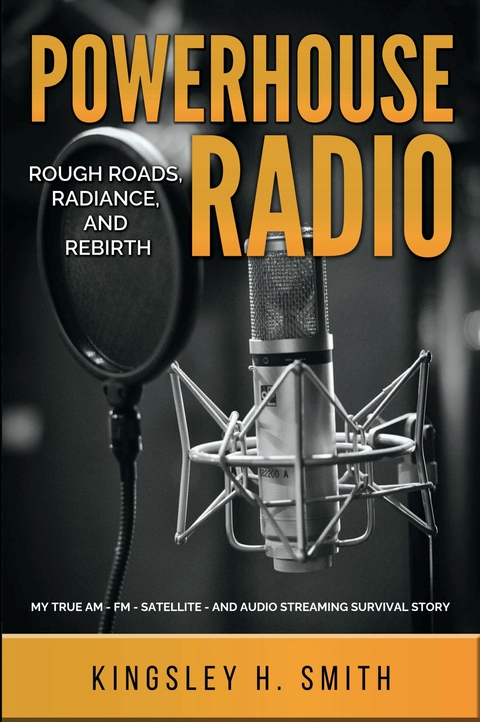
Powerhouse Radio: Rough Roads, Radiance, and Rebirth; My True AM - FM - Satellite - and Audio Streaming Survival Story by Kingsley H. Smith is an authentic true story about adversity, failure, and ultimate success. Smith performed on-air as an engaging radio personality and off-air as a program director in the hyper competitive radio broadcasting field. Despite roadblocks, the author details how he took advantage of growth opportunities offered at both general market and Black commercial radio stations in the Philadelphia radio market. Experiences at Southern New Jersey radio stations are carefully detailed. When the story expands to Washington, DC and Smith's NPR management responsibilities, this radio memoir documents what public broadcasting really creates. You'll learn what listener sponsored media attempts to do domestically and internationally, all in the public interest. You'll come along for the ride at the launch of satellite radio when the author and his team prepare two channels for a new world of digital subscribers across the USA. What you must know to create a memorable internet radio online audio music streaming service is discussed in depth in a chapter about Smith's fifteen years as a Live365 producer. Music radio personality hosts have opinions about the music they play for their broadcast audience. So does Kingsley. You'll get five crafted opinions in reviews about five award winning popular culture music artists expressed by the author in the paperback, eBook, and audiobook. Radio is a cultural constant that survives despite innovative competitors. Smith's Powerhouse Radio story begins in New York City, touches down at multiple USA destinations, and passes through Berlin, Germany. The narrative doesn't end there. Experience the whole journey, in the full story.
College Radio Craft: WNYU and More
You could build a solid and substantial skill set thanks to a New York City public school education in the 1960s. St. Albans in the Borough of Queens offered me the neighborhood community classroom experiences of public schools 116 and 136. Adding to the lower grade foundation built at those elementary schools was Junior High School 192 in the hamlet of Hollis, next door to St. Albans and the home of many future NYC hip hop legends.
“I grew up in a house where nobody had to tell me to go to school every day and do my homework.”
—Constance Baker Motley
My mother selected an even more rigorous curriculum for grades 9–12. With no say in the matter, it was off to the private Rhodes Preparatory School. Rhodes, at 11 West 54th Street in Manhattan, was right around the corner from the American Broadcasting Company (ABC) building. This favorable fact was filed away for future reference. The time to take ABC action was only three years away.
In high school, I was a decent student but not one of the brainiacs who would constantly shine in the glow of academic reputation among other classmates. I had a small coterie of friends at Rhodes.
True social integration was on the move in the late 1960s. Sadly, the racial mix of my high school skewed 95 percent white. However, enrollment betraying the city’s ethnic demographic mix did not get in my way. I hung out with a melting pot of cultured Big Apple kids.
One of them, Jeff Siegel, photographed some pictures of me appearing on The Long John Nebel Show at 66 WNBC radio in the fall of 1968, when I was a senior.
Music and talk stations were equally shared on my radio dial. 66 WNBC featured hosts Big Wilson, Lee Leonard, Brad Crandall, Bill Mazer, and Long John Nebel. I would repeatedly phone Mr. Nebel’s show for that addicting thrill of live talk radio. He got to know my teenage voice and on-air sobriquet, ‘Rhodes.’ Eventually, Nebel invited me and other NYC high school students into the WNBC Rockefeller Center Studios for a live-hour broadcast to chat with him about the generation gap.
In the mid-1960s, strong, self-selected strands of political ideology didn’t necessarily reflect the public identity of the typical call-in talk radio host or their listener-caller. The tone of a host projected the voice of a friend rather than the scream of a political, gender-based, or race-based foe. Opinions were strong, but the zealous cacophony was muted. There were exceptions, but the opposite is true of twenty-first-century USA talk radio. A new sheriff is in town with a big star on a screaming badge, symbolizing loud, louder, and loudest. If you are looking for an alternative, civility is the credo that can be found on public radio talk shows: NPR from the US, BBC from the UK, CBC from Canada, and others.
“Hate radio, hate speech, hate groups, hate crimes really don’t fit in, in the America that we know today.”
—Kweisi Mfume
I was a very shy guy with respect to interacting with the girls, but never when I was on the right side of a microphone! Subsequently, on future roads in a tough industry, I realized that I’d have to assert myself and learn what was needed to move forward.
As a sophomore, junior, and senior during high school, I worked at Triboro Record Shop in Jamaica, Queens, and as a messenger for the Rapid Messenger Service located in Manhattan.
At the record store, pitching James Brown and Bob Dylan records to different audiences became a passionate personal research project. I was tabulating consumer likes and dislikes in my mind. You can learn a lot about why The Times They Are A-Changin’ by just listening and observing. Bob Dylan’s song spelled out those changes.
American Broadcasting Company was targeted as a summer job after high school graduation. ABC didn’t ask me about college, so I didn’t tell them that I was already accepted to New York University.
After I completed high school—this is around the time when Neil Armstrong walked on the moon in the summer of 1969—there was no Woodstock Music and Art Fair in the season for me. I did try to get tickets in advance but couldn’t score them, so a prudent choice was made not to go.
My “Summer of Soul” (another 1969 NY music event) was spent delivering mail to ABC President Leonard Goldenson. What I really liked was hanging out in the 77 WABC music studio during the accommodating Dan Ingram or Chuck Leonard shows to observe on-air personality excellence (while I was on various breaks).
ABC headquarters at 1330 Avenue of the Americas and 54th Street was just half a block away from my high school. Corporate and radio studios were in the same forty-four-story ABC building.
Performing mail-room clerk duties made for a fun-filled three-month summer. I resigned in late August, and it was off to college.
A full scholarship afforded me the privilege of attending New York University. In the second semester of my first year, I landed at NYU’s School of the Arts. Math was dumped as a major to activate the switch. Outside of classes, guess what captured my attention?
Involvement in the student radio station was much more exciting than shooting a 16-millimeter film near the Washington Square Park campus for class projects. I still learned quite a bit about the world of film.
Radio production chores involving splicing silicone-lubricated acetate-backed magnetic audio tape with a single-edged razor blade became a much more enjoyable creative outlet. Cutting analog tape and then putting it back together was like setting up a chorus line of dominoes. The thrill of success doesn’t come until the pieces touch in harmony!
WNYU AM 810 was heard in the NYU student dormitories and in the Washington Square student center. Most of us at the station were amateurs. In this new recreational arena, I moved gradually through my first radio broadcasting experience.
By May of 1973, WNYU FM was also on air, licensed to New York University, using 89.1, Monday through Friday from 4:00 pm to 1:00 am. Fairleigh Dickinson University, which operated WFDU FM in New Jersey, shared the frequency when WNYU FM was not on the air.
WNYU, a nonprofit, noncommercial public radio station, was operated and managed by NYU students.
Before Richard Roth reported (CNN), Mark Knoller corresponded (CBS), and Martin Brest directed (Beverly Hills Cop), we were all students doing our WNYU broadcasts at the same time from 1969 to 1973. Martin loved playing ’20s and ’30s nostalgia music!
Fellow student broadcaster Jon Frank would bring in his own Sennheiser microphone and plug it in when he was on the air! It was not until later that our student station had top-shelf mics. Congrats to Jon for his fifty years of engineering service. He had a variety of jobs, including a long stint at WGBH television and radio in Boston.
Student station manager Denis McNamara, with his rock expertise, would later, at WLIR-FM Garden City, Long Island, help lead the early 1980s wave of fresh bands taking over progressive music radio.
These are just a few of the bumper crop of special talents who were drawn to the WNYU student radio experience.
Thanks to WNYU connections, I had the chance to direct traffic, getting acts on and off the stage for a Murray the K show on May 24, 1974. Murray was one of the top radio DJs in New York City. He made a name for himself at 1010 WINS during the 1960s. Murray Kauffman was one of the first people, like Billy Preston after him, to be known as “the Fifth Beatle” (for supporting the Beatles). Stage-managing for the Murray the K show was great experience for me that I used later in Atlantic City.
Seeing many diverse concerts is a huge benefit of the culture of New York City. On the East Side of Lower Manhattan, it was Bill Graham’s Fillmore East. Between the weekend warrior headliners and the Tuesday night up-and-comers, I probably saw over a hundred shows at affordable prices. You were guaranteed to see a trio of acts for a $3, $4, or $5 ticket. The evening show ‘Fillmore East Tuesday Nights’ was even cheaper. Here are a couple of shows I attended. June 13, 1969: Mothers of Invention (featuring Frank Zappa), Youngbloods, Chicago. Post-1970, ticket prices increased by fifty cents, but not enough to sing the blues for this February 12, 1971 show: Taj Mahal, Leon Thomas, and Roberta Flack.
Playbills also popped up in the city. The Negro Ensemble Company productions downtown, plus the Broadway spectaculars uptown, provided multiple theater memories. I had a subscription to see all of The Negro Ensemble Company’s plays during one eye-opening season.
In Lower Manhattan’s Greenwich Village, Allan Pepper and Stanley Snadowsky’s The Bottom Line Club was making waves, featuring A-list talent. WNYU FM cultivated a relationship with the showplace owners. The station recorded and broadcast many acts that appeared at this hot spot. Student engineer David Vanderheyden recorded many of these concerts for WNYU FM. I...
| Erscheint lt. Verlag | 3.1.2024 |
|---|---|
| Sprache | englisch |
| Themenwelt | Literatur ► Biografien / Erfahrungsberichte |
| ISBN-13 | 979-8-3509-1203-6 / 9798350912036 |
| Informationen gemäß Produktsicherheitsverordnung (GPSR) | |
| Haben Sie eine Frage zum Produkt? |
 EPUB (Ohne DRM)
Größe: 9,0 MB
Digital Rights Management: ohne DRM
Dieses eBook enthält kein DRM oder Kopierschutz. Eine Weitergabe an Dritte ist jedoch rechtlich nicht zulässig, weil Sie beim Kauf nur die Rechte an der persönlichen Nutzung erwerben.
Dateiformat: EPUB (Electronic Publication)
EPUB ist ein offener Standard für eBooks und eignet sich besonders zur Darstellung von Belletristik und Sachbüchern. Der Fließtext wird dynamisch an die Display- und Schriftgröße angepasst. Auch für mobile Lesegeräte ist EPUB daher gut geeignet.
Systemvoraussetzungen:
PC/Mac: Mit einem PC oder Mac können Sie dieses eBook lesen. Sie benötigen dafür die kostenlose Software Adobe Digital Editions.
eReader: Dieses eBook kann mit (fast) allen eBook-Readern gelesen werden. Mit dem amazon-Kindle ist es aber nicht kompatibel.
Smartphone/Tablet: Egal ob Apple oder Android, dieses eBook können Sie lesen. Sie benötigen dafür eine kostenlose App.
Geräteliste und zusätzliche Hinweise
Buying eBooks from abroad
For tax law reasons we can sell eBooks just within Germany and Switzerland. Regrettably we cannot fulfill eBook-orders from other countries.
aus dem Bereich