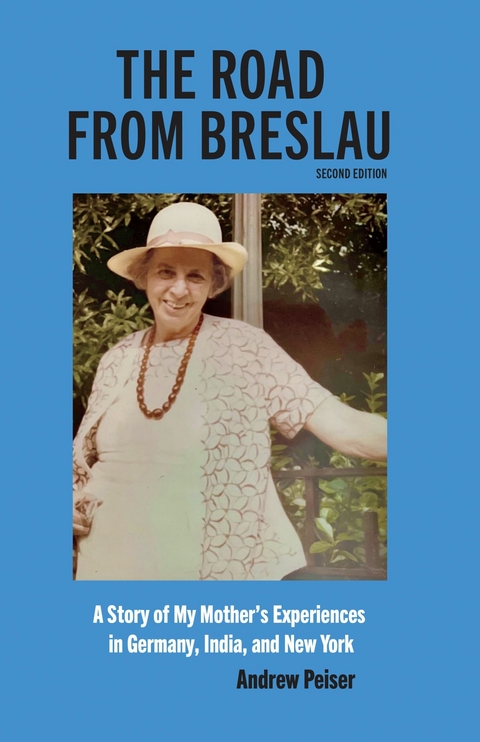
Road From Breslau (eBook)
112 Seiten
Bookbaby (Verlag)
979-8-3509-0761-2 (ISBN)
The book is entitled "e;The Road from Breslau: A Story of My Mother's Experiences in Germany, India, and New York."e; The genre is non-fiction. It tells the story of Marianne, a remarkable woman whose journey in life spanned three continents and who was eyewitness to some of the most important events of the 20th century. It is based upon her memoirs and her many writings, as well as family archives, and can be considered a case study of the larger German Jewish experience. The story is interwoven with historical facts, making it both a biography as well as a historical narrative. Marianne was born in Breslau, Germany (now known as Wroclaw, part of Poland) in 1908, an only child, and grew up during World War I. She attended the University of Breslau, but while attending became a victim of the anti-Jewish racial laws passed by the Nazis during the 1930s. On November 9, 1938, on the eve of World War II, Marianne suffered a harrowing experience when she witnessed her husband being taken away to the concentration camp at Buchenwald during Kristallnacht. Incredibly, she managed to free him and, in January 1939, they managed to emigrate from Germany to Bombay, India on one of the last available passenger ships to leave Europe prior to the outbreak of World War II. Marianne was also able to secure a visa for her mother, thus saving three lives from certain deportation and death. In 1940, her first son was born. In 1942, three years after arriving in India, Marianne became a widow after her husband died. Five years later, in 1947, she witnessed India gain its independence from Britain and experienced the riots that took place after Mahatma Gandhi was assassinated. In the same year, she married another German-Jewish refugee and had a second son in 1949. In 1953, after her mother passed away and India gained its independence, Marianne immigrated to New York via Ellis Island a year before it closed, where she began yet another new life, now for the third time. She had lived in India for 14 years. The story of Marianne is one that was all too often characterized by adversity, but it is also a story of bravery, hope, perseverance, and inspiration. Despite the many hardships that she endured - and this was one of the many extraordinary things about Marianne - she was never bitter and constantly maintained a sense of humor, good cheer, and charming wit. She was strong and resilient, ever able to adapt to changing circumstances. Events and situations that would have overwhelmed most people had exactly the opposite effect upon Marianne.
CHAPTER 1
Historical Background
THE period between the two World Wars was marked by significant political, economic, and social upheavals in Europe. After Germany’s defeat and the fall of the German Empire at the end of World War I, the Weimar Republic was established in 1919. It was named after the city of Weimar where the new constitution was written to replace the previous monarchy. For the first time in its history, the new government was a parliamentary democracy with a president, elected every seven years, and a chancellor appointed by the president to head the Reichstag, one of two legislative houses, and it aimed to establish a stable and democratic government in Germany.
However, the Weimar Republic faced political instability and economic crises throughout its existence. The Treaty of Versailles, signed in 1919, imposed significant penalties on Germany for its role in World War I. These penalties included harsh reparation payments, loss of territory and colonies, and severe limitations on Germany’s military capabilities.
The Treaty of Versailles was deeply unpopular in Germany. The massive war reparations crippled Germany’s economy and led to hyperinflation, high unemployment, and widespread poverty. In addition, the treaty included a “War Guilt Clause” that placed full blame for the war on Germany and its allies. As a result, the treaty was seen as a humiliation by many Germans, making them susceptible to extremist political ideologies that blamed their country’s problems on outside forces, particularly Jews and other minorities.
The Weimar Republic also faced challenges from left-wing groups, including the Communist Party of Germany and the Social Democratic Party, which were advocating for socialist policies and workers’ rights. These groups clashed with right-wing groups, including the National Socialist German Worker’s Party (Nazis), which was gaining popularity with its nationalistic and anti-Semitic ideology that emphasized the superiority of the German race and the need to restore Germany’s rightful place in the world.
The political instability and economic crises that occurred under the Weimar Republic provided fertile ground for extremist parties to gain support. The Nazi Party, led by Adolf Hitler, was founded in Munich, Germany in 1919. It was initially a small party with only a few members, but began to gain popularity in the 1920s and 1930s with a promise to restore Germany’s greatness and rid the country of perceived enemies, including Jews, Communists, and other minorities. The Nazi Party’s ideology was based on a combination of racial theories, anti-Semitism, and extreme nationalism. They believed in the supremacy of the “Aryan” race, a mythical race which they saw themselves part of and as superior to all others. They also believed in the need for territorial expansion and the establishment of a “Greater Germany” that would include all German-speaking people.
The Nazi Party’s appeal to the German people can be attributed to several factors. The party promised to restore Germany’s economy and international standing after the devastation of World War I. They also capitalized on widespread feelings of resentment toward the Treaty of Versailles, which had imposed harsh reparations on Germany. Additionally, using various techniques such as posters, speeches, and rallies to spread their message, they used propaganda to appeal to people’s fears and prejudices, portraying themselves as the only party that could protect Germany from the perceived threats of communism and Jewish influence. Finally, they offered a strong, charismatic leader in the form of Adolf Hitler.
The Nazi Party’s rise to power was also facilitated by the weakness of the Weimar Republic. In the 1932 elections, the Nazi Party became the largest party in the Reichstag, but they did not have enough seats to form a government. After the election, the Nazi Party, which had the support of powerful industrialists and conservative politicians, began negotiating with other parties to form a government. Although the Nazis did not have a majority in the Reichstag, they were able to form a coalition with the conservative Nationalist Party, which gave them a majority.
On January 30, 1933, German President Paul von Hindenburg appointed Hitler as Chancellor, hoping to use Hitler’s popularity to stabilize the country. Once in power, however, Hitler and the Nazi Party used their position to consolidate power, suppress political opposition, and eventually achieve complete control over all aspects of society.
One of the most significant events in the rise of Nazism was the Reichstag fire of February 27, 1933, which was blamed on the Communists by the Nazi Party. Shortly after the fire, German President Paul von Hindenburg signed the Reichstag Fire Decree, which suspended civil liberties and allowed the Nazi Party to arrest and imprison thousands of Communists, socialists, and other political opponents without trial.
However, Hitler contended that the decree was insufficient and proposed the passage of a law which would allow the Chancellor to bypass the system of checks and balances in government. As a result, the German Reichstag passed the Enabling Act on March 23, 1933, to be in effect for four years and giving Hitler and his Nazi government dictatorial powers to rule Germany without parliamentary or constitutional oversight. The Enabling Act was renewed twice, in 1937 and 1941, and was rendered null in 1945 following Germany’s defeat in World War II. The combined effect of the Reichstag Fire Decree and the Enabling Act was a significant turning point in German history and laid the groundwork for a totalitarian regime.
During the 1930s and 1940s, anti-Semitism and persecution of minorities were key features of Nazi ideology and policy in Germany. The Nazis scapegoated Jews and other minority groups as a means of promoting their vision of a racially pure Aryan society. They believed in a racial hierarchy, with Aryans at the top and Jews at the bottom. This ideology was promoted through propaganda, which portrayed Jews as subhuman and dangerous to German society.
This round of government-sanctioned persecution of minorities began soon after the Nazis came to power in 1933. Laws were passed that deprived Jews of their civil rights and prohibited them from holding public office, attending school, or marrying non-Jews. Jewish-owned businesses were confiscated, and Jews were forced to wear a yellow star to identify themselves.
The persecution of Jews and other minorities in Nazi Germany led to a growing refugee crisis. To address the issue, an international conference was organized by the government of France, held in July 1938 in the French town of Evian. Known as the Evian Conference, it was attended by representatives from 32 countries, including the United States, Great Britain, and Canada. The main objective of the conference was to find a solution to the refugee problem.
However, the conference failed to produce any concrete solutions or commitments from the participating countries. During the nine-day meeting, most countries expressed sympathy for the refugees but were reluctant to accept them due to economic, political, and social concerns. For example, in the United States, which had set up immigration quotas in 1924 that limited the number of immigrants, Americans were reluctant to welcome Jewish refugees. In the midst of the Great Depression, many Americans believed that refugees would compete with them for jobs and overburden social programs set up to assist the needy.
Another pathway for emigration that closed for Jewish refugees took place in Palestine, which at the time included modern-day Israel, the West Bank, and Gaza Strip. In 1922, the British government had been given a mandate to administer Palestine that was based on the Balfour Declaration of 1917, in which the British government expressed support for the establishment of a “national home for the Jewish people” in Palestine. The mandate also recognized the rights of the Arab population in the region and committed Britain to protecting those rights.
During the 1930s, there was continuing Arab unrest against the British mandate in Palestine, especially regarding the status of Jews in Palestine. The conflict led to a decisive change in British policy in 1939, in which the British government rejected the establishment of an independent Jewish state and severely restricted future Jewish immigration to Palestine. These restrictions remained in force until the establishment of Israel in 1948.
The persecution of minorities reached its zenith during World War II with the implementation of the Final Solution, which aimed to exterminate all Jews in Europe. The Nazis used their military conquests to expand their control over Europe and establish a network of concentration and extermination camps. Jews and other minority groups were rounded up and transported to these camps, where they were subjected to forced labor, starvation, disease, medical experimentation, and death.
The Final Solution was implemented in stages, beginning with mass shootings of Jews and other minorities in occupied territories. As the war progressed, the Nazis began using gas chambers and crematoria to murder large numbers of people in the death camps. This genocide, which became known as the Holocaust, resulted in the deaths of approximately six million Jews, as well as millions of other people, including Romani people (then known as “gypsies”), homosexuals, and people with disabilities.
The Holocaust ended with the defeat of Nazi Germany in 1945, but its impact on Europe and the...
| Erscheint lt. Verlag | 14.7.2023 |
|---|---|
| Sprache | englisch |
| Themenwelt | Literatur ► Biografien / Erfahrungsberichte |
| ISBN-13 | 979-8-3509-0761-2 / 9798350907612 |
| Informationen gemäß Produktsicherheitsverordnung (GPSR) | |
| Haben Sie eine Frage zum Produkt? |
 EPUB (Ohne DRM)
Größe: 20,6 MB
Digital Rights Management: ohne DRM
Dieses eBook enthält kein DRM oder Kopierschutz. Eine Weitergabe an Dritte ist jedoch rechtlich nicht zulässig, weil Sie beim Kauf nur die Rechte an der persönlichen Nutzung erwerben.
Dateiformat: EPUB (Electronic Publication)
EPUB ist ein offener Standard für eBooks und eignet sich besonders zur Darstellung von Belletristik und Sachbüchern. Der Fließtext wird dynamisch an die Display- und Schriftgröße angepasst. Auch für mobile Lesegeräte ist EPUB daher gut geeignet.
Systemvoraussetzungen:
PC/Mac: Mit einem PC oder Mac können Sie dieses eBook lesen. Sie benötigen dafür die kostenlose Software Adobe Digital Editions.
eReader: Dieses eBook kann mit (fast) allen eBook-Readern gelesen werden. Mit dem amazon-Kindle ist es aber nicht kompatibel.
Smartphone/Tablet: Egal ob Apple oder Android, dieses eBook können Sie lesen. Sie benötigen dafür eine kostenlose App.
Geräteliste und zusätzliche Hinweise
Buying eBooks from abroad
For tax law reasons we can sell eBooks just within Germany and Switzerland. Regrettably we cannot fulfill eBook-orders from other countries.
aus dem Bereich