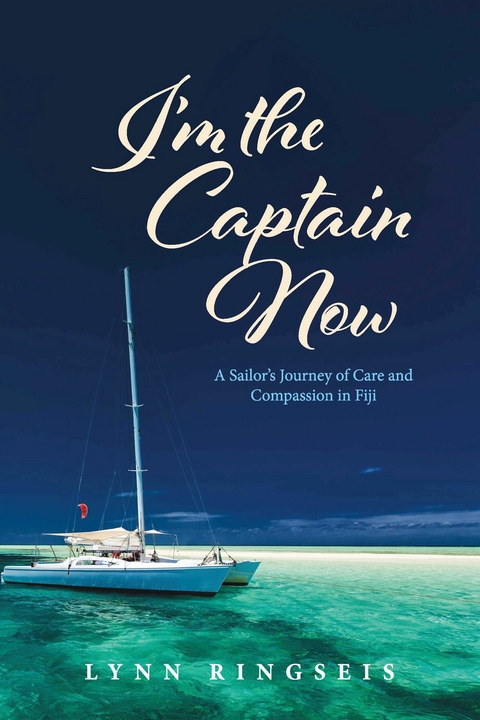
I'm the Captain Now (eBook)
178 Seiten
Bookbaby (Verlag)
979-8-3509-0080-4 (ISBN)
When Lynn's Captain acquires dementia, their world turns upside down. Rather than fight it, they float to the Southern Hemisphere in the tropical islands of Fiji and connect with two beautiful Fijian women, Mela and Neil, who help care for Captain on his journey with memory loss. Captain thrives in the island environment and the four of them have cultural experiences and adventures throughout the islands. They explore pristine coral reefs and swim with manta rays and sharks. They attend traditional kava rituals with village chiefs and fill their house with love from Fijian family members and friends. Lynn shares stories from her past travels, which helps her navigate this new path. Traveling in remote Africa, she encounters spectacular wildlife experiences. She crews on a small sailboat across the Atlantic and volunteers on the ocean, helping protect the ocean's creatures, while facing poachers and pirates. Lynn's past meets her present and she learns how to become captain of her ship of care. Join them in this inspirational true story of finding unique care in the islands of Fiji.
Chapter 2
Crazy Neurologists
“The simple act of listening to someone and making them feel as if they have truly been heard is a most treasured gift.”
L.A. Villafane
British Virgin Islands, Caribbean and Northern California, U.S.A.
When the first stages of our dementia journey began, it was spring in the British Virgin Islands, and we were living on our catamaran. As Captain’s unusual behavior became evident, we secured our boat earlier than usual for the upcoming Caribbean hurricane season. As we had done for many summer seasons, we hauled out, took off sails and essential gear, and left our precious boat on the hard in the boatyard.
We went to our home in Northern California for the summer, and I made an appointment for Captain with a neurologist. Foolishly, I sent Captain by himself for the first appointment. When he returned, I asked him how it went. He replied with a grin, “I don’t remember!”
That was a ridiculous maneuver on my part. I had to be the smart one for both of us. I accompanied him on every future appointment.
After several visits and a three-hour memory test, his neurologist called us into her office. She declared in a loud, brisk manner, “Captain probably has Alzheimer’s, and he has about ten years to live.” She then rushed out of her office before I could even form questions. I sat there stunned and devastated. If this truly was the correct diagnosis, could she not have delivered it with even a shred of empathy?
Strangely, in the car on the way home, Captain never mentioned anything about the office visit. I avoided the subject as well. The following day, I decided to quit her, and I searched for neurologist number two.
For the second evaluation, I found what seemed to be a well-established practice located in a refurbished old house. The waiting room smelled like the piss of a thousand cats, warning sign number one. She had compassion enough but appeared to lack knowledge. She didn’t run any tests and had barely asked about his symptoms when she suddenly surmised that Captain had suffered a seizure.
Seemingly in a rush to be rid of us, she handed me a prescription for anti-seizure medication, which I promptly placed in the rubbish bin on the way out of her smelly office.
Doctor number two, we are finished! As I later learned, when a person is diagnosed with seizures, the doctor is required to notify the Department of Motor Vehicles. The driver must relinquish their license until cleared by another medical evaluation.
I had already been contemplating taking over the driving duties, even though Captain was still capable of driving. However, I noticed his lack of recognition of once-familiar streets and locations on many occasions.
Friends in our neighborhood had invited us to their house for dinner. They lived a few blocks away, and Captain had driven there hundreds of times. As Captain backed out of the driveway, he asked where we were headed. I said, “We’re going to Jan’s house.”
He said, “Oh, great,” yet he continued to drive past her street. I patiently directed him back to her house while my mind was simultaneously filled with terror and fascination. We had an enjoyable evening, yet I knew I needed to take the reins of the vehicle.
Interestingly, the following morning, we headed to our vehicle to run errands, and he casually walked to the passenger door without any questions or protests. He had always been the primary driver, yet he never asked for the car keys from that day.
I started making assessments of his daily mental status. We walked or rode bicycles every morning to our local coffee shop. While sitting outside, I would ask him to guess the temperature. Sometimes friends would join us, and they knew about my test, disguised as a contest.
We let him guess first, and occasionally, he got the temperature spot on, but mostly it was wildly off, like guessing 502 degrees or 7 degrees. I never corrected him; I went along with his guess as we sat and enjoyed the morning. One time, I asked, “Captain, what do you think the temperature is this morning?” He looked at his watch and confidently replied, “It’s 9:20.” I knew it was going to be an interesting day.
Sometimes I imagined he was messing with me and making up this whole behavior. He often had an innocently mischievous expression. What if this was the most elaborate practical joke? Oh, how I wished. I finally found the charm in neurologist number three. This intelligent and caring young woman was exactly what we needed. She treated Captain with great kindness and explained everything so well. After running her own set of tests, there still was no getting around the diagnosis, he had some form of dementia, most likely Alzheimer’s, but that would only be a label.
Oddly enough, to find out if a person has Alzheimer’s, they have to die first and have an autopsy. It made no sense to me to use the label Alzheimer’s, and I certainly did not want to say it in front of Captain. I chose the generalized term of dementia when discussing Captain’s brain problem with others. I researched endless amounts of information and looked into clinical trials, but there simply was no proven medication or cure.
I read articles about people with dementia becoming more cognizant after a drastic change in their lifestyle, like exercising more and changing their eating habits to cut back on meat and increase vegetables and fruits. However, we already had a very active lifestyle with hiking, kayaking, and bicycling. As the chef, I cooked primarily plant-based and healthy meals.
It became as clear as the tropical sea that I would have to make all our decisions. I couldn’t ask Captain what I should do, yet he helped me navigate the proverbial rough seas, even if he didn’t realize it, just by being his kind and lovable self.
As the summer in California progressed, and after monitoring Captain’s behavior, I knew we could not return to our sailing life. I made the difficult decision to sell our catamaran, our pride and joy. It was like losing a dear friend. She had provided us with a livelihood and boatloads of adventures.
Even though I had to sell our sailboat, I still thought like a sailor, as I tried to be capable and prepared for rough seas. I have crewed on three ocean crossings and countless miles around islands and coastal waters while gaining strength, resilience, and gratitude from my dear Mother Ocean.
Our friends and fellow baseball fans, Lori and Roy, picked up Captain one day and took him to a San Francisco Giants game. As much as I would have loved to join them, I knew they were giving me the gift of time to myself, which I greatly appreciated. I poured over photographs of our sailing days on our sweet catamaran and said farewell to her in my own way.
I recalled the fearlessness of my youth. Transporting my thoughts of traveling in Africa helped me power through challenges. I did whatever I could to keep my mind from slipping into a deep sadness, and thinking about my past travels gave me moments of joy.
Durban, South Africa
Tom had spent six months hitchhiking down through the countries of East Africa. I first met him in Durban, South Africa, where we both found work in a waterfront pizza restaurant. His suntanned skin accentuated his eyes, which were bluer than any ocean. He had dark, wavy hair and a lean frame from months on the road. I was mesmerized by his travel stories. I had been living with a wonderful family on their farm in Zimbabwe, and arriving in Durban was like coming home, as it could have been a sister city to my birthplace, San Diego, California. Except San Diego didn’t have mass racial segregation.
Tom and I headed to the beach on our days off, but we would go farther away from town to the “non-white” beach, where we would play with local kids in the surf. Tom loved bringing a soccer ball every week to toss with the kids and would always leave the ball for them to keep. We learned so much about gratitude and joy from these youngsters who had few possessions.
This was in the era of apartheid. I was young and naive about foreign politics, but the world taught me quickly. We were guests in their country, and all we could do was surround ourselves with open-minded South Africans, regardless of skin color. When we discussed the differences in our countries, they were fascinated to learn that a person of color could marry a white person in the U.S. Our young South African friends had grown up with apartheid policies, which started in 1948.
Our greatest joy of living in Africa was seeing wildlife and spending time in nature. We made every effort to visit wildlife reserves, sanctuaries, and national parks; the more remote, the better. We had saved enough from our paychecks in Durban to hit the road and travel together. We hugged goodbye to our international pod of fellow workers and friends in Durban.
Ironically, Tom was from San Francisco, California, only 500 miles (804 kilometers) from my hometown in San Diego, yet our destiny was to meet on the other side of the...
| Erscheint lt. Verlag | 23.6.2023 |
|---|---|
| Sprache | englisch |
| Themenwelt | Literatur ► Biografien / Erfahrungsberichte |
| ISBN-13 | 979-8-3509-0080-4 / 9798350900804 |
| Informationen gemäß Produktsicherheitsverordnung (GPSR) | |
| Haben Sie eine Frage zum Produkt? |
 EPUB (Ohne DRM)
Größe: 3,2 MB
Digital Rights Management: ohne DRM
Dieses eBook enthält kein DRM oder Kopierschutz. Eine Weitergabe an Dritte ist jedoch rechtlich nicht zulässig, weil Sie beim Kauf nur die Rechte an der persönlichen Nutzung erwerben.
Dateiformat: EPUB (Electronic Publication)
EPUB ist ein offener Standard für eBooks und eignet sich besonders zur Darstellung von Belletristik und Sachbüchern. Der Fließtext wird dynamisch an die Display- und Schriftgröße angepasst. Auch für mobile Lesegeräte ist EPUB daher gut geeignet.
Systemvoraussetzungen:
PC/Mac: Mit einem PC oder Mac können Sie dieses eBook lesen. Sie benötigen dafür die kostenlose Software Adobe Digital Editions.
eReader: Dieses eBook kann mit (fast) allen eBook-Readern gelesen werden. Mit dem amazon-Kindle ist es aber nicht kompatibel.
Smartphone/Tablet: Egal ob Apple oder Android, dieses eBook können Sie lesen. Sie benötigen dafür eine kostenlose App.
Geräteliste und zusätzliche Hinweise
Buying eBooks from abroad
For tax law reasons we can sell eBooks just within Germany and Switzerland. Regrettably we cannot fulfill eBook-orders from other countries.
aus dem Bereich