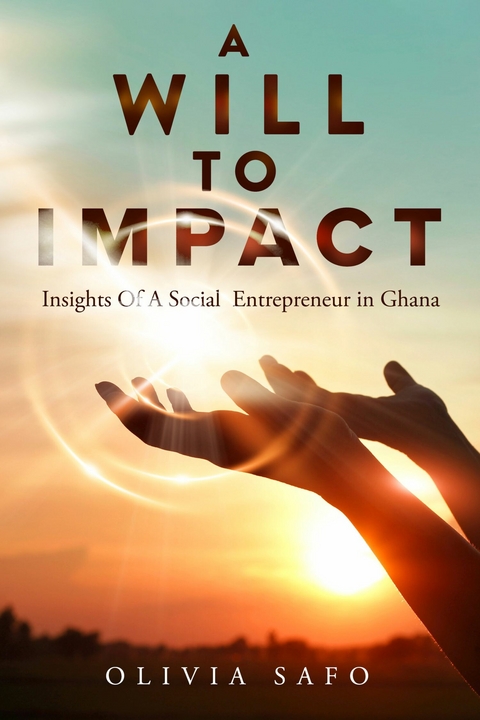
Will To Impact (eBook)
69 Seiten
Bookbaby (Verlag)
978-1-6678-6706-9 (ISBN)
Become a Change Maker, Generate Social Good Through Impact Investing, and Achieve Sustainable ProgressDo you yearn to be a change maker in your corner of the world -- or even beyond?Imagine finally lighting the fire that burns deeply in your heart. A social entrepreneur and author, Olivia Safo will inspire you to become the change maker you've longed to be. She is a facilitator of new business initiatives and will lead you forward with her diversity of experiences in the world of Impact Investing. Here's a small portion of what Olivia will share in her memoir Will to Impact: Eye-opening knowledge and guidance (especially if you are thinking of starting a business) Must-have insight on Social and Impact Investing Business and entrepreneurial experiences Olivia has had along the way Lessons learned throughout her journey Why the Nine-Point Rule for Life matters How you can leave behind a blueprint for victory and sustainability (for those generations yet unborn) Tips to use moving forward (if you want to retire from working for others)You are the change you seek. But, you will need knowledge and guidance to get you there. Claim your copy NOW to become a change maker
Chapter One –
Early Beginnings
The 1970s was a period of instability in Ghana’s political life. The yearning for freedom towards the late 1950s into the 1960s had given way to instability, interspersed with a string of military interventions. I was too young to experience the discomfort and hardship. I was born after two boys and so it was natural that I spent more time with them than with my two older sisters. I got introduced to the rough and tumble of childhood play – tree climbing, football, and all other games reserved exclusively for boys. I was a ‘tomboy’, a fancy term for girls who were usually found in the company of boys.
I interacted with a lot of people and made many childhood connections back then. We lived in several places all over the capital.
North Kaneshie was a place I remember vividly. I attended Ann’s Preparatory School, which was close to the Cocoa Marketing Board workers’ apartments in that suburb of Accra. Mataheko, another suburb, about 10 kilometres from Kaneshie, was another place I remember quite distinctly. I was given the opportunity to attend the Rapid Way Academy school – a decent school back then. Next, we made a giant leap to a completely different part of town – Burma Camp, an area occupied by personnel of the Ghana Armed Forces. There I made new friends whilst attending the Burma Camp Complex school.
My father was transferred to the United Kingdom to act as the Area Manager of the Ghana Commercial Bank in Cheapside, an area of London, at a point in time during my early development. When he had settled into his new role, I had the opportunity to visit him in London. It blew me away.
I was so enthralled with the surroundings. It was indeed a teeming city to my mind back then. Its unvarnished dedication to individualism was very visible at this time. My siblings were equally excited about the adventure. When Daddy was eventually transferred back to Ghana, my surroundings changed again. This time I was enrolled into Association International School at the Airport Residential Area. It was a very competitive environment with a sophisticated network of students. I sat for the Common Entrance Examination there and made it to Achimota school, located in Ghana’s capital city, Accra.
One of the unique recollections of my time at Achimota School was an overpowering, obsessive desire to become a Catholic nun. It started off as an idea that I kept to myself. The prospect of being tucked away at a convent, away from the glare of humankind, was appealing. I considered myself a social misfit on campus at this time. I lacked the confidence to face people. The very thought was enough to push me away. A misanthrope might be a strong word to describe me, but it was quite close. I had some friends, but I wasn’t necessarily someone who made an impression at first glance. When the school authorities managed to contract Reverend Father Charles G. Palmer Buckle to become Achimota’s chaplain, I knew my moment had come. I mustered all the courage possible and knocked on his office door one day.
When I eventually made my way inside, I broke the news to him. I had decided to become a Catholic Nun. ‘It is my calling, Father’, I told him forcefully. He wasn’t particularly shocked. He was somewhat impressed, I would say. He wanted to know more about my motivations, hopes, and fears. He wanted me to get in touch again for a series of meetings to enable us get the process underway. I was cautiously happy. I understood that a career path had been set before me, but I was confused.
Achimota School always held a fascination for me. When I first set foot there as a student, the feeling was surreal. It was an environment like no other – a world as colourful as the Baghdad of the Arabian Nights.
Back in 1927, when the colonialists established it in the heart of Accra, they made it clear that it was to be a unique educational experiment in West Africa. The pristine gardens, the unique and carefully curated architectural settings, made it a dream for many young students across the country. It was a melting pot of multiple cultures. Students from across the sub-region - countries like Nigeria, The Gambia, Senegal, and even Equatorial Guinea, were enrolled there. Towards the end of my education there, my outlook and perspectives transformed altogether.
But at this point, I was still in self-discovery mode and my regular meetings with Father Buckle had become a source of comfort for me. However, Mrs. Noye, my housemistress, had other ideas. She had taken a good liking to me and acted In Loco Parentis for me on campus. Unlike other students, I hardly got any visitors during the school period, so she was overly kind to me and did so many things for me without expecting anything in return from my parents. When she noticed that I was harnessing the convent idea and had started seeing Father Buckle, she stepped in. Without mincing words, she said I wasn’t cut out to be a Nun. She wanted me to immediately discard the thought. I did, and it became a pipe dream.
I took my religious life extremely seriously in Achimota as a devout Catholic and got involved in a lot of church activities. I had a small and closely-knit network of friends and we always kept together. Later, we realised, to our amusement, that we had been christened the ‘Quack Squad’. I still haven’t come to terms with why we were branded with that moniker, but maybe it had something to do with being inconspicuous, because that’s what we were. I was in Slessor Dormitory – an exclusively female residence. It housed the most radical and aggressive ladies anywhere in Achimota School. We had a reputation for being overly adventurous and edgy. Most of the girls on the school’s cadet team were from Slessor. I had my epiphany in that dormitory. It was a time of fun and a diversity of experiences.
Around this same time, my father resigned from his lucrative banking career and took up a job as a large-scale commercial farmer. He was already dabbling in the sector alongside his banking career, but he eventually decided to give it his full attention. This was the family business, and every sibling was encouraged to be a part of the venture. He was convinced farming was the next big entrepreneurial adventure, and he was determined to make a big deal out of it. He grew a lot of crops including cassava, okra, pineapples, and other cash crops. It was a source of pride for me – we were part of a unique kind of occupation where the impact and benefits could actually be felt and seen. The tangibility of the venture always made sense for me. The visits to the farm were a source of great happiness for me. There were times when I would particularly make sure I was placed at the back of one of the farm trucks with the foodstuffs and the other workers. I had always known that I wanted to be an integral part of the whole process. There were other times when I would insist on sitting next to the bulldozer driver, just to watch him drive and work on the soil. My curiosity was very strong back then – eventually I started driving at the age of 15. This happened out of necessity. When the holiday classes started one fine summer vacation, I desperately wanted to attend. There was no driver to drive me to school in my father’s Mini Cooper. It didn’t also make sense to take the bus to school when there was a car parked at home. So, I got help from my brothers and started driving without assistance. It was a rare sight at the venue of the extra classes when my friends realised, I was driving to school. I became a sort of spectacle. From Mini Coopers, my fascination turned to driving trucks and tractors on the farm. Eventually I joined the produce sales team and started learning the trade from end to end. It silently pleased my father.
The sales team were responsible for ensuring that the foodstuffs were properly harvested and transported safely to the marketing centres in Accra for sale. Gradually, I joined the marketing team to understand the rudiments of selling and creating differentiation for specific products. Even at such an embryonic age, I was very curious and asked a lot of questions. I wanted to be given some responsibility; especially in ensuring that the perishable goods were sold quickly in order to avoid harvest losses. I also wanted to ensure that the goods were sold at the most optimum prices to generate enough returns to support the family. The family business was blossoming, and we were all happy to be a part of it.
It is instructive to highlight that my passion for the business started way back when I was in Association International School. I worked at the accounts section and kept a stringent eye on the sales the marketers brought in. I saw myself back then as one determined to make my parents proud by my involvement in the family business. The pineapple aspect of the crops started to take a giant leap in performance and success. The business was able to secure networks with a variety of farmers and market women spread throughout the country. Soon we were selling to the major markets including Mamobi, Mallata, Kaneshie, Ashaiman, Nima, and Tema.
The thrilling aspect of the business was the sales. You had to be tough with your negotiation skills in order to get a good bargain for your goods. The competition was keen, and you had to always keep your loyal customers close to you. The perishable produce always moved first to manage post-harvest losses. It was always a challenge to get great prices for such goods to cut your losses. Some of the negotiation skills I possess today came from the market women. Ghana’s democratic ideal finds expression in these women. They did not rely on government support and assistance – they were...
| Erscheint lt. Verlag | 3.10.2022 |
|---|---|
| Sprache | englisch |
| Themenwelt | Literatur ► Biografien / Erfahrungsberichte |
| ISBN-10 | 1-6678-6706-7 / 1667867067 |
| ISBN-13 | 978-1-6678-6706-9 / 9781667867069 |
| Informationen gemäß Produktsicherheitsverordnung (GPSR) | |
| Haben Sie eine Frage zum Produkt? |
 EPUB (Ohne DRM)
Größe: 3,1 MB
Digital Rights Management: ohne DRM
Dieses eBook enthält kein DRM oder Kopierschutz. Eine Weitergabe an Dritte ist jedoch rechtlich nicht zulässig, weil Sie beim Kauf nur die Rechte an der persönlichen Nutzung erwerben.
Dateiformat: EPUB (Electronic Publication)
EPUB ist ein offener Standard für eBooks und eignet sich besonders zur Darstellung von Belletristik und Sachbüchern. Der Fließtext wird dynamisch an die Display- und Schriftgröße angepasst. Auch für mobile Lesegeräte ist EPUB daher gut geeignet.
Systemvoraussetzungen:
PC/Mac: Mit einem PC oder Mac können Sie dieses eBook lesen. Sie benötigen dafür die kostenlose Software Adobe Digital Editions.
eReader: Dieses eBook kann mit (fast) allen eBook-Readern gelesen werden. Mit dem amazon-Kindle ist es aber nicht kompatibel.
Smartphone/Tablet: Egal ob Apple oder Android, dieses eBook können Sie lesen. Sie benötigen dafür eine kostenlose App.
Geräteliste und zusätzliche Hinweise
Buying eBooks from abroad
For tax law reasons we can sell eBooks just within Germany and Switzerland. Regrettably we cannot fulfill eBook-orders from other countries.
aus dem Bereich