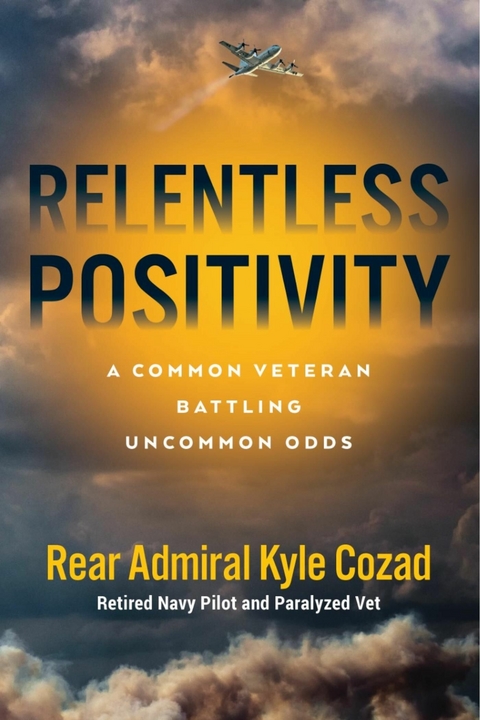
Relentless Positivity (eBook)
350 Seiten
Ballast Books (Verlag)
978-1-955026-36-9 (ISBN)
Rear Admiral Kyle Cozad graduated from the U.S. Naval Academy in 1985. His Navy career centered around aviation training and operations, and he served extensively as an instructor pilot in numerous operational and training tours around the world. During his career, Cozad commanded at various levels within naval aviation and joint multi-service in five critical assignments. Ashore, he served in a variety of diverse leadership positions within the Navy and Department of Defense, including as the 22nd Senior Director in the White House Situation Room, Commander of Joint Task Force Guantanamo Bay, and Commander of the Naval Education and Training Command. Following a service-connected spinal cord injury in 2018, Cozad recovered and returned to full service, completing his final thirty months of active duty as the Navy's only wheelchair-bound flag officer. During that time, he became an advocate for disability awareness and competed in the 2019 Department of Defense Warrior Games. Prior to his retirement, Cozad was recognized as one of the Department of Defense's top employees with disabilities in 2020. After a thirty-five-year career in the Navy, Cozad joined the Naval Aviation Museum Foundation as the President and Chief Executive Officer in October 2020. Today, he resides in Pensacola, Florida-affectionately known as the 'Cradle of Naval Aviation.' Since his injury, Cozad has dedicated countless hours mentoring other spinal cord injury victims through their individual recoveries.
Author Kyle Cozad - retired US Navy Rear Admiral and current President and CEO of the Naval Aviation Museum Foundation tells his own personal story following a service-related spinal cord injury while he was on active duty. Insightful, honest, and frank, his account describes how he bounced back from a debilitating spinal cord injury with one overarching motivation: to "e;give back"e; and make a positive difference for others. His leadership as a senior Navy two-star admiral serving on active duty, and his current role as President and CEO of the Naval Aviation Museum Foundation exemplify his grit and resilience and a commitment as a societal change agent. Relentless Positivity is a must-read for anyone facing personal adversity in their lives. It is an inspirational personal story of toughness and resilience from which Wounded Warriors, their families, and anyone who has faced major trauma in their lives will be encouraged in overcoming incredible odds.
CHAPTER 4
Fly, Fight, Lead… and WIN!
When people ask me what do I want to be remembered for, I have one answer. I want the people to remember me as a winner, ‘cause I ain’t never been nothing but a winner.
—Coach Paul “Bear” Bryant
One could say that, despite a dubious academic beginning at the Naval Academy, things seemed to work out for me during what many of my classmates probably considered an unlikely career. Frankly, I never intended to stay in the Navy beyond my initial commitment. The mere thought of flying for a career had been an inspiration ever since the day a good friend took me to visit his squadron at Nellis Air Force Base in Las Vegas. I couldn’t understand why some people chose to work in seemingly boring and benign careers such as law, accounting, or architecture. I had no desire to pursue that but rather sought a path toward aviation—and military aviation at that—as a means to put food on the table and, in retrospect, cheap beer in the refrigerator. Little did I realize I’d soon replace that beer with diapers and baby formula! That single day with my friend on the flight line made my decision. I had the aviation bug, and I had it bad.
Thinking back to that discussion with my company officer during my sophomore year, I remain dissatisfied with the final direction that conversation took. However, refocusing on the classroom and keeping my nose above the proverbial minimum GPA mark earned me a slot at the Navy’s flight school located in Pensacola, Florida. The Navy sends every budding flight student to a single location in Pensacola, where they begin their journey that will someday lead to earning their coveted wings of gold. Since every one of those hopeful future aviators passes through Pensacola on their aviation journey, it is affectionately known as the “Cradle of Naval Aviation.”
Once I realized what I truly wanted to do in the Navy, flying drove every decision I made during my time in Annapolis. It drove my study habits, it drove the classes I took, and it drove every thought about how and when I’d get to Pensacola. However, man can’t live on aviation alone, and I rationalized that many good pilots have equally good copilots.
Enter Amy Louise Welter. I met my future wife during my last week of summer vacation going into my senior year at the Academy. If there is any such thing as love at first sight, I was certain that I had found it. We met in Georgetown when I had chosen at the last minute to skip out on another party and head into the big city for an impromptu albeit low-key birthday celebration with another classmate of mine. Amy also happened to be out that night with a friend, and as her story goes, she “accidentally” locked her keys in her car. I have a suspicion that, shortly after meeting me, she pretended to go use the restroom but instead intentionally locked her keys in her car to play the damsel in distress to my knight in shining armor. A pretty extreme measure to spend a few more minutes with me that night, I must admit—but that’s pure speculation on my part.
Regardless of how those keys got locked in her car, I took advantage of the situation and did what any aspiring aviator would do. I let my buddy unlock her car while I chatted Amy up and secured her phone number. We married just under a year later and have grown closer and closer with every day that we’ve been together since then. As a matter of fact, I later laminated the parking receipt that Amy gave me with her name and phone number handwritten on the back as a sentimental keepsake. I carry it in my wallet to this day as a treasured memento and reminder of that warm, August evening when we met and our love started. For decades, I’ve ensured it’s made the transition from one wallet to another, believing that it just might continue to bring me good luck. It hasn’t failed me yet.
No matter whose version of the how-we-met story you believe, we had our wedding at the Naval Academy Chapel several months after graduation, and within a few weeks, I was headed to Pensacola for initial aviation training. As we packed all our worldly belongings into the car, I could hardly contain my excitement with the understanding that our journey in naval aviation would soon begin.
There is something much bigger about naval aviation that transcends the allure of flight that I didn’t understand until well after my training. Frankly, there are some things I don’t think I fully understood or appreciated until I retired some thirty-five years later. As a rule, naval aviation is an unforgiving profession. There are rarely earned do-overs with dire life-or-death consequences that revolve around individual decision-making as it pertains to hundreds of sequences flown in a given mission. For example, a few things involved are precise interpretation of a multitude of spatial and contextual presentations that happen on every flight; an in-depth technical knowledge of the aircraft and weapons systems and how they are employed in a variety of good and bad scenarios; and, finally, the ability of one person (or one crew) to harness their peak level of performance each and every time they suit up to fly.
While the professionalism and application of those physical piloting skills in the world’s most sophisticated aircraft are often referred to as airmanship, I always preferred the term my initial flight instructor used with me. During one of the first briefs, he laid things out for me, plain and simple.
“Ensign Cozad, I don’t care how well you know your procedures. I don’t care how well you know your aircraft operating limits. Don’t get me wrong, it’s a package deal, and you need to know them all cold anytime, anywhere. But just about anyone can commit words and procedures to memory. What separates great pilots from all the others are the monkey skills. You’ve got to be a good stick to be the best. And when you’re the best, you’ll be able to do this—that is, to fly Navy aircraft—for many years to come.”
During flight school, things come fast. You’re expected to master a range of topics from aerodynamics to meteorology to aircraft emergency procedures. You’re expected to know mechanical aircraft systems cold. One minute, you’re getting graded on how accurately you can describe how a molecule of fuel goes from the fuel cell until it’s combusted; the next minute, you are describing how to avoid heavy weather in a variety of meteorological scenarios. You’re expected to commit critical procedures to memory and to apply those procedures as you are flying, communicating via radio and interpreting the radio beacon signal after your instructor has pulled the controlling circuit breaker and rendered that signal inoperative.
That pace of one evolution after another rattled my nerves. Consider a syllabus that teaches someone how to taxi a high-performance aircraft on their first flight and accelerates them to a point where, fourteen flights later, they earn the right to fly solo. Then, on the second time, they must complete a complex set of aerodynamic maneuvers. No, they’re not Blue Angels worthy, but that’s an amazing learning curve to comprehend in two weeks’ time. Throw in hot summer days, aircraft exhaust, a bit of student anxiety, and perhaps some initial airsickness, and I came to an easy conclusion—this is what I wanted to do for the rest of my career.
In aviation, and more specifically in naval aviation, there is no such thing as a perfect flight. They simply don’t exist. Even the world-famous Blue Angels, the Navy Flight Demonstration Squadron, take the pursuit of the elusive perfect flight to an unparalleled level. The Navy’s Blue Angels epitomize excellence in every practice and public airshow during a typical season. While the Navy and our general public recognize them as a symbol of aviation precision and excellence, the team refuses to accept any airshow or practice without excruciating self-criticism, all with an aim toward being better during the next show.
Often, that need for improvement is not apparent to the typical aviation enthusiasts who watch their shows, but that relentless pursuit of perfection is a common theme that permeates the rest of naval aviation. It’s never just good enough. We all want to be better at what we do today than we were yesterday.
As much detailed planning as one might do, something always changes, and in many cases, some things just plain go wrong. Sometimes, it’s a simple mistake that we make, such as missing a radio call from an air traffic controller, forgetting a checklist item on climb out, misinterpreting route flight clearance changes, or dealing with aircraft systems that don’t always work as advertised. During flight school, it’s an out-and-out battle (at least it seems that way for every student) between the instructor and the student. The instructor wants to create confusion. The instructor wants to overload a student’s meager ability to multitask. The instructor wants to add a variety of distractions that inject the fog of war.
Although I didn’t necessarily give my instructors credit for the method to their madness, I later realized that in doing those things, they were preparing me to succeed. They were setting the conditions for what I’ve come to call “dynamic resilience” or the ability to adapt, overcome, and perform at the highest level possible regardless of the challenges that any one pilot or crew will face on any given flight. At the end of the day, naval aviation is called upon to deliver firepower on the adversary. Nobody will care about your excuses or alibis, but they will take notice if and when you fail to deliver ordnance that might be required to...
| Erscheint lt. Verlag | 6.12.2022 |
|---|---|
| Sprache | englisch |
| Themenwelt | Literatur ► Biografien / Erfahrungsberichte |
| ISBN-10 | 1-955026-36-X / 195502636X |
| ISBN-13 | 978-1-955026-36-9 / 9781955026369 |
| Informationen gemäß Produktsicherheitsverordnung (GPSR) | |
| Haben Sie eine Frage zum Produkt? |
 EPUB (Ohne DRM)
Größe: 4,1 MB
Digital Rights Management: ohne DRM
Dieses eBook enthält kein DRM oder Kopierschutz. Eine Weitergabe an Dritte ist jedoch rechtlich nicht zulässig, weil Sie beim Kauf nur die Rechte an der persönlichen Nutzung erwerben.
Dateiformat: EPUB (Electronic Publication)
EPUB ist ein offener Standard für eBooks und eignet sich besonders zur Darstellung von Belletristik und Sachbüchern. Der Fließtext wird dynamisch an die Display- und Schriftgröße angepasst. Auch für mobile Lesegeräte ist EPUB daher gut geeignet.
Systemvoraussetzungen:
PC/Mac: Mit einem PC oder Mac können Sie dieses eBook lesen. Sie benötigen dafür die kostenlose Software Adobe Digital Editions.
eReader: Dieses eBook kann mit (fast) allen eBook-Readern gelesen werden. Mit dem amazon-Kindle ist es aber nicht kompatibel.
Smartphone/Tablet: Egal ob Apple oder Android, dieses eBook können Sie lesen. Sie benötigen dafür eine kostenlose App.
Geräteliste und zusätzliche Hinweise
Buying eBooks from abroad
For tax law reasons we can sell eBooks just within Germany and Switzerland. Regrettably we cannot fulfill eBook-orders from other countries.
aus dem Bereich