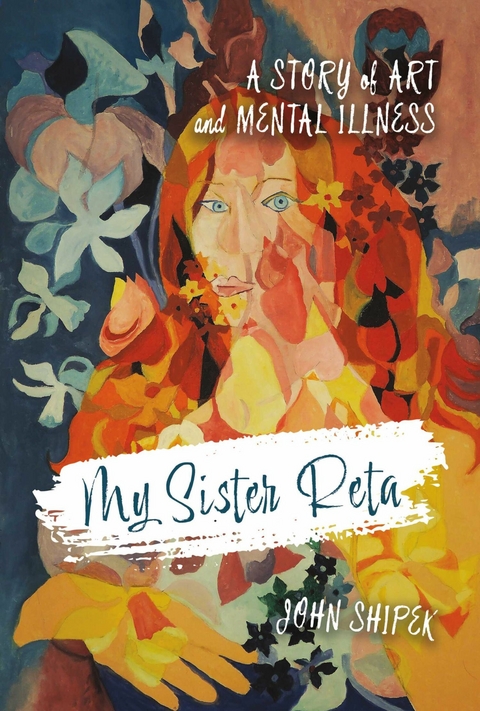
My Sister Reta (eBook)
144 Seiten
Bookbaby (Verlag)
978-1-6678-6139-5 (ISBN)
John Shipek earned a BSEE from the University of Washington and has worked in the electric utility industry ever since. This is his first book. His inspiration came when he first laid eyes on what must have been at least 200 canvases jammed into Reta's basement. He knew he had to get involved before things really got out of control.
My Sister Reta: A Story of Art and Mental Illness is a non-fiction book, crossing the genres of family biography, mental health, and self-help. It is a story of an artist living with debilitating mental illness, and a brother's journey to understand and love an inscrutable sister. My story is about a brother learning to understand and love a sister who has lived with schizoaffective disorder, bipolar type for her entire adult life. It begins with Reta at age 10 and continues through to 2021. Within the narrative I have interlaced nearly 70 of her artistic works that serve as aesthetic mileposts as well as visual representations of her mental health as her story is traversed. Her early years, after establishing herself as a promising artist, are followed by a roller coaster experience of relative stability and high-quality artistic output, followed by gravely disabling manic episodes and an inability to create. Between 1968 and 2021, Reta experienced 15 manic episodes, 10 of which required extended, psychiatric hospitalization. Complicating Reta's living with an incurable disease are, to this day, an imperfect health care system, financial woes and an abusive relationship. Well into adulthood, on a rare visit to my sister's home, I encountered a vast trove of artistic works she had created since her college days hundreds of paintings and sketches that had never seen the light of day. It was then I began to consider more deeply this person that I had known only superficially in my youth, and that there might be a rich story to tell. The more I researched, the deeper and broader the story became. From what started as an idea to capture a sister's unique life for family transformed into a story that I hope will resonate with anyone who has a family member or loved one that is living with mental illness.
Introduction
In the family there is a considerable history of insanity on the mother’s side. The patient has one 11-year-old brother said to be normal.
~ Clinical record, c. 1968
Self-Portrait, 1968
Oil on canvas
24 in x 18 in
Reta’s text messages were completely incoherent, and she was having difficulty talking on the phone. She said she was cold, soaked with sweat, and her arms and hands were shaking uncontrollably. Reta said she found it impossible to paint. I concluded that her body was failing her as much as her mind.
Deciding Reta’s condition had reached a tipping point I packed my bags and hit the road the next morning to see if I could do anything to help. My goal was to spend a couple of nights in Wenatchee and provide some level of comfort.
I arrived at Reta and Michael’s house mid-morning. When Reta sluggishly greeted me at the door she said she was so tired that she had to lie down. While Reta rested, Michael asked if I would do him the favor of installing a pair of grab bars in his bathroom, which I did. When Reta got up she moved to the living room couch, and we just hung out. She said she was not up for anything else. On a better day we would have gone for a drive, and I would have treated her to lunch at one of her favorite restaurants.
After a few hours, Michael got out of bed and wheeled himself into the living room and at the same time Reta retreated to her bedroom. Our conversation began innocuously, but then abruptly Michael ordered me to drive Reta right that moment to the ER and request she be sent to a mental hospital. I said, calmly, “Michael, that is not how these things work. I’m not going to do that.” To this he replied, “You don’t seem to understand my situation. I am at the end of my rope. So, I am just giving you a heads up. If you don’t do anything it’s up to you, if you do something, you are doing it for your sister, not me.”
Michael became increasingly irate. In a voice that began civilly but increased to a bellow, he said, “I am trying to be rational, to do something that will help her and will stop me from doing anything that I might regret if I lose my control.” Next, with harsh words Michael ordered me out of the house. I said, in an even tone, “I would like to say goodbye to my sister before I leave.”
Michael snapped, “I am married to her, this is my house, this is our marriage, and if I say don’t go there, don’t go there!” “Alright,” I said. “Can I yell goodbye at her from here?”
Michael stuttered at my question before he replied, “No, uh, go ahead and yell. I’d like to hear you yell for a change. Yeah, GO AHEAD!” I called out with an inflection that would befit the introductions at a professional wrestling match, “HEY RETA!” She does not answer. Michael continues his shouting, “I’ll tell you what, I’m trying to be a good person, GO AND SAY GOODBYE TO HER AND GET THE HELL OUT OF HERE! GOODBYE!”
I got up from the couch with my pack in hand and made my way toward Reta’s bedroom. When I got to her, she was sitting in a chair in the corner, looking at the floor. I said, “I’m sorry.” Weeping, Reta responded, “You have to go? I don’t blame you. Why does he keep threatening? I can’t do anything.” I said, “I’m sorry, please keep your phone with you and please call me when you can. Okay? Bye sweetie.” I made my exit quickly and drove away, knowing I was leaving behind an amalgam of pain and uncertainty.
The next day in a sheepish voice, Michael left a message on my phone, “If you want to see your sister, you can. Sorry about yesterday. That’s all I can say. Goodbye.”
I was only eight years old when Reta began college and moved away from home. When Reta became ill, my parents did not talk with me about it. They likewise did not talk about a family history of mental illness, which, during the course of my research for this book I found did, indeed, exist. I only recently pieced together the complete story; my mother had two younger brothers (who both died young), four older sisters, and two younger sisters. Through interviews with Reta and my mother, plus some detective work, I was able to corroborate the story that one of my mother’s older sisters, Delia, was involuntarily institutionalized for six years at Northern State Hospital (NSH).
My mom and dad must have had a deep, sinking feeling when Reta experienced her first episode. It left no doubt that mental illness would persist in the family.
Bipolar Disorder and Heredity
In New Hope for people with Bipolar Disorder - Your Friendly, Authoritative Guide to the Latest in Traditional and Complementary Solutions, Jan Fawcett, M.D., Bernard Golden, Ph.D., and Nancy Rosenfield explain:
Studies indicate that when both parents have bipolar disorder, the likelihood of having a child who evidences the disorder is 50 to 75 percent. In contrast, when only one parent has been diagnosed, that possibility decreases to 15 to 30 percent. However, these statistics only imply a disposition to the illness, not a prediction of whether the child will ever experience the symptoms.
In Touched with Fire: Manic-Depressive Illness and the Artistic Temperament, Kay Redfield Jamison explains:
Manic-depressive illness is indisputably genetic … Manic-depressive illness is relatively common: approximately one person in a hundred will suffer from the more severe form and at least that many again will experience milder variants, such as cyclothymia. One person in twenty, or 5 percent, will experience a major depressive illness, in contrast to major depressive illness which is twice as likely to affect women. The average age of onset of manic-depressive illness is (18 years) is considerably higher than that of unipolar depression (27 years).
I have few memories of Reta from my early childhood, but I do remember she was always nice to me. From that time until my adulthood her existence from my point of view was fragmented. It wasn’t until I was in my 30s that I re-engaged with her in any memorable way. I had learned quickly that I could never be responsible for her. When Reta was well, she was wonderful company. She was intelligent, creative, and articulate. When she was ill, she can have the inertia of a locomotive and her needs can be endless. When she was very ill, she required heavy medication and restraints. Thankfully, I’ve never seen Reta in that condition. I only learned the details of these terrible occurrences by reading her medical records, important bits of her life that existed only in distant archives. I obtained copies of whatever I could find. In one case, I found a set of records just before their retention period had expired and they were destroyed.
Obtaining Medical Records (for Someone Else)
The Health Insurance Portability and Accountability Act (HIPAA) is a 1996 Federal law that restricts access to individuals’ private medical information. HIPPA sets rules for health care providers and health plans about who can look at and receive your health information, including those closest to you – your family members and friends. The HIPAA Privacy Rule ensures that you have rights over your health information, including the right to get your information, make sure it’s correct, and know who has seen it.
In spite of HIPAA, obtaining medical records is not an impossible task; requests simply require proper authentication. Every institution has their own process, and some outsource the business to a third party. Fees are modest, if any, and are usually paid after delivery. Visit the institution’s website and search for “records.” In most cases the necessary form to be completed is online. Be generous when indicating a date range so as to not miss a valuable item.
Records will be delivered by mail as printed paper, on computer disc, or online as an encrypted file to download. Some requests may come up empty while others may yield hundreds of pages.
To complicate matters there are many different types of records and each institution has its own set of requirements. There are physical health, mental health, psychotherapy, legal, criminal, department of corrections, school, and public records. For example, to obtain a Washington State Department of Corrections record, a court order is required, however sometimes a requirement like this is waived without explanation. Records deemed public should be readily available but still require forms and a process.
A U.S. Department of Health and Human Services bulletin states:
HIPAA helps by allowing the health and mental health providers who treat your loved one to make decisions about communicating with his or her family and friends based on their professional judgment about what is best for the patient.
In other words, even with the patient’s consent, not all health and mental health records are necessarily available to family members.
According to ICANotes Behavioral Health EHR:
While you have the right to access your mental health record, that right does not extend to a psychotherapist’s notes taken during any therapy sessions. These, of course, are the notes a therapist makes during conversations with a patient and are separate from the patient’s health...
| Erscheint lt. Verlag | 19.9.2022 |
|---|---|
| Sprache | englisch |
| Themenwelt | Literatur ► Biografien / Erfahrungsberichte |
| ISBN-10 | 1-6678-6139-5 / 1667861395 |
| ISBN-13 | 978-1-6678-6139-5 / 9781667861395 |
| Informationen gemäß Produktsicherheitsverordnung (GPSR) | |
| Haben Sie eine Frage zum Produkt? |
 EPUB (Ohne DRM)
Größe: 13,7 MB
Digital Rights Management: ohne DRM
Dieses eBook enthält kein DRM oder Kopierschutz. Eine Weitergabe an Dritte ist jedoch rechtlich nicht zulässig, weil Sie beim Kauf nur die Rechte an der persönlichen Nutzung erwerben.
Dateiformat: EPUB (Electronic Publication)
EPUB ist ein offener Standard für eBooks und eignet sich besonders zur Darstellung von Belletristik und Sachbüchern. Der Fließtext wird dynamisch an die Display- und Schriftgröße angepasst. Auch für mobile Lesegeräte ist EPUB daher gut geeignet.
Systemvoraussetzungen:
PC/Mac: Mit einem PC oder Mac können Sie dieses eBook lesen. Sie benötigen dafür die kostenlose Software Adobe Digital Editions.
eReader: Dieses eBook kann mit (fast) allen eBook-Readern gelesen werden. Mit dem amazon-Kindle ist es aber nicht kompatibel.
Smartphone/Tablet: Egal ob Apple oder Android, dieses eBook können Sie lesen. Sie benötigen dafür eine kostenlose App.
Geräteliste und zusätzliche Hinweise
Buying eBooks from abroad
For tax law reasons we can sell eBooks just within Germany and Switzerland. Regrettably we cannot fulfill eBook-orders from other countries.
aus dem Bereich