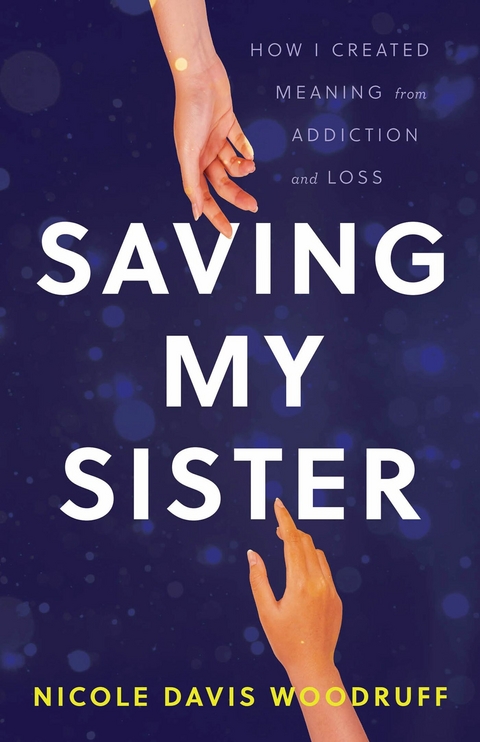
Saving My Sister (eBook)
222 Seiten
Lioncrest Publishing (Verlag)
978-1-5445-2950-9 (ISBN)
On June 13, 2019, Nicole Woodruff got the call she had been dreading for years. Her sister, Amanda, had suffered a fatal overdose. Amanda had become addicted to heroin as a young woman. For five years, Nicole and her family struggled to help as Amanda cycled through the process of getting clean, starting to recover, and falling back into using. Saving My Sister is a memoir about navigating addiction told through a sister's love, sharing the fear, hope, disappointment, stress, frustration, and ultimate loss that all too often finally ends the cycle, leaving families wondering what else they could have done-or whether they did enough. If you have experienced addiction firsthand, or if you love someone who has, Saving My Sister is a poignant reminder that addiction affects not just individuals but families, that you're only human, that you're all going to need help, and that you're not alone
Chapter 1
The First Time
The first time my sister overdosed on heroin was in January 2014. I’ll never forget that day for the rest of my life. I was still living at home with my mom and stepdad, working at my first job in a skilled nursing facility after graduating college with my occupational therapy degree. I remember being at work and seeing that my mom was calling me, which I knew was never a good sign, as she would usually text or wait to tell me something when I got home. I answered, worried what she might say.
“Nicole?” She sounded panicked.
“Yes,” I answered.
“Your sister just called me and told me she is stuck in Allentown at the hospital. She was with that guy, Joe. She said he injected her with heroin and left her to die.”
“What? Are you sure? You’ve got to be kidding me.” I fumbled over my words, lost in disbelief.
“Yes, she just called me. She needs someone to go down there and get her. Joe took off with her car and everything. I don’t know what to do because I’m working.”
SOS. Total panic came over me. It felt like my heart fell into my chest and I lost the ability to breathe. Even after all the years of dealing with Amanda shadily taking pills, I was still unprepared to hear my mom say these words.
This was literally our worst nightmare. Amanda was my only sibling, and this news rattled me to my core. She always swore that she would never touch heroin. I remember her specifically telling me, a few years prior to this overdose, “You know I would be in a really bad place if I were ever to use heroin. That stuff is nasty. I’ll never fuck with that.”
I mean, I guess I should have expected this day to come. Amanda had been on and off prescription opiates for years, with a long history of abuse, since before her son, Christopher, was born in 2008. After multiple car accidents in her early twenties, she developed chronic pain and was diagnosed with fibromyalgia. Amanda never found alternative therapies to manage her pain and relied on narcotic pain medications. She started with tramadol, then moved onto Vicodin, then Percocet…you get the picture.
After Christopher was born, she went into a depression and leaned on opiates to make herself feel better. A few months into this cycle, she admitted to having an opiate addiction and taking around twenty Vicodin pills per day. This was the first time she had ever outwardly admitted to having a problem with substance abuse. She told my family, her doctor, and Christopher’s father, who was still her boyfriend at the time. She had some tough discussions with my parents and Christopher’s father, and they all supported her in getting the treatment she needed. She started outpatient drug counseling and committed to getting better for herself and her son.
I remember feeling confused back then because I didn’t understand substance use disorders. I knew taking twenty pills a day was an awful lot, but I thought that with counseling, she would overcome it. However, I was only nineteen years old at the time and didn’t understand the challenges of new motherhood, postpartum depression, and the struggles Amanda was facing as a young mom. She was only twenty-three when she was thrust into motherhood as the result of an accidental pregnancy. She and Christopher’s father had only been dating for a few months when they found out she was pregnant. She was still getting to know him as she navigated pregnancy, moving back home to live closer to family, and the hardships of early motherhood.
As the mom of a young toddler myself, I now know those hardships oh so well but did not understand at all in 2008. Looking back, I can see how a predisposition to addiction can spiral out of control when you add in postpartum depression. I wish my family and I had a better understanding of what Amanda was going through. She didn’t breastfeed, but she was still feeding a baby around the clock. Add in lack of sleep, body changes, hormonal shifts, and discovering her identity as a mom—it was a whole new world for her. I didn’t understand these things at all. I wish I could say my parents did, but after having my first child last year, I quickly learned they do not remember what it is like to raise a newborn.
Maybe if we all had understood what Amanda was going through at the time, we could have offered her more support to prevent her disease from progressing. Unfortunately, we were uneducated and ignorant to the challenges she was facing as a young mother dealing with substance use disorder. So here we were, five years later, trying to clean up the mess of her first heroin overdose.
I felt angry, disappointed, frustrated, and confused. So many emotions all at the same time. I didn’t know what to say to my mom, but I knew she couldn’t handle this on her own. My mom is fragile and doesn’t handle stress well. I knew I would have to step up and take care of this situation. I just didn’t understand how we had gotten here. How did Amanda go from taking prescription pills to overdosing on heroin?
I decided to turn these thoughts off for the time being and went into what I call “handle it” mode. My shock still in overdrive, I told my boss I needed to leave early and briefly explained the situation as I ran out of the therapy gym and nursing facility where I worked. My mom picked up Christopher from school, and after I left work, I drove more than an hour to get Amanda from the emergency department of the Lehigh Valley Hospital.
As I drove to the hospital, I felt anxious and didn’t know what to expect. I had never seen anyone on heroin before. I could only picture what I had seen in the media: someone slumped over on the side of the street after sticking a needle in their arm. What would Amanda look like? Would she even be able to talk to me? I was about to find out.
I pulled in front of the hospital and waited for her to come outside. After a few minutes, Amanda approached my vehicle and flashed what looked like a drunken smile. She flung herself into my car and said hello. Her eyes were barely open, and she looked exhausted.
At first, I just drove, staring at the road ahead as my shock wore off. What was the best way to approach this? I wanted answers, but she wasn’t in the right state of mind to give them. After a while, I finally asked, “So why did you do it? I thought you said you’d never do heroin.” She mumbled, “I dunno…I just wanted to.”
Her breathing was loud and heavy. Out of the corner of my eye, I could see her thick brown hair whipping back and forth as she swayed in my passenger seat. We spoke sparingly, mostly just me asking questions and her responding with short, one-word answers. Her speech was slurred, and I could tell it was difficult for her to even process what I was saying. Eventually, I just let it go. She wasn’t in the right state of mind to talk, so I decided it would be best to wait until the morning. For the rest of the trip, she was either nodding off or asleep. She had no clue what was going on; she just knew that she was with me and I was taking her home. She was safe, for now.
I’ll never forget that drive for the rest of my life. I couldn’t believe what Amanda looked like, how she spoke to me, or the effects heroin still had on her, even hours after she had used. And long after Narcan had been administered. Narcan is an opioid antagonist that immediately begins to reverse the effects of an opioid overdose. At the time, in 2014, I was not well-versed in opioid addiction, and because this was Amanda’s first overdose, I had never heard of Narcan. Now I know all about it, as it saved my sister’s life more times than I can count. This was just the first.
When we got home, I decided to stay the night at her place so I could keep an eye on her. I didn’t trust her to be alone. I wanted to make sure she was okay and wouldn’t use any more heroin for the rest of the night. I planned to call out of work in the morning so I could arrange for her to go to rehab and get the help she needed. In her stupor, she had agreed to go to rehab, so I was hopeful we could find a place for her to go the very next day. Christopher was staying at my mom’s and, thankfully, did not have to witness what I’d just seen over the last few hours.
The next morning when we woke up, Amanda was not feeling well. She was tired and complained of being in a lot of pain, which was nothing new for her. She had fibromyalgia, so this was an everyday complaint. With the added effects of heroin withdrawal, I imagine that pain was a bit more intense. So, while she lay around on the couch, I started making phone calls to find her a rehab facility. I called numerous facilities and struggled to find quality programs that accepted her Medicaid insurance.
My friend’s brother had gone to a privately owned rehab facility in Pennsylvania about a year prior. He’d had a positive experience and was still in recovery. The facility was known for expert addiction recovery specialists, supportive programs, and connections to elite transitional programs after discharge. I had heard there were possible scholarships available, so this facility was the first place I called. I thought, Wow, if I could just get her in here, she would have exactly what she needs to get better.
Unfortunately, they did not have a scholarship available to offer Amanda. And I quickly learned the cost of these private facilities is very high. The admissions coordinator explained that it would cost several thousand dollars just to...
| Erscheint lt. Verlag | 24.5.2022 |
|---|---|
| Sprache | englisch |
| Themenwelt | Literatur ► Biografien / Erfahrungsberichte |
| ISBN-10 | 1-5445-2950-3 / 1544529503 |
| ISBN-13 | 978-1-5445-2950-9 / 9781544529509 |
| Informationen gemäß Produktsicherheitsverordnung (GPSR) | |
| Haben Sie eine Frage zum Produkt? |
 EPUB (Ohne DRM)
Größe: 501 KB
Digital Rights Management: ohne DRM
Dieses eBook enthält kein DRM oder Kopierschutz. Eine Weitergabe an Dritte ist jedoch rechtlich nicht zulässig, weil Sie beim Kauf nur die Rechte an der persönlichen Nutzung erwerben.
Dateiformat: EPUB (Electronic Publication)
EPUB ist ein offener Standard für eBooks und eignet sich besonders zur Darstellung von Belletristik und Sachbüchern. Der Fließtext wird dynamisch an die Display- und Schriftgröße angepasst. Auch für mobile Lesegeräte ist EPUB daher gut geeignet.
Systemvoraussetzungen:
PC/Mac: Mit einem PC oder Mac können Sie dieses eBook lesen. Sie benötigen dafür die kostenlose Software Adobe Digital Editions.
eReader: Dieses eBook kann mit (fast) allen eBook-Readern gelesen werden. Mit dem amazon-Kindle ist es aber nicht kompatibel.
Smartphone/Tablet: Egal ob Apple oder Android, dieses eBook können Sie lesen. Sie benötigen dafür eine kostenlose App.
Geräteliste und zusätzliche Hinweise
Buying eBooks from abroad
For tax law reasons we can sell eBooks just within Germany and Switzerland. Regrettably we cannot fulfill eBook-orders from other countries.
aus dem Bereich