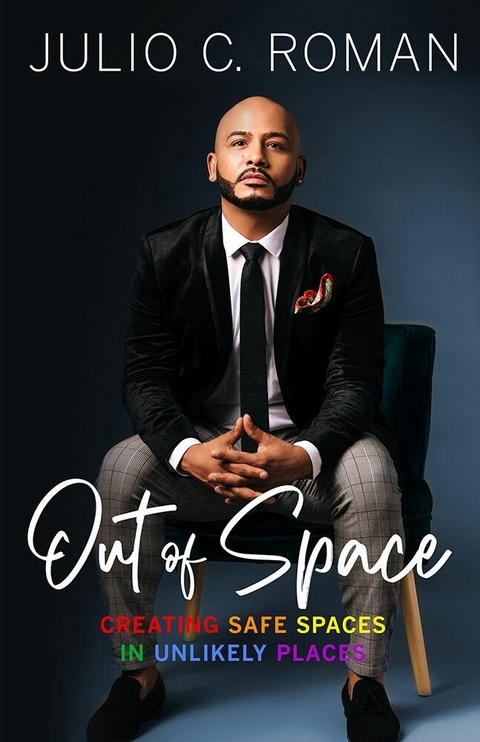
Out of Space (eBook)
278 Seiten
Lioncrest Publishing (Verlag)
978-1-5445-2806-9 (ISBN)
Are you a safe space?Julio C. Roman's groundbreaking memoir and leadership guide for LGBTQIA+ advocates suggests that safe spaces are not rooms with four walls and a door. Safe spaces are people-leaders whose values, words, and actions invite and encourage every individual in their presence to express their fully authentic self. Leaders embody those spaces physically, and they embody them on social media. They create them by sharing the values of worth, acceptance, and self-esteem with every life they touch. But what happens when our safe spaces are violated? What happens when the people we love, especially those who represent safety, are taken from us? How do we deal with what we are witnessing, and where do we start picking up the pieces?By sharing his own poignant struggle to overcome the emotional scars of violence and abuse, Roman demonstrates the critical importance of safe spaces for every marginalized voice. Whether you're a young LGBTQIA+ person, a community-based organizer or ally, an LGBTQIA+ rights advocate, a business leader, an HR representative, or anyone else who wants to create a safe space for others, Out of Space can help you learn how to do it-and what being a safe space truly means.
Introduction
The Pulse of a Community
“Of course, I am afraid, because the transformation of
silence into language and action is an act of self-revelation,
and that always seems fraught with danger.”
—Audre Lorde, author and activist
I wrote this book so that other LGBTQIA+ people may see pieces of their stories in mine. I wrote it to share leadership lessons I have collected and learned along the way. This is not meant to be a holy grail, but a toolbox filled with real-life narratives and advice.
For twenty-two amazing years, I’ve had the honor of creating safe spaces for Black and Brown Lesbian, Gay, Bisexual, Transgender, Queer or Questioning, Intersex, Asexual (LGBTQIA+), and other marginalized communities. This includes advancing health equality, social justice, and public health initiatives for these communities. In this book, I share honest pieces of my story as I navigated life as a queer, timid Latino boy who would one day become a confident gay man who mentors and advocates for other LGBTQIA+ leaders. My journey isn’t for the faint of heart, but it is a life lesson in determination. I share experiences of sexual and physical abuse, homelessness, drug use, sex work, and HIV and AIDS—but also deep faith, family, forgiveness, and finding my calling.
The Oxford Dictionary defines safe space as: “a place or environment in which a person or category of people can feel confident that they will not be exposed to discrimination, criticism, harassment, or any other emotional or physical harm.”
On my safe space journey, I have learned one crucial thing about the world we live in today. Safe spaces can no longer be bound and limited to physical locations. Rather, they must be found and created in each of us, allowing us to transcend the limitations of walls, rooms, or a single environment. We do this by actively representing acceptance, kindness, and compassion, requiring the same in return, and displaying the courage to speak up against the inhumanity and injustices toward LGBTQIA+ people in every space we occupy.
How do we make this happen? Leadership is about creating safe spaces or representing a safe space where none exists. This is a role that will require integrity, follow-through, and courage. Growing up, I was fortunate enough to find this guidance through mentors who not only displayed leadership abilities, but also created and transformed communities and cultures. Lessons were often passed down. I had mentors who impacted the way I saw the world and my place in it, and who echoed the importance of paying it forward for others. Within these pages, I share these leadership lessons and tools through the lens of my experiences as a proud, queer Puerto Rican man, with the hopes that it will reach you to benefit you and the communities you serve. I hope that you find enlightenment, empowerment, and tools that you can make work for you. All these tools and lessons are now yours.
It’s important to understand that when we talk about safe spaces, we are referring to the spaces we represent as human beings, not only a literal place.
So many times growing up, I was taught directly and indirectly that a safe space was a physical location made up of four walls and a door that could be locked, a place that I had to travel to in order to access its safety. Many times, this was supposed to mean home, school, or a family member’s house. But what do you do, and where do you go, when those places aren’t safe anymore?
I want to challenge you to think about the physical space that your body and voice take up in the world.
Growing up, it was hard to find safe spaces, but I managed to find safe people. I learned that unless we feel safe to blossom into our true selves, unless we can express who we are without fear and without intimidation, we can never fulfill that which we are called and destined to do in the world. Finding my safe space allowed me to understand and accept that it was okay to be gay, feminine, Boricua (people of Puerto Rican descent), and draped in all my Brown skin. It was okay that I stuttered when I got nervous or excited. It was okay to let my guard down and be open to others, and it was okay to admire other gay men as they socialized and carry on. Witnessing how they cared for one another and looked out for one another made me proud. It allowed me to feel my community’s love as something tangible and real for the first time.
But what happens when our safe spaces are violated? What happens when the people we love, especially those who represent safety, are taken from us? What happens to our spirits when we can’t find safety, answers, or support, and we feel hopeless and in despair? How do we deal with what we are witnessing, and where do we start picking up the pieces?
These are the questions I grappled with after the tragic Pulse incident in the summer of 2016. It was Latino Night, at two in the morning, when a lone gunman—armed with hatred, evil intent, a SIG Sauer MCX semi-automatic rifle, and a 9mm Glock 17 semi-automatic pistol—murdered forty-nine people. He made it his goal for all 320 people in attendance to experience terror like no other.
I remember that night, freezing in disbelief and horror as I watched what was happening in Orlando on the news. My heartbeat became a drum pounding louder and louder in my head. The first thing that flashed through my mind was seeing the Columbine tragedy on TV when I was twelve years old. That had been the first time I’d ever seen what a shooting looked like. It was the first time I had ever seen such terror on the faces of innocent people. And it was the first time I had ever seen blood flowing from lifeless bodies.
Pulse, however, cut me in a different way.
Just the year before, I had attended the Pulse nightclub myself. Like those at Pulse during the fateful incident, I was dancing away on a darkened and packed dance floor to the high beats of reggae with my best friend, Luis, whom we lovingly called Speedy. The strobe lights offered only quick glimpses of recognition and bathed the faces of the community all around me in flashes of light and color. The room was filled with energy, music, and a celebration of life. Looking back now, the only thing that separated me from the 2016 shooting victims was time and random chance.
The night I was at the club, it was the end of our adventurous two-week-long Miami and Orlando trip, and we chose this place as the climax. After all, Pulse is known all over the country as a must-visit hot spot, especially if you wanted to party with the Latinx and Black LGBTQIA+ community.
Entry was easy, like most gay clubs I’ve attended. No hassle, no dress code, no overbearing security guards (for the most part). No metal detectors—a pat down at most. Just an entry fee in hand and a valid ID, and you were good. After all, the point of these clubs has always been to create an accepting, all-inclusive safe space to be yourself and to party with others who may or may not look like you. Many clubgoers were seeking what we all seek—fun, acceptance, new friendships, and what most of us want at the end of the day, which is admiration and the respect of our community.
At the end of a long, fun night, Speedy and I were exhausted, high from the adrenaline of dancing all night, and so glad we’d made the trip. That night, I fell asleep replaying the sounds, colors, faces, and conversations from an experience I’d never forget.
But on June 12, 2016, the journey of life would be cut short, and the safe space taken from many of those who were enjoying a night out at Pulse.
Forty-nine people died in the shooting incident. Another fifty-eight were injured: fifty-three by gunfire, and five by other causes. Also, according to reports, “Thirty-eight were pronounced dead at the scene, and eleven at local hospitals. Of the thirty-eight victims to die at the scene, twenty died on the stage area and dance floor, nine in the nightclub’s northern bathroom, four in the southern bathroom, three on the stage, one at the front lobby, and one out on a patio.”1 At least five of the victims were not killed during the shooter’s initial volley of gunfire but during the hostage situation in the bathroom, which took law enforcement hours to end after the initial shooting rampage started. This was a tragedy of epic proportion.
Immediately following Pulse, LGBTQIA+ centers and establishments around the country went on full alert. LGBTQIA+ centers on ground floors were now having their windows blackened, doors were to always remain locked, buzzers were installed, and in some places, security guards were hired. Those friendly pat downs mentioned earlier at bars and clubs now turned into full-on frisks and searches. The idea that a gay club was targeted horrified many in the LGBTQIA+ community, and there was now a legitimate concern that others would be inspired to attack in the same way. I encountered many LGBTQIA+ individuals who were traumatized by the images of bodies carried out and the stories of the horror endured inside. The number of LGBTQIA+ people seeking counseling increased everywhere.
I had been there just a year before. And I could not help but relive the night through the stories I heard on the news of people who experienced the attack. Since it was the end of Latino Night, I could not help but be taken back into the chaos that must have ensued in the haze of a good night, as the music pounded its last beats. The bathrooms I had used, the stage I had sat on, and the dance floor where I had laughed so hard were now part of horror stories where the...
| Erscheint lt. Verlag | 17.5.2022 |
|---|---|
| Sprache | englisch |
| Themenwelt | Literatur ► Biografien / Erfahrungsberichte |
| ISBN-10 | 1-5445-2806-X / 154452806X |
| ISBN-13 | 978-1-5445-2806-9 / 9781544528069 |
| Informationen gemäß Produktsicherheitsverordnung (GPSR) | |
| Haben Sie eine Frage zum Produkt? |
 EPUB (Ohne DRM)
Größe: 3,3 MB
Digital Rights Management: ohne DRM
Dieses eBook enthält kein DRM oder Kopierschutz. Eine Weitergabe an Dritte ist jedoch rechtlich nicht zulässig, weil Sie beim Kauf nur die Rechte an der persönlichen Nutzung erwerben.
Dateiformat: EPUB (Electronic Publication)
EPUB ist ein offener Standard für eBooks und eignet sich besonders zur Darstellung von Belletristik und Sachbüchern. Der Fließtext wird dynamisch an die Display- und Schriftgröße angepasst. Auch für mobile Lesegeräte ist EPUB daher gut geeignet.
Systemvoraussetzungen:
PC/Mac: Mit einem PC oder Mac können Sie dieses eBook lesen. Sie benötigen dafür die kostenlose Software Adobe Digital Editions.
eReader: Dieses eBook kann mit (fast) allen eBook-Readern gelesen werden. Mit dem amazon-Kindle ist es aber nicht kompatibel.
Smartphone/Tablet: Egal ob Apple oder Android, dieses eBook können Sie lesen. Sie benötigen dafür eine kostenlose App.
Geräteliste und zusätzliche Hinweise
Buying eBooks from abroad
For tax law reasons we can sell eBooks just within Germany and Switzerland. Regrettably we cannot fulfill eBook-orders from other countries.
aus dem Bereich