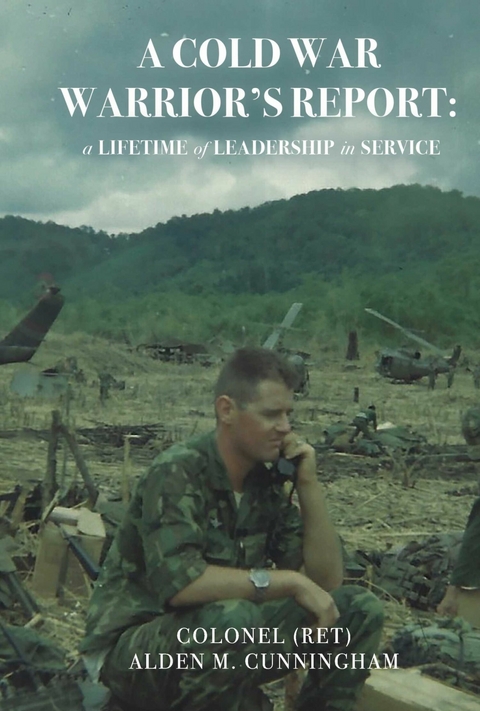
Cold War Warrior's Report (eBook)
198 Seiten
Bookbaby (Verlag)
978-1-6678-1816-0 (ISBN)
COL (RET) ALDEN M. CUNNINGHAM'S life and military career provide an example of professional and family life that was typical of the US Army officer corps during the Cold War period at least from 1963 to 1990, especially as regards the Foreign Area Officer Specialty program. His deployments and assignments ranged from Western Europe to West Point (Department of Foreign Languages), Washington, DC (Pentagon), and Carlisle, Pennsylvania (US Army War College), from Vietnam to Korea, and from Mexico to Nicaragua in effect covering most of the Cold War battlegrounds in situations from war, to no war no peace, to insurgency. During the last 15 years of his career, he provided senior leaders with valuable support through his extensive intelligence reporting, instruction, direct advice, articles, and speeches to the public and military leaders both in the United States and Latin America. This autobiography captures all phases of his life of Leadership in Service both as an Army senior Foreign Area officer defending our nation and its values of family, faith, and freedom, and as a former officer of Rotary International doing good in the world. To Alden Cunningham Congratulations on a job well done, [Panama Canal Treaties] - Jimmy CarterNow that the National Bipartisan Commission on Central America has completed its work, I should like on my own behalf and that of my colleagues to express our appreciation for your thoughtful response to our questionnaire. The contribution you and others made . . . were of invaluable assistance to the Commission's deliberations. - Henry A. Kissinger Colonel Cunningham is the finest Defense and Army Attache that I have observed in thirty years of foreign service. He has the surest grasp of hemispheric politico-military affairs of any officer, civilian or military, that I know. - Ambassador Harry Bergold [Nicaragua]As you complete your service with the Defense Intelligence Agency, I'd like to express my appreciation for the great work you've done [in Nicaragua]. Your contributions have been immeasurable to the success of the Joint Chiefs of Staff, and were made during a critical period in the Nation's history. - Admiral William J. Crowe, Jr., Chairman, Joint Chiefs of Staff
PART I
EARLY CHILDHOOD
I was born on March 6, 1941 most likely in the Los Angeles General Hospital. War was raging in Europe and before the year would end the United States would enter the war. At the time of my birth, my father and mother lived on Foothill Boulevard in Arcadia, CA in a relatively isolated area on the outskirts of Los Angeles, California. We had a beautiful Mediterranean style home draped in ivy with a circular driveway in front of the home that sat on a six-acre property. To give you a general idea of where we were from the back end of the property, you could see Santa Anita Racetrack in the distance. I lived in Arcadia from the year of my birth 1941 to 1946 the year we moved north to San Mateo, California in the San Francisco Bay area.
The Arcadia property had rose gardens, a tangerine orchard, and the home was a beautiful L shape with a large living room, a fairly large dining room with a view to the backyard of the home, a small kitchen, most likely a large master suite upstairs with at least two or three additional bedrooms and baths. I also had my own playhouse and sandbox. The playhouse was a real house with windows, possibly parquet flooring, and benches in which toys could be stored.
My mother named me Alden because in 1933 she was in a bad traffic accident and almost lost her leg. The surname of the doctor that saved her leg was Alden so when I was born eight years later my mother used that name for my first name. I became Alden Michael Cunningham.
Some interesting incidents that occurred during this period included the following:
- Knocking a can of spinach off the tray in front of my highchair in the kitchen. Apparently, I had not seen the power of Spinach demonstrated in the Popeye cartoons.
- Being stung by a bee that was crawling along the floorboard in my bedroom. After that I steered clear of bees whenever possible.
- Seeing a poor gardener fall from a ladder while trimming a tall tree.
- Losing my little diamond ring somewhere on the property
- Being taken by my mother to a very forbidding looking child care place and being placed in a crib in a very dark room. Fortunately, my mother picked me up later.
I had a happy childhood because I had wonderful parents who loved me, and we had beautiful places to live. I certainly was spoiled. They gave me the early childhood nickname of “Honey Bun” and with my long golden locks I think I did look like my nickname. Despite being spoiled, I think I probably had a good disposition.
We clearly were wealthy. My father was a successful and well-respected real estate developer who usually carried a roll of $100 bills (no credit cards in those days). He smoked cigars and liked to go to the tony places of that time like the Brown Derby. My mother looked like a Hollywood star and was associated with the actress Gene Harlow. The lady with the platinum blond hair.
We moved to San Mateo, CA in 1946, as my father, Cedric Delmour Cunningham, had purchased a seven-acre property in the middle of San Mateo at Fifth and El Camino right across from the Fitzgerald Park baseball stadium. Sadly, my dad passed away in 1947 stricken by brain cancer at the young age of 50 years. It would not be until many years later in my 40s that I realized what a tremendous loss this was for me and impacted my life direction profoundly as I most likely would have had a real estate related career and not a military one.
My sister, Kathleen Cunningham, was born on April 15, 1946. I now had a sibling. We definitely had no trouble fighting for space in the huge mansion (the Hayne estate) with six or seven bedrooms and at least five baths on the second floor. The home even had an elevator because old Mrs. Hayne had a hard time walking up stairs. There was another mansion at the rear of the property, but it had been vandalized and was in bad shape. The property also had a barn and the Portuguese gardener lived upstairs. A bit later my mother let the Boy Scouts use the barn and its various stalls for their meetings. I remember my father taking me back to see the Parrott mansion and talking to me, but I do not remember what he told me, perhaps what he planned to do with the property someday.
I attended Kindergarten at St. Matthews elementary school, but all I remember about that is I mostly took naps and colored within the lines (possibly an important life lesson or not). I was at St. Matthews for five years (kindergarten through the fourth grade – 1946 to 1951). I had some good sisters there who taught me a lot. One in particular, Sister Mary Brenda, taught social studies, and she must have made an impression because later in life, I was very strong in the humanities. When I got home from school my mother would greet me, after which I usually did my homework and then played. I used a bicycle to get to school since we lived on 5th avenue and the school was fairly close on ninth avenue. I disliked two things about St. Matthews: the fried bean smell from the cafeteria and piano recitals. I did meet a lifetime friend at St. Matthews, Ron Stefani, who introduced me to the love of my life some years later.
My mother was a great cook, and I loved her liver with mashed potatoes and cooked carrots with parsley sprinkled over them. Of course, steak, chicken, potatoes, green vegetables, salads and ice cream sodas, milkshakes, and banana splits and various pies and cakes were all my childhood favorites. I also was not allergic to shellfish in those early days, and I liked shrimp cocktails when we ate out.
I remember my seventh birthday party. We had all my classmates from St. Matthews to our home and were entertained by JoJo the clown. I got so many presents that I did not open many of them. Yes, I guess I was a bit spoiled. During the Christmas season we would dress a big tree and string it with popcorn and angel hair (very messy). One of those Christmases Santa gave me a Springfield 1903 dummy rifle. This might have been a harbinger regarding my future military career.
During these early childhood years from 1946 to 1951, I loved listening to radio shows like the Green Hornet, the Lone Ranger, the Shadow, and Howdy Doody, one of the earliest TV shows for children. I think the Wizard of Oz was the first movie I ever saw.
Another movie I saw on a typical Saturday afternoon matinee, which included 17 cartoons, a Flash Gordon serial episode, a western movie, or in this case the movie “Lassie Come Home”. I was so impacted by the little blind boy in the movie that I ran crying all the way home from the Manor Theatre on 25th Avenue just west of the El Camino Real (now Highway 82), which was 20 blocks. I guess I was a sensitive little boy in those days.
Another traumatic event occurred in the 1948-1949 timeframe. I was crossing Alameda de las Pulgas near Aragon High School in San Mateo. There was a ditch on the west side of the street, and I decided I would try to jump over it, but I did not make it and my foot dislodged a rock, which hit me in the head to the right of my left temple near the hairline as I was sliding down into the ditch. The rock made such an impression on my skull that it is visible on scans to this day.
As regards diseases, our biggest concern was polio, which was ravaging our country and the world at that time. Thankfully, vaccines came along in the 1950s and saved many including me from this dread disease, which is why much later I became so heavily invested in Rotary International’s effort to eradicate Polio. I had my tonsils out in 1946 and right after that while still in the hospital recovering from the tonsillectomy I came down with the mumps – not fun as I was put in isolation in the hospital.
As regards favorite relatives, I remember my great aunt Ada who lived in Richmond, CA. I would often go there on weekends. Her husband Tony Serres managed my father’s apartment buildings in Richmond and Oakland (he had roughly 18 four-unit buildings in that area). Ada had a World War II Victory Garden the produce from which she would use to make the best, freshest salads ever and on top of that she made delicious cupcakes with all kinds of different colored toppings – yummy! Her sister, Vera, was a World War I-Red Cross nurse and very smart. She helped my father with his real estate business.
We moved to Mexico City in the summer of 1951 to live with my Aunt Nita where I attended fifth grade at the American School. The courses were taught in English and Spanish. Some notable things that happened that year was I heard my first swear word (the “F” word) and was threatened with a pin to get me to run relay races faster during track events. After six months, I could speak Spanish fairly well and did not lose my fluency upon our return to the states in 1952. This year proved to be a pivotal one for me in that it directed me toward Latin America in my professional life.
The historic events happening in this era were the start of the Cold War in 1945, the Korean War (1950 to 1953), and the Truman presidency which oversaw the modernization of the U.S. defense agencies and the approval of the National Security Act of 1947.
Upon return to the United States my mother enrolled me in the San Rafael Military Academy (SRMA) in San Rafael, CA north of San Francisco in Marin County. This decision started me on the military path which I would follow for...
| Erscheint lt. Verlag | 27.4.2022 |
|---|---|
| Sprache | englisch |
| Themenwelt | Literatur ► Biografien / Erfahrungsberichte |
| ISBN-10 | 1-6678-1816-3 / 1667818163 |
| ISBN-13 | 978-1-6678-1816-0 / 9781667818160 |
| Informationen gemäß Produktsicherheitsverordnung (GPSR) | |
| Haben Sie eine Frage zum Produkt? |
 EPUB (Adobe DRM)
Größe: 18,3 MB
Kopierschutz: Adobe-DRM
Adobe-DRM ist ein Kopierschutz, der das eBook vor Mißbrauch schützen soll. Dabei wird das eBook bereits beim Download auf Ihre persönliche Adobe-ID autorisiert. Lesen können Sie das eBook dann nur auf den Geräten, welche ebenfalls auf Ihre Adobe-ID registriert sind.
Details zum Adobe-DRM
Dateiformat: EPUB (Electronic Publication)
EPUB ist ein offener Standard für eBooks und eignet sich besonders zur Darstellung von Belletristik und Sachbüchern. Der Fließtext wird dynamisch an die Display- und Schriftgröße angepasst. Auch für mobile Lesegeräte ist EPUB daher gut geeignet.
Systemvoraussetzungen:
PC/Mac: Mit einem PC oder Mac können Sie dieses eBook lesen. Sie benötigen eine
eReader: Dieses eBook kann mit (fast) allen eBook-Readern gelesen werden. Mit dem amazon-Kindle ist es aber nicht kompatibel.
Smartphone/Tablet: Egal ob Apple oder Android, dieses eBook können Sie lesen. Sie benötigen eine
Geräteliste und zusätzliche Hinweise
Buying eBooks from abroad
For tax law reasons we can sell eBooks just within Germany and Switzerland. Regrettably we cannot fulfill eBook-orders from other countries.
aus dem Bereich