Rescued at Birth (eBook)
252 Seiten
Bookbaby (Verlag)
978-1-6678-3808-3 (ISBN)
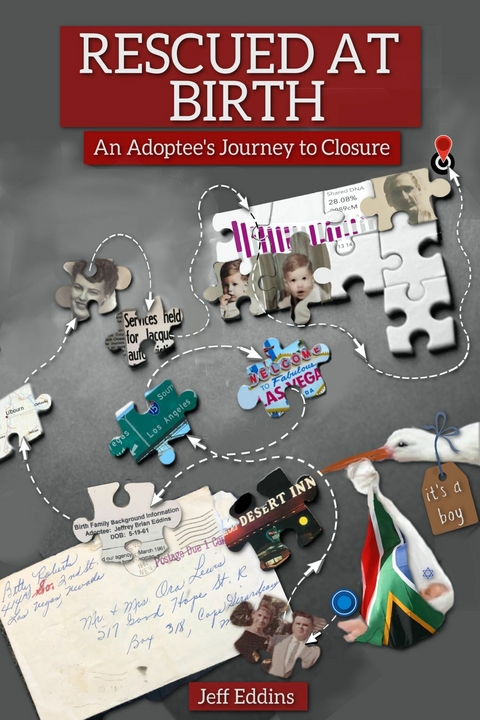
"e;Rescued at Birth"e; is a breathtaking story about identity, belonging, and family. Have you ever wondered what it would be like to grow up never physically identifying with anyone, or seeing pictures of immediate family members who bare any resemblance to you? For Jeff Eddins, he spent most of his life feeling like he came from nowhere - but he knew he had to come from somewhere. For most adoptees like Jeff, there are critical elements missing in their lives. And no matter how well they were loved and cared for by their adoptive parents, it's not enough to carry on through life without identifying who created them or the circumstances that led to their adoption. All human beings have an innate desire to identify with someone of similar genetic traits. This book describes his insatiable desire to determine his genetic origins while attempting to find as much closure as possible. It is a thoughtful representation of the complexities of adopted life, and a place for non-adoptees to understand what being adopted feels like. This is a unique memoir that seeks to find answers to seemingly impossible questions. It takes readers on a compelling journey through ups and downs as Jeff embarks on a life-changing and life-defining quest to finally reveal the unanswered questions and secrets that have been hidden for most of his life.
[1]
Dropping the “A” Bomb
Have you ever tried to recollect the earliest years of your life? If so, how far were you able to go back? I think it’s difficult for most of us to recall any of the details of our lives before, say, the age of five. And if you believe you remember anything from your earliest years, how can you be sure you’re not confusing what you remember with photos you’ve seen that captured specific moments of your childhood? If your parents have also given you details about your early life that coincide with any of those pictures, they’re probably not actual early memories, but imagined recollections of life events that were constructed based on what you learned about them.
That said, I’m going to tell you about an early life event that I can picture so vividly that there is no question that it happened. It’s not just that my mother has corroborated the event; I can picture it down to the exact shirt I was wearing at the moment it happened. I’m sixty years old now and can barely remember what I’ve eaten for lunch, but this memory has stayed with me since sometime before the age of six.
I was sitting on the edge of my bed, wearing a long sleeved red turtleneck, getting ready for school. My mother was bent down on her knees as she helped me tie my shoes. I can’t remember how we got on the topic, but I clearly remember her standing up, then sitting next to me on my bed and telling me that I was adopted.
Adopted? What did that mean?
My mother began describing the adoption process. She wasn’t being truthful with me, but what she said to me came straight from her loving heart. She explained that she and my father were unable to have kids of their own. I find it strange now that she would tell me that at an age when I knew nothing about the birds and the bees. She then went on to explain that she and my father wanted to have children so much that they went to an adoption agency to find me.
Here’s the part that’s a bit sketchy, but I now understand my mother’s motives for offering me a misleading explanation of the process. She told me that after they arrived at the agency, they searched through all the available children that were there. I think she had me believing it was like a smorgasbord or buffet of some sort and they simply went down all the rows of children that were laying in bassinets until they found me. “We’ll take that one!” She clearly told me that they handpicked me from all the available children, and I was the only one they wanted.
The most important part of our discussion for my mother was that she wanted me to know that I was special. I wasn’t some throw-away kid or someone who wasn’t greatly desired by both of my parents. Irrespective of how I landed in their arms, they were going to love me as if I was their biological son. And that had a huge impact on me. My mother’s words have stayed with me through the entirety of my life and may have been what deterred me from searching for my birthparents until much later. I never questioned the love my parents had for me.
In fact, I even remember that when I was a few years older, I told all my friends that I was more special to my parents than they were to their parents. I almost felt sorry for them because their parents just got what they got through the natural random chance of reproduction. I was different. My parents chose me. It’s funny to me how I took that information and ran to an illogical conclusion. Perhaps I just wanted to reassure myself about just how much I was loved and wanted.
It wasn’t until I was in my early teens that I questioned what my mother told me that day regarding how they “handpicked” me. I eventually learned that my parents had nothing to do with choosing me. They simply applied for a Caucasian male baby and the adoption agency assigned me to them. I learned later that the first time my parents set eyes on me was the day they took me home. But that didn’t bother me in the least. I knew however random the path into their loving arms was irrelevant. I knew the depth of love they had for me and that’s all that ever mattered.
It wouldn’t be until decades later that I would come to realize that I had hit the “family lottery” compared to what my family life would have been like if my birth mother chose to keep me.
Adolescence
I was born in Los Angeles, California, on May 19, 1961, and raised in West Covina, California, a middle-class suburb located about twenty-five miles east of downtown LA. We lived in an eleven hundred square foot two-bedroom house. My father worked hard as a tool and die maker, and my mother stayed home and cared for me.
At nearly the age of six, not long after my mother explained the adoption process to me, my parents told me that soon I would have a baby sister. I probably assumed they were going back to the “adoption store” to pick her out. I recall people from the adoption agency coming to our house multiple times to interview my parents and observe our home environment and how well my parents were taking care of me. On one occasion, while the social workers were meeting with my parents at our house, I slammed my bike into the rear corner of a parked car on our street. Over the handlebars I went. I hit the asphalt headfirst and had a huge egg-shaped lump on my forehead. I’m sure that didn’t look good for my parents, but that didn’t railroad their efforts or prevent them from bringing my sister Sharon home a few months later.
I don’t remember the day they brought Sharon home from the agency. What I do remember was that she was given my bedroom and I was moved to the den and slept on a bright red roll-away couch. At the time, I thought it was more fun to sleep on a special bed like that. And because I thought I was so special, a special bed was appropriate.
I remember thinking my baby sister was cute, but we weren’t that close growing up, mostly because of our five-year age difference. It certainly wasn’t because I didn’t love her—Sharon has always had the biggest heart for animals and people, and I always felt a warm feeling toward her. But I was busy playing with the other boys my age in our neighborhood, and G.I. Joes just didn’t play well with Barbies.
My father was raised in Mississippi and my mother in Minnesota. They were introduced to each other by my mother’s sister and married in Las Vegas in 1951. Although I grew up in LA, you’ll discover many people involved in my story spent time in Las Vegas, but they didn’t always stay in Las Vegas.
My dad served in the Korean War and as much as I tried to get him to divulge stories about his war experiences, he rarely would go there. I’ve continued to wonder what horrors he was exposed to during his time serving. I do remember it was a requirement to always finish my dinner—even as I gagged on the disgusting vegetables my parents put on my plate. He explained to me that on many occasions in Korea, he had seen dead Korean children who’d drowned in the fifty-gallon drums outside of their mess tents while trying to get to the discarded sloppy food muck inside those containers. He wasn’t the type to open up about too many things, but I remember him telling me on numerous occasions that I should always come to him first with any of my life problems. He told me he would always be there to help me, no matter the issue. That was important to me, solidifying just how much my dad loved me. Having a safe foundation for help if or when I would get into any trouble provided me a sense of security. Knowing how important that comfort was to me motivated me to extend that same offer to my own children many years later.
I wouldn’t fully realize until my late teens that my father was an alcoholic. Each night after work he sat at our kitchen table and drank two six-packs of beer while smoking filter less cigarettes before retiring for the night. My dad was not a “fall down” kind of drunk, and he was never verbally or physically abusive toward anyone in our family. Perhaps he was traumatized by his war experiences. Or maybe he was just a hard-working, blue-collar guy who found escaping from reality as a way of survival.
My dad smoked so heavily that there were times he would have intense coughing spells where it sounded like he was dying. More than once, during a coughing spell he passed out and fell to the ground. One afternoon when I was about ten years old, he passed out on our kitchen floor, and it looked like he wasn’t breathing. My mom was on the floor holding him, screaming his name, trying to wake him, and that’s the last thing I heard. I ran out our front door as fast as I could run. I finally stopped two miles away, sitting in the hallway of a local junior high, wondering what I would have to face when I came home. I stayed there for over two hours, until it got dark, before returning home. When I got back, my dad was seated at his chair at our kitchen table as if nothing happened. That one incident stands out, but there were others that were just as traumatizing. Even at night, when my dad was sleeping, he would wake up and cough like that. I always closed the one door in my bedroom / den that was the closest to my parents’ bedroom. If I heard him coughing, I would also wrap my pillow around both ears and hum to drown out the sound. I honestly lived in fear of my dad dying as far back as I can remember.
My mother was a “reformed” Christian who was raised in a Midwestern Lutheran church. In her later years, she told me that she had struggled with the “fire and brimstone” style of churches she...
| Erscheint lt. Verlag | 19.4.2022 |
|---|---|
| Sprache | englisch |
| Themenwelt | Literatur ► Biografien / Erfahrungsberichte |
| ISBN-10 | 1-6678-3808-3 / 1667838083 |
| ISBN-13 | 978-1-6678-3808-3 / 9781667838083 |
| Informationen gemäß Produktsicherheitsverordnung (GPSR) | |
| Haben Sie eine Frage zum Produkt? |
 EPUB (Adobe DRM)
Größe: 5,1 MB
Kopierschutz: Adobe-DRM
Adobe-DRM ist ein Kopierschutz, der das eBook vor Mißbrauch schützen soll. Dabei wird das eBook bereits beim Download auf Ihre persönliche Adobe-ID autorisiert. Lesen können Sie das eBook dann nur auf den Geräten, welche ebenfalls auf Ihre Adobe-ID registriert sind.
Details zum Adobe-DRM
Dateiformat: EPUB (Electronic Publication)
EPUB ist ein offener Standard für eBooks und eignet sich besonders zur Darstellung von Belletristik und Sachbüchern. Der Fließtext wird dynamisch an die Display- und Schriftgröße angepasst. Auch für mobile Lesegeräte ist EPUB daher gut geeignet.
Systemvoraussetzungen:
PC/Mac: Mit einem PC oder Mac können Sie dieses eBook lesen. Sie benötigen eine
eReader: Dieses eBook kann mit (fast) allen eBook-Readern gelesen werden. Mit dem amazon-Kindle ist es aber nicht kompatibel.
Smartphone/Tablet: Egal ob Apple oder Android, dieses eBook können Sie lesen. Sie benötigen eine
Geräteliste und zusätzliche Hinweise
Buying eBooks from abroad
For tax law reasons we can sell eBooks just within Germany and Switzerland. Regrettably we cannot fulfill eBook-orders from other countries.
aus dem Bereich