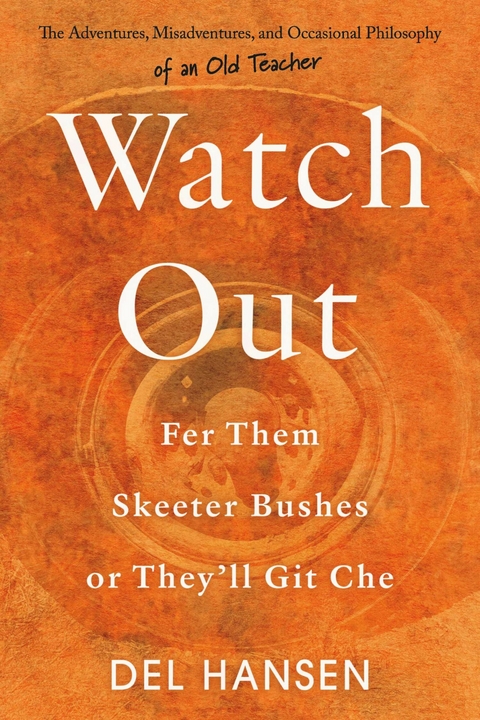
Watch Out For Them Skeeter Bushes Or They'll Git Che (eBook)
180 Seiten
Bookbaby (Verlag)
978-1-6678-3229-6 (ISBN)
Del Hansen is a veteran of public education with thirty-seven years of experience. Along with serving as a teacher association president, he was selected as Teacher of the Year in a district of 24,000 students and first runner-up for New Mexico Teacher of the Year. He also received the State Administrator of the Year award from the New Mexico Music Educators Association. Hansen volunteers as an evaluator for the Golden Apple Foundation helping to select the top teachers in the state and received his own Golden Apple as a member of the Golden Apple Academy. After retirement, he continues to present lectures on classical and popular music to senior citizens in his community. An avid gardener, Del resides in Las Cruces, New Mexico with his wonderful wife, Donna, who was also a teacher and counselor for forty-five years. He is a charter member of the 'Grand Old Society Specializing in Pontification' (GOSSIP) achieving the platinum level of 'Why Don't You Do Yourself a Favor and Just Shut Up!' To scratch his music itch, he travels to band concerts, marching festivals, and drum corps competitions locally, regionally, and nationally. Finally, with a little luck and a healthy dose of divine intervention, he wonders if he might someday accept the title of 'writer.' Miracles do happen.
Teaching and swimming pools have a lot in common. Sometimes you ease into the cold water and tinkle a toe before getting your head wet. Other times, a burly friend picks you up and hurls you into the deep end to sink or swim. The author of "e;Watch Out Fer Them Skeeter Bushes Or They Will Git Che"e; began his teaching career the second way, and takes the reader through an amazing array of adventures in his classrooms and offices. Almost four million minutes of interactions with young people and staff during his long career yields plenty of humorous, poignant, soul-searching, and ridiculous moments. This book is an escapist, entertaining set of stories appealing to both teachers and non-educators. Every recollection is based on a true set of events, as head-scratching as some may appear. What is a skeeter bush anyway? That question is eventually answered, but not until the author completes his journey from flailing in the deep end of public education to safely climbing out of the pool.
Part Three
A Pioneer Spirit
I so clearly remember the wind. It blew incessantly. As I played with my toys or read from the basket of books on the floor by the daybed, I could hear the telephone wires singing and screen door banging against its frame all day long. A patient soul could try to get used to it, but the dry wind was always with you in Pinon.
Though the spelling of the New Mexico state tree and pine nut is piñon, the folks of this small town spelled it “Pinon” and some pronounced it “pin-ee-own.” Others did pronounce it “piñon” like one would in northern New Mexico. However, I had never heard it called anything but “pin-ee-own” so that is what I called it too.
My childhood memories of summers spent with my maternal grandmother have stuck with me over the years. At the time, she was a teacher in a one-room schoolhouse in a forgotten corner of a forgotten part of the forty-eight. Her little house, provided by the local district through the labor of local ranchers, sat just to the east of the school building. It was bare bones. Her air conditioning system was an electric fan and a cross breeze while the amenities consisted of running water and a butane heater.
She was too isolated to even receive a decent television signal from one of the three networks, so a bulky AM radio perched on the end table and books checked out from the Artesia Public Library provided our entertainment. Most importantly, my visits gave me the chance to fantasize about going to work in that old schoolhouse next to my grandmother’s teacherage.
Teaching is in my DNA. I am convinced of that. A great uncle on my father’s side of the family taught Lyndon Baines Johnson in central Texas and my first cousin once removed was a teacher of physics and department head in one of the top school systems in the country. Even my mother taught in a Montessori-driven kindergarten. However, possibly the finest teacher of all was my maternal grandmother. I must admit that I am biased, but anyone who knew her admired her pioneer spirit and indomitable attitude.
My grandmother’s career began and ended in small rural schools having none of the advantages of larger and wealthier districts. It didn’t matter to her. Without fanfare, she educated legions of students in the most challenging conditions imaginable. She never taught in a new building. She never enjoyed new equipment. She was her own janitor and maintenance department and for a while, she could not even call on a colleague or an administrator for guidance or advice. My grandmother was it and her students were none the worse for their experience.
As a fresh-faced twenty-year-old holding a newly issued certificate from a teacher college, she began teaching in a tiny building on the caprock in east-central New Mexico. Her little schools rested in obscure places hardly big enough to land on a map, such as Pinon, Bonita, Weed, Wheatland, and Avis. Some of those communities don’t even exist today, shriveled up and returned to the earth like old felled trees. Her career stretched for forty-five hard years, much of it deep in sheep and cattle country astraddle the eastern foothills of the Sacramento Mountains. That’s where I spent some of my summers.
We often talked about her work as a teacher while I played and she sewed clothes on her Singer treadle machine. I’m not sure she even considered it a job. I think it was more of an extension of herself.
Her duties required her to be teacher, janitor, principal, and cook, as well as acting in loco parentis to children ranging in ages from six to twelve. Her students’ home-away-from-home for seven hours a day and five days a week was an aging white plaster building about thirty-by-forty feet with creaking wood plank floors and a corrugated tin roof. Had it been marketed by a French perfume company, the classroom scent would most likely have been “Eau de Musty.”
Every so often in those halcyon days of summer, we walked the fifty yards from her tiny house past prickly lavender thistles sprouting from the scant runoff and entered the old school building. It was hallowed ground. I played and read books while she worked. Though I do not claim an eidetic memory, for some reason that place stuck with me like an old friend.
A small elevated stage flanked on both sides by the flags of the United States and the state of New Mexico dominated one end of the room while a single solid wood door mounted on creaky hinges welcomed our entry. Placed away from the endless southwesterly winds of spring and the bitterly cold northerlies of winter was a single block of casement windows set high above the floor. They provided some natural light and accented the wall in contrast to the others which were windowless, yet not without color and personality.
Student work and art from local amateurs decorated the drab plastered surfaces. I remember a crazy quilt sewn by a talented sheep ranch seamstress lazily draped over a pine dowel. A varnished lasso hung like a Dustin Payne sculpture inches above a multi-petaled silvery flower crafted by a crusty old cowboy who used tin snips to coax art from sheet metal. Finger paint masterpieces by her younger students, framed by colored construction paper and hung in a place of honor, were the centerpieces of the makeshift gallery. Those walls were not uninteresting by a long stretch.
She told me that in the early forties before the rural electrification administration delivered power to the community, frosty mornings brought her to school at dawn to light the coal oil lamps and build a fire in the heavy black wood stove. A pot of beans or stew placed on top might be ready to eat by noon, although there were no convenient knobs and dials to regulate the heat. It was either cold, hot, or very hot.
Most of the time students brought their own bagged lunches, but on special days a parent might serve sandwiches of peanut butter and elderberry jelly or of beef, chicken, and possibly venison on homemade bread, each garnished with canned vegetables and pound cake for dessert. There was no cafeteria service--that was for the rich folk.
Her kids behaved. They respected her authority and knew they would be taken to the woodshed at home if word got out that they had been naughty. I do believe it was akin to modern nuclear deterrence.
My grandmother liked to sing and there were days when the old room vibrated with songs sung acapella by ranch kids under the direction of their teacher. On quiet Saturdays you could almost hear their fading voices whisper in the rafters. Maybe what you heard was only the wind, but I am quite sure the act of education was distilled to its essence in the old school. There was something to be said for that.
The little community had two churches and a post office but no law enforcement. The clapboard-sided general store, which sold just about everything, occupied the south side of the dusty road scratched out of hardpan caliche. Walking up to the door, you couldn’t help but notice the Mobil Oil gas pump sporting a red Pegasus standing as a sentinel in front while a cold pop machine tempted you just inside.
It was the only grocery mart for miles and well beyond walking distance from the teacherage, so we drove there twice a week in my Mamaw’s brown Plymouth coupe. She shopped for essentials while I sat on a stool and mouthed a Milk Nickel ice cream bar as I listened to old codgers argue politics and discuss the price of sheep.
People necessarily grew up to be self-sufficient and independent in that little town. The rather spartan living conditions didn’t strike anyone as having been dealt a bad hand in the card game of life. You just coped and moved on. There was also something to be said for that.
The first time I visited the old school, I asked where the bathroom was. There wasn’t one. When nature called, as it was bound to do, students were obliged to trudge through snow or dodge tumbleweeds to the boys’ and girls’ two-seater outhouses. Her kids washed up using a flowered ceramic bowl filled from a pitcher of cold water. Homemade lye soap doctored with peppermint usually washed dirty hands just fine, that is unless someone donated a few bars of Ivory pilfered from a travel court somewhere. Indoor plumbing and the addition of a septic tank highlighted the upgrades to facilities a few years later.
When I played school in that old building, my eyes were always drawn to the ancient desks. I loved sitting in them. They didn’t look at all like the ones at my school. Each was a splendid concoction of tarnished steel and metal scrollwork crowned with a desktop of tawny wood worn smooth by years of children’s fingertips and elbows rubbing against the grain. Those old desks creaked and groaned when her students opened them to store books and perhaps a horned toad or two.
I remember asking her about the strange looking chairs. It seemed each desk had its own distinctive companion, not distinctive because the schoolmarm had carefully shopped for them but because, over the years, some had broken and were replaced with donated items, each a family heirloom concealing a story.
A venerable rancher from ten miles out of town once said, “This one here, it belonged to old lady J and it was the only one left after she had to chop up the other chairs to burn in the wood stove in the winter of ’44 when she got snowed in, but y’all can have it.” Those kinds of stories. The mismatched pairs imbued the room with a serendipity of mirth and belonging.
Under the lone bank of windows stood a long bookcase constructed from wood planks milled at a little lumberyard not far away. Its shelves brimmed...
| Erscheint lt. Verlag | 15.6.2022 |
|---|---|
| Sprache | englisch |
| Themenwelt | Literatur ► Biografien / Erfahrungsberichte |
| ISBN-10 | 1-6678-3229-8 / 1667832298 |
| ISBN-13 | 978-1-6678-3229-6 / 9781667832296 |
| Informationen gemäß Produktsicherheitsverordnung (GPSR) | |
| Haben Sie eine Frage zum Produkt? |
 EPUB (Ohne DRM)
Größe: 1,4 MB
Digital Rights Management: ohne DRM
Dieses eBook enthält kein DRM oder Kopierschutz. Eine Weitergabe an Dritte ist jedoch rechtlich nicht zulässig, weil Sie beim Kauf nur die Rechte an der persönlichen Nutzung erwerben.
Dateiformat: EPUB (Electronic Publication)
EPUB ist ein offener Standard für eBooks und eignet sich besonders zur Darstellung von Belletristik und Sachbüchern. Der Fließtext wird dynamisch an die Display- und Schriftgröße angepasst. Auch für mobile Lesegeräte ist EPUB daher gut geeignet.
Systemvoraussetzungen:
PC/Mac: Mit einem PC oder Mac können Sie dieses eBook lesen. Sie benötigen dafür die kostenlose Software Adobe Digital Editions.
eReader: Dieses eBook kann mit (fast) allen eBook-Readern gelesen werden. Mit dem amazon-Kindle ist es aber nicht kompatibel.
Smartphone/Tablet: Egal ob Apple oder Android, dieses eBook können Sie lesen. Sie benötigen dafür eine kostenlose App.
Geräteliste und zusätzliche Hinweise
Buying eBooks from abroad
For tax law reasons we can sell eBooks just within Germany and Switzerland. Regrettably we cannot fulfill eBook-orders from other countries.
aus dem Bereich