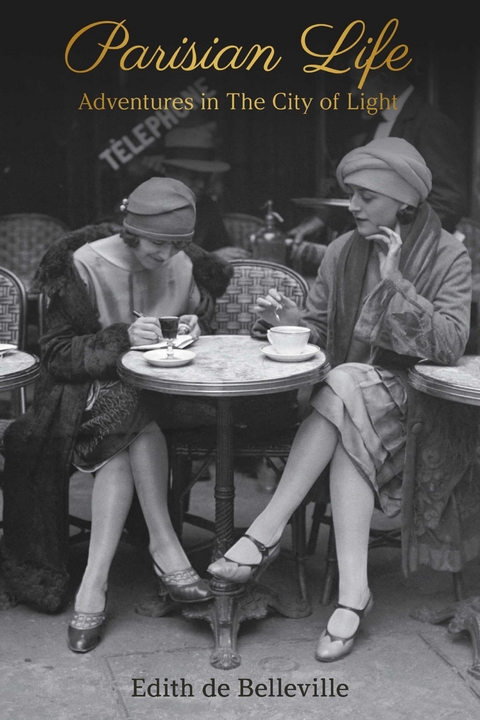
Parisian Life (eBook)
182 Seiten
Bookbaby (Verlag)
978-1-6678-3199-2 (ISBN)
When your best girl friend is Coco Chanel, your life can't be too dull. When your enemy is Napoleon, your life can't be too ordinary either. And when you are flirting with Hemingway at the Ritz bar in Paris, even your love life is glamorous. This is the fabulous and real life in the City of Light of Edith de Belleville, a native Parisian who is in love with the past, art and extravagance. Edith's frank and charming style brings Paris vividly to life-its charm, its idiosyncrasies, its cafes and its glorious ghosts from the past. This collection of short stories is for anyone who loves Paris-the history, the romance, the culture-and who dreams of Parisian life. About the author:Edith de Belleville is a licensed tour guide in Paris, an attorney-at-law and an author. She published a book in French about inspirational Parisian women from the past, "e;Belles et Rebelles, l'ombre des grandes Parisiennes"e; ( Editions du 81). When she is not at Versailles or the Orsay Museum, Edith is sitting on a caf terrace in Paris, enjoying a caf crme and watching the world go by.
Chapter 1:
Lost with Napoléon
Click-clack, click-clack, click-clack.
I’m walking on the pavement of the beautiful courtyard of the Hôtel des Invalides, a building from the seventeenth century. I don’t know if you have ever walked on cobblestones in high heels, but believe me, it’s not easy at all.
If it were a different day, I would be explaining to you that this magnificent place was built by Louis the XIV, our glorious Sun King. You can’t miss Les Invalides; it’s the golden dome that you see on postcards of Paris. The Sun King wanted a shelter for his soldiers who were injured during the 32 years of wars against almost all of Europe. The injured soldiers were invalids; that’s where the name “Invalides” comes from. The architects, Liberal Bruand and Hardouin-Mansart, found inspiration in the Spanish royal palace, El Escorial, in Madrid. Now Les Invalides is a military hospital and museum.
Where does my knowledge about Paris come from? I’m a native Parisian and a licensed tour guide. But right now, I’m not in the mood to be your tour guide. It’s midnight; I’m all alone, and I just want to get out of here. There’s no light, I’m cold, tired, and lost. Absolutely lost.
I know what you’re thinking: how can a Parisian, who’s supposed to do guided tours of Les Invalides, get lost? It’s my weakness. I have no sense of direction. For a tour guide, I know it’s not exactly convenient. A Swedish friend of mine told me it’s not my fault because women have no sense of direction (I know, un peu sexiste), so he gave me a compass. It’s a perfectly good gold compass, but it’s useless since I have no idea how to use it. I’ve done many guided tours of Les Invalides, of course, but during the day. But now it’s very dark and I can’t see a thing.
Where is the exit? I go to the right side of the courtyard, next to the big arcades. There are magnificent, old canons but no gate. I go to the left side—click-clack, click-clack—the place is vast. No exit.
I look up, and that’s when I see him.
The full moon highlights his slim silhouette. He looks young, not very tall, but he has charisma in his military uniform. Behind him, I see the golden dome of the Invalides, which shines.
He is watching me, this man. I recognize him; you can’t miss him with his signature bicorn hat. It’s Napoléon Bonaparte.
“Hey, you!” I scream in the direction of the statue of Napoleon. “Yes, you! The little Corsican! Tell me where the exit is!”
No answer.
“You don’t know?” I shout. “Or you don’t want to tell me?” I’m not surprised. I never liked Napoleon, anyway. First of all, he was a misogynist and a bad lover. Five minutes, tops. He had more lovers than battles. And he was terrible to sweet, devoted Joséphine. “Plus, you sent thousands of young soldiers to die for your enormous ego!”
I sigh. I should have not drunk so much Champagne. Now, I feel dizzy, and I have a headache. This chilling cold, these canons all around, and this statue of Bonaparte remind me of a poem by Victor Hugo. It’s about the disastrous Russian Campaign of Napoléon in the winter of 1812. To cheer myself, I think of these beautiful verses. Well, to be honest, I try to remember the verses of Hugo, which is about as easy as walking on cobblestones in high-heels.
Ah yes…I remember now. More or less.
It snowed.
Someone was defeated by his conquest.
For the first time, the eagle lowered its head.
Heavy days!
Men discarded cannons
Who lay down, died
Ten of thousands went to sleep, a hundred awoke, it snowed
it snowed always, the cold wind…
The wind is very cold here, too. I’m freezing half to death; I’m wearing only a white silk blouse with a pencil skirt, and an elegant (but not very warm) black jacket. I’m starting to panic. I’m going to die of cold exactly like the thousands of Napoleon’s poor soldiers in Russia.
How did I get an invitation at midnight to this prestigious courtyard? Me, who is not even a VIP? Mrs. Nobody? Well, it’s a long story.
•••
It all started at a party.
I was invited to this party by Randy, a friendly Francophile doctor from Los Angeles who comes to Paris twice a year. It was a potluck, so I brought the only thing I know how to make chocolate mousse. I’m always successful with my chocolate mousse. The secret is not to add sugar (yes, none at all) and to use the very best dark chocolate.
While the guests were eating the desserts, a woman came over to compliment me on my mousse. Her tight green jeans, her black linen jacket and her stilettos were highlighting her tall silhouette. Her big, dark eyes underlined with kohl pencil were perfectly fitting with her curly, short black hair. She had allure! She was probably my age, meaning in her fifties.
Her name was Marie-Jeanne. She explained how she became a chocolate addict. It was hard to believe, because this woman was extremely slim. She was warm and charming, and for a moment, I thought she might be American since she spoke fluent English with what seemed like an American accent.
Not at all. Turns out, she was Corsican, and she told me that she was teaching American History at the prestigious Political Sciences Institute, or Sciences Po, as they call it here in Paris.
During this time, I was trying to write a book about the great Parisian women of history and what today’s women can learn from them. But I was doubting myself a lot because I doubt a lot in general. Was it a good idea? Was it really a new concept? Does the world need yet another book about Parisian women?
I was sharing all my doubts with the friendly Marie-Jeanne when she said to me:
“Oh! I know who you should meet! My good friend Jean who is a historian! He’s an expert on the seventeenth century. He’ll tell you if your book idea is good or not.”
Of course, I knew him. This “Jean” is professor at the prestigious Sorbonne, and even appears on TV programs.
“But do you really think he’ll have time to see me and to give me his advice?” I ask Marie-Jeanne, wondering why this famous, busy French historian would care about me and my unwritten “masterpiece.”
“His family comes from the same little village in Corsica as mine,” she says, “So if I ask him, yes, he will meet you. He won’t have a choice!”
She compliments me again on my “killer” chocolate mousse, as she takes another bite of her third helping. I tell her how grateful I am to have met her. Really grateful.
•••
Cling!
A text message: “Good morning, I’m Jean Pasqualini, historian, the friend of Marie-Jeanne. She told me you wanted to meet me. Where and when?”
Talk about a direct message. I can tell this man has no time to lose. To be honest, I was sure that Marie-Jeanne would never contact him, and even if she did, I was sure he would never contact me (I’m a bit of a pessimist). But obviously Marie-Jeanne liked me and my chocolate mousse was enough to convince this professor to write to me one month later.
Where and when? Okay, let me think, Mister Famous Historian. When? Tomorrow. And where? Yes, of course, I know where!
I reply: “Tomorrow at 10:30 a.m. at Le Bonaparte Café.”
Cling! His answer: “Alright. See you tomorrow.” With a smiley face emoji.
At least he has a sense of humor; he understood my joke. What better for a Corsican historian than to meet in a café called Le Bonaparte on Rue Bonaparte?
Fortunately, Le Bonaparte Café is next to the Saint-Germain-des-Prés Metro station. I could have chosen the mythical Café de Flore—cradle of writers, intellectuals, and poets from the nineteenth century. But for my important meeting, I preferred a simpler café, nothing ostentatious. Paris cafés are like the Parisian inhabitants. Each one has its own style, its own personality.
I love Paris cafés. I spend half my life in the cafés of Paris. Since I was 15 years old, I have been going to a café every day.
Parisian cafes are where I celebrate good times, and where I insulate myself from bad news. It’s where I’ve had love at first sight, but also where I’ve had break-ups and cried. Cafes are, for me, the place to be when I want to be alone but not feel alone.
Paris would not be Paris without its cafés. The soul of Paris is in its cafés. Cafés were the laboratory of ideas where writers, artists, and intellectuals invented movements that all end in -ism: Impressionism, Romanticism, Surrealism, Cubism and Existentialism. A Paris café is also where a wanderer ends his or her aimless stroll. It’s where you meet your friend for a coffee and chat. It’s where you have your business meeting or your rendezvous with your lover. It’s also where you do nothing but people-watch.
Le Bonaparte Café is less prestigious than Café de Flore, of course, but has lots of charm. It’s a small café, doesn’t get too crowded, and the old engravings of Paris on its walls give you a homey feeling. While you sip your coffee, you can chat with the friendly waiters, and enjoy the best view of the Church of Saint-Germain-des-Prés.
I can see the colorful chairs of the terrace, which are empty and waiting for me, and the canopy with its blue and burgundy stripes. But to access the elegant terrace, I need to first cross a tiny square, Place Jean-Paul Sartre and Simone de Beauvoir, which is full...
| Erscheint lt. Verlag | 26.4.2022 |
|---|---|
| Sprache | englisch |
| Themenwelt | Literatur ► Biografien / Erfahrungsberichte |
| ISBN-10 | 1-6678-3199-2 / 1667831992 |
| ISBN-13 | 978-1-6678-3199-2 / 9781667831992 |
| Informationen gemäß Produktsicherheitsverordnung (GPSR) | |
| Haben Sie eine Frage zum Produkt? |
 EPUB (Ohne DRM)
Größe: 703 KB
Digital Rights Management: ohne DRM
Dieses eBook enthält kein DRM oder Kopierschutz. Eine Weitergabe an Dritte ist jedoch rechtlich nicht zulässig, weil Sie beim Kauf nur die Rechte an der persönlichen Nutzung erwerben.
Dateiformat: EPUB (Electronic Publication)
EPUB ist ein offener Standard für eBooks und eignet sich besonders zur Darstellung von Belletristik und Sachbüchern. Der Fließtext wird dynamisch an die Display- und Schriftgröße angepasst. Auch für mobile Lesegeräte ist EPUB daher gut geeignet.
Systemvoraussetzungen:
PC/Mac: Mit einem PC oder Mac können Sie dieses eBook lesen. Sie benötigen dafür die kostenlose Software Adobe Digital Editions.
eReader: Dieses eBook kann mit (fast) allen eBook-Readern gelesen werden. Mit dem amazon-Kindle ist es aber nicht kompatibel.
Smartphone/Tablet: Egal ob Apple oder Android, dieses eBook können Sie lesen. Sie benötigen dafür eine kostenlose App.
Geräteliste und zusätzliche Hinweise
Buying eBooks from abroad
For tax law reasons we can sell eBooks just within Germany and Switzerland. Regrettably we cannot fulfill eBook-orders from other countries.
aus dem Bereich